CHI 2026 | Asking AI for Inspiration — Why Waiting for Answers Is Not Enough
A CHI 2026 survey of 85 studies extends design-by-analogy from inspiration into prototyping, fabrication, and evaluation. What matters is what you borrow, how you borrow it, and where users can still redirect the process.

Getting AI to produce ten more options is usually easy. The hard part is knowing, after reading them, where to go next. If they only swap colors, wording, or silhouettes, you have more choices — but the original framing has not loosened. Hitting generate again may not fix the step where you are stuck.
This CHI 2026 paper turns attention to something else: helping people find transferable experience from other domains, then letting people decide what to borrow and how. The authors synthesize 85 related studies. The design-by-analogy work they discuss is not only for inspiration; it also touches prototyping, manufacturing, and evaluation.
A creativity tool should do more than deliver results — it should make clear why a result is worth choosing. To that end, the authors organize different analogy practices and the creative stages where they fit. This is a systematic survey, though: it does not use a new controlled experiment to prove that design-by-analogy always beats direct generation.
01 What you borrow should be more than a surface shape
One example in the paper is Textoshop: it borrows interaction ideas from drawing software into text editing. What is borrowed need not be a finished product’s look — it can be a way of operating. Other work borrows material properties, functional relations, or craft know-how. That is the starting point of design-by-analogy: first make clear what, between two domains, can actually correspond.
The upper half of Figure 1 breaks the process into four steps. Representation decides how the problem is described; retrieval seeks borrowable sources; mapping builds relations between source and target; evaluation judges whether the borrow holds. A good-looking result can come from a wrong mapping; looking only at the final generated image makes that hard to notice.
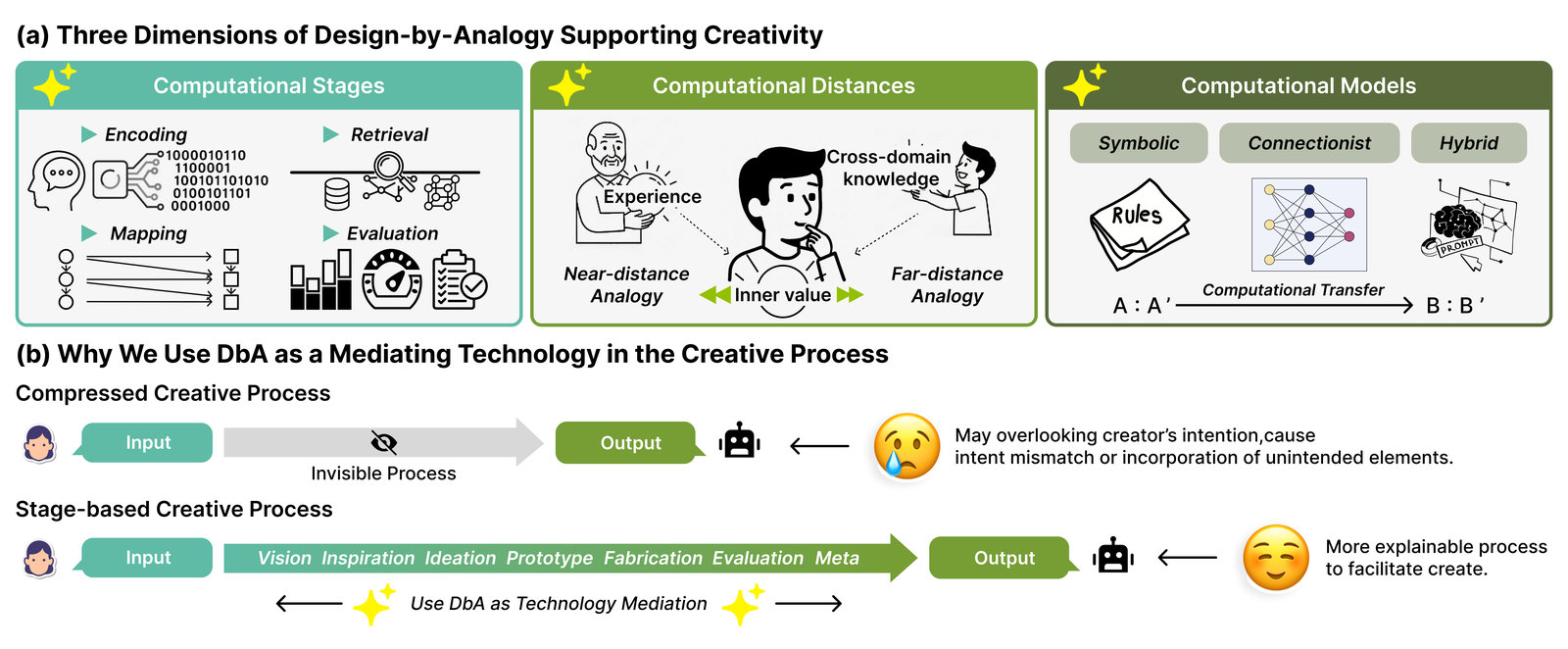
The lower half of the figure is the authors’ critique of creativity tools: if the process between input and output is fully hidden, user intent may be lost along the way. Showing analogy sources and how correspondences are drawn at least gives users an entry point for questioning — rather than only accepting or rejecting a finished product.
Translated into interface design, I would ask the system to account for: why this reference is recommended, which parts can be borrowed, and which parts should not be copied wholesale. The paper calls the tool’s role in shaping understanding and choice technological mediation. A tool can help people find new directions; it can also lead them astray. The name itself does not vouch for either.
02 The same problem needs a different description to find different references
The authors summarize six forms of analogy representation; see Figure 2. Semantic and textual forms focus on conceptual relations; visual and appearance forms on shape, color, and style; material and structure on physical properties or construction. The difference is not file format — it is what the system treats as transferable knowledge.
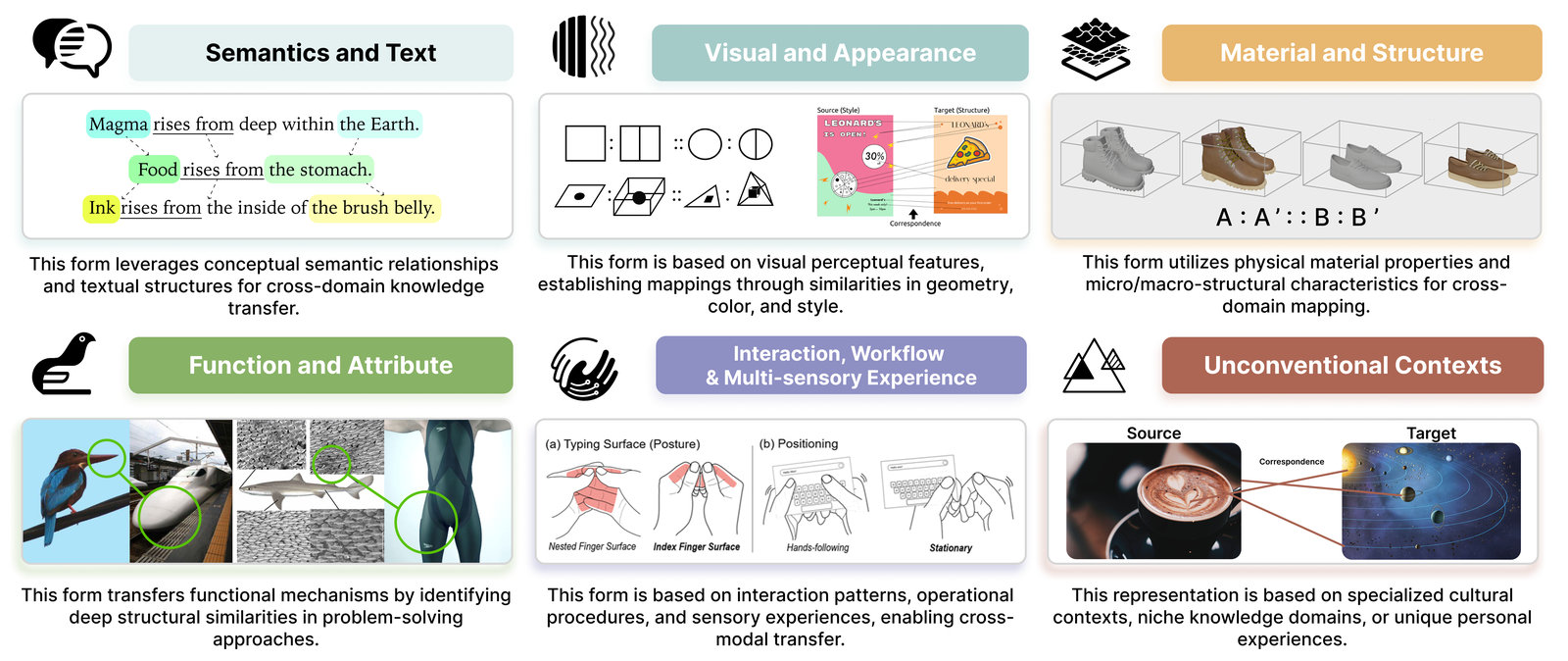
Three further forms widen the search: function and attributes care about what problem something solves; interaction, workflow, and multisensory experience care about how action unfolds; unconventional situations bring local knowledge, cultural context, and personal experience into the pool of references. The six can overlap; studies are not forced into mutually exclusive boxes.
Anther, discussed in the paper, retrieves craft video tutorials across domains. What can be borrowed is a method of doing, not only whether two objects look alike. If a corpus keeps only finished photos and drops the making process, the system may match appearance and still fail to hand useful experience to the user.
Given the same user request, if the system always searches by visual similarity alone, the directions on offer stay limited. Following this typology, I would add a product choice: this time, borrow appearance, operation, or function? Let people change the search basis first, then decide whether to give them more results.
03 Sometimes find more references; sometimes help people converge
Analogy is often placed at the start of brainstorming; the authors instead situate it across four phases and seven stages. Figure 3 runs left to right through problem definition, ideation, implementation, and evaluation. The first two columns each have two stages; implementation maps to making; the last column further distinguishes product evaluation from broader process management.
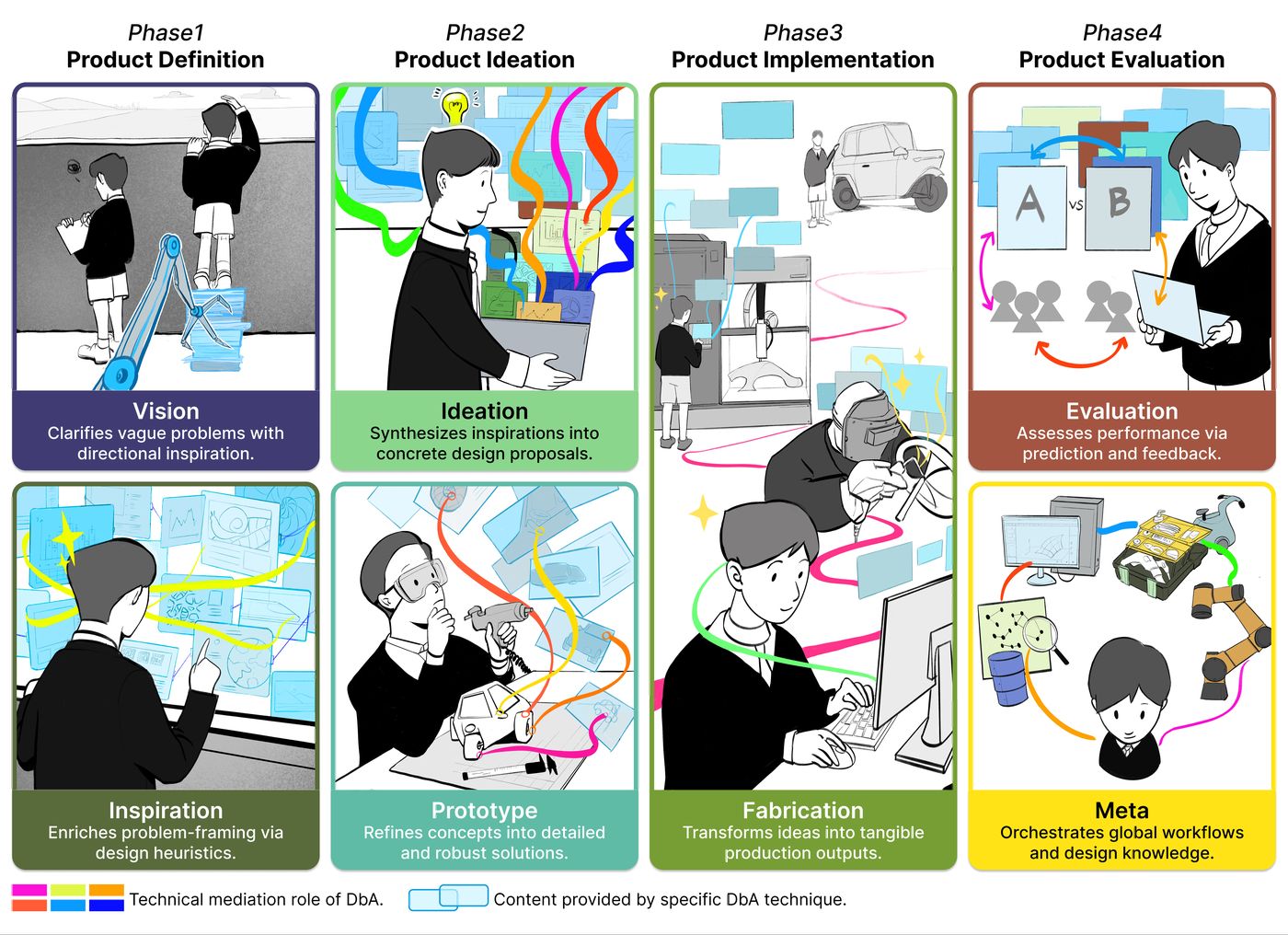
Concretely: Vision helps clarify direction; Inspiration expands references; Ideation gathers scattered cues into usable options; Prototype continues into detail; Fabrication makes the idea real; Evaluation checks outcomes; Meta coordinates cross-domain knowledge and workflow. It is a map for organizing research, not a mandate that every design project mechanically walk all seven steps.
Across these seven stages, the help users need changes. When the problem is still unclear, an example from an unfamiliar domain can shift the angle; once a direction is chosen and prototyping begins, flooding in many new ideas may not fit. What is needed then is judging which details can land and which constraints are still unmet.
The paper especially notes that, at the ideation stage, existing techniques skew toward divergence and give less attention to converging design decisions. That is what I care about: generating ten versions is easy to show; helping someone abandon nine with reasons requires knowing why they are doing the project. The latter cannot be solved by a “more options” button alone.
04 Crossing farther does not make inspiration automatically more useful
The authors distinguish near and far analogy. Near analogies come from more familiar or adjacent domains; far ones cross larger knowledge gaps. Far references can disrupt habitual thinking, but turning them into usable options also needs more explanation. Unfamiliarity itself is not creative value.
Drawing on prior work, the paper suggests novices may need clearer structure and nearer materials; experts early in exploration may benefit from more abstract, farther cues, then borrow concrete experience once refinement begins. The “may” matters: task goals, experience, and individual differences all change the choice — people cannot be split into two types with a permanently fixed recommendation strategy.
Figure 4 shows several borrow styles: (b) migrates interaction behavior from a source website into target development; (d) transfers style across vector graphics; (f) uses analogy sketches to support design exploration. These are not tools ranked against one another in one test — they show that what is analogized, and where users can intervene, can differ greatly.
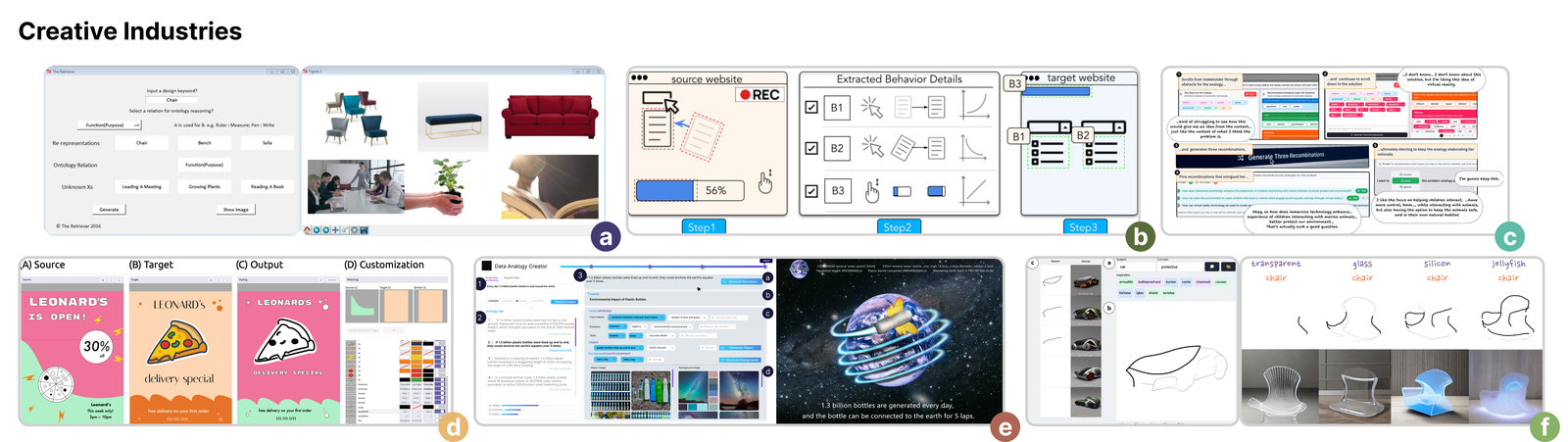
The authors recommend graph structures, tree views, and interactive canvases to put mappings in front of users. On that basis, I would let users edit a correspondence that does not hold, and step back to change the source. Otherwise the reference changes, but users still can only continue along a path the system has already arranged.
05 Borrowing an idea is not the same as borrowing a way of working
Figure 5 brings analogy onto the shop floor. Cases include BioSpark’s bio-inspired design, case-based design-to-manufacture flows, and Anther’s cross-domain craft knowledge transfer. In these tasks, designers still must judge whether a borrowed practice can fit the materials, tools, and operating conditions at hand.
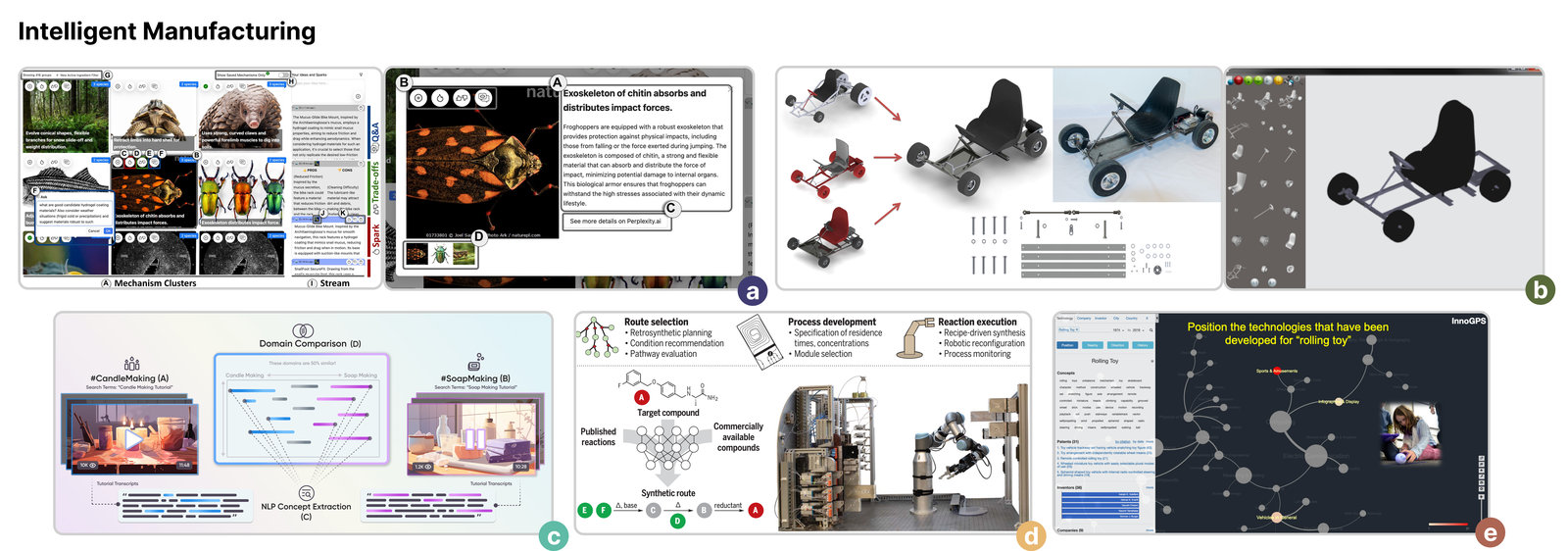
The authors note that fabrication-stage research is relatively thin; one barrier is that shop-floor experience is hard to record. Skilled workers know when to adjust tools, materials, or operations, but that know-how may never have been written as rules a system can retrieve. Storing only final parameters also may not keep why those parameters were chosen.
So the paper suggests knowledge representation should include not only parameters but operation trajectories, causal relations, and phenomena, and that mapping rules need domain experts to help write and revise them. For manufacturing tools, showing a novel form is only a start; process conditions and manufacturability still need separate checks. The authors discuss these risks without offering a validated general safeguard.
Education faces similar limits. Pedagogical Prisms, cited in the paper, tries to design analogies from backgrounds and experience students already know. Familiarity can aid understanding, but borrowing still requires checking the target concept. I would separately check two things: whether students find the metaphor friendly, and which relations they actually understood. Good feedback on the former does not settle the latter.
06 This survey can guide design — it cannot guarantee effects
Screening followed a PRISMA process; the report keeps 85 papers from 1,615 initial records. Two researchers independently coded with a 17-dimension guide; mean Cohen’s κ is reported as 0.7289. That metric checks agreement on classification — it does not measure creativity tools’ real-world effects.
Inclusion criteria also shape what the survey can answer. The authors excluded work that only validates analogy mechanisms without proposing concrete methods or techniques, and work that uses only non-AI computational methods. So the survey better helps us understand how systems are designed and where they are used — not compute how much more effective design-by-analogy is overall than other methods.
In the research gaps, the authors themselves stress that AI analogy outputs still lack rigorous empirical evaluation for novelty, feasibility, and usefulness. This paper also does not pool the 85 studies into one creativity-gain figure. Putting the cases together surfaces design directions worth trying; it does not turn those directions into already-validated laws.
The paper also discusses corpus bias, over-reliance, and the risk of oversimplifying complex problems. Recommended cases shape what people think of — and can keep some possibilities permanently out of view. I am reluctant to treat a final confirm button as human agency: if users cannot see how references were chosen or how relations were borrowed, that button still leaves them few real decisions.
For people building AI creativity tools, I would first audit the current interface: where references come from, which relations are migrated, and where users can object. If those questions cannot yet be answered, do not rush to add another “generate more” entry. Following this paper’s suggestions, find the step where users can least intervene — then test whether a change truly helps them choose.
Sometimes users lack new references; sometimes they lack a way to adapt a reference until it fits; sometimes they only need to judge whether the option in front of them should stay. Those should not all be crushed into one generation request. The paper unfolds that work again; which help works for which task still has to be tested case by case.
Paper informationOriginal title: Beyond Input–Output: Rethinking Creativity through Design-by-Analogy in Human–AI Collaboration. Authors Xuechen Li, Shuai Zhang, Nan Cao, and Qing Chen, all from the College of Design and Innovation, Tongji University; Qing Chen is corresponding author. Published at CHI 2026. Paper link: https://doi.org/10.1145/3772318.3791403
Key termsDesign-by-analogy (DbA): mapping knowledge or relations from a source domain onto a target design problem. Representation: deciding whether knowledge is described via appearance, function, process, and so on. Design fixation: remaining constrained by existing examples or lines of thought and struggling to explore other directions. Technological mediation: tools participate in shaping understanding, judgment, and action — they do more than pass input to output.
ReferencesLi, X., Zhang, S., Cao, N., & Chen, Q. (2026). Beyond input–output: Rethinking creativity through design-by-analogy in human–AI collaboration. In Proceedings of the 2026 CHI Conference on Human Factors in Computing Systems (CHI ’26) (pp. 1–20). Association for Computing Machinery. https://doi.org/10.1145/3772318.3791403