CHI 2026 | Without Blocking Friends, Can AI Soften Only the Details That Hurt?
Want to keep friends’ posts while avoiding details that hurt. DIY-MOD tries transforming content on the receiver side; two rounds of user research also exposed inconsistent preferences, changed original meaning, and generation failures.

Want to see friends’ dinner photos, but not the food on the table. In the paper’s interviews, one participant with an eating disorder had exactly that struggle: they hoped to know who friends met and where they went, yet found it hard to accept food in the photos. Blocking the whole post also erases the social information they value.
For the platform, this may be a perfectly ordinary photo. For this person, what needs handling may not be the whole photo either. They want to keep friends, scene, and the moment of gathering — only reduce the details they cannot bear right now. Asking friends not to post, and asking to see in a different way, are two different requests.
This CHI 2026 paper introduces the browser extension DIY-MOD, which lets readers themselves decide which details to change and how. Rather than rushing to delete the whole post, first ask whether any part is worth keeping. But once AI has rewritten an image for you, can you still know what originally happened?
01 Not wanting to see it yourself is not the same as asking others not to post
Researchers first interviewed 12 people with different content-sensitivity experiences. What troubled them did not all fall into categories platforms usually handle. Someone after a miscarriage found it hard to face pregnancy announcements; someone found jewelry against skin hard to accept; others cared about ethical meanings behind particular foods. The same labels cannot hold these differences.
Sometimes detail matters more than category. The participant sensitive to jewelry also distinguished metal materials, piercing jewelry, and whether jewelry touched skin. Adding only a “jewelry” keyword easily blocks too broadly; only looking at whether the object is in the image may miss the presentation that truly hurts them.
Figure 1 shows the system’s approach: for the same food-related filter need, a dinner photo can remove food on the table while keeping people; a photo whose subject is food can reduce realism. Content on the right appears in the user’s own browser; others still see the original post. This is a system example, not a demonstration of therapeutic effect.
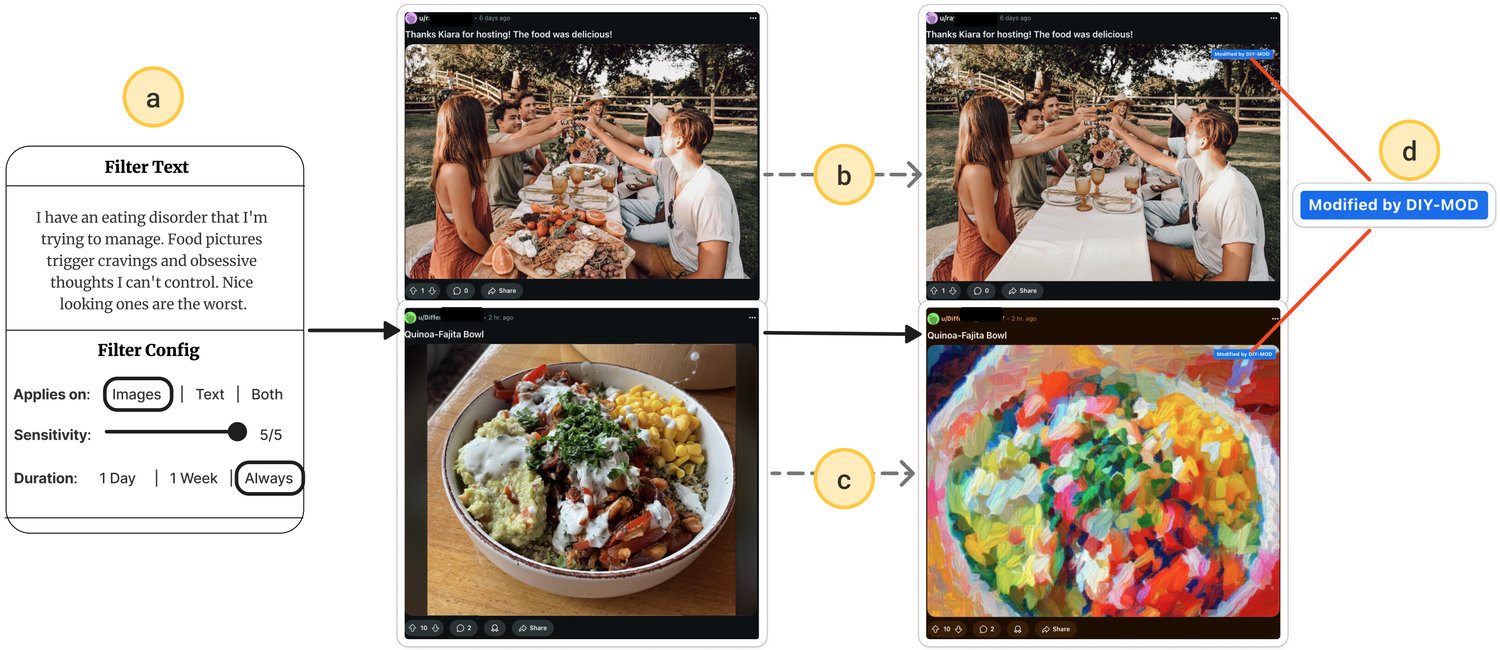
What the authors discuss is content that can be posted normally yet may distress particular people. Personalized rewriting gives receivers more choice, but the authors do not claim it should replace removing illegal content. Governance responsibility platforms themselves should bear remains another matter.
02 A filter rule must be speakable — and reversible
Users can describe needs in natural language or provide image examples. When the system meets vague phrasing it keeps asking. The left side of Figure 2 is the process of narrowing a broad topic step by step to specific content types and visual features. It allows users to write exceptions — for example, not wanting close-ups, but accepting very small, distant figures.
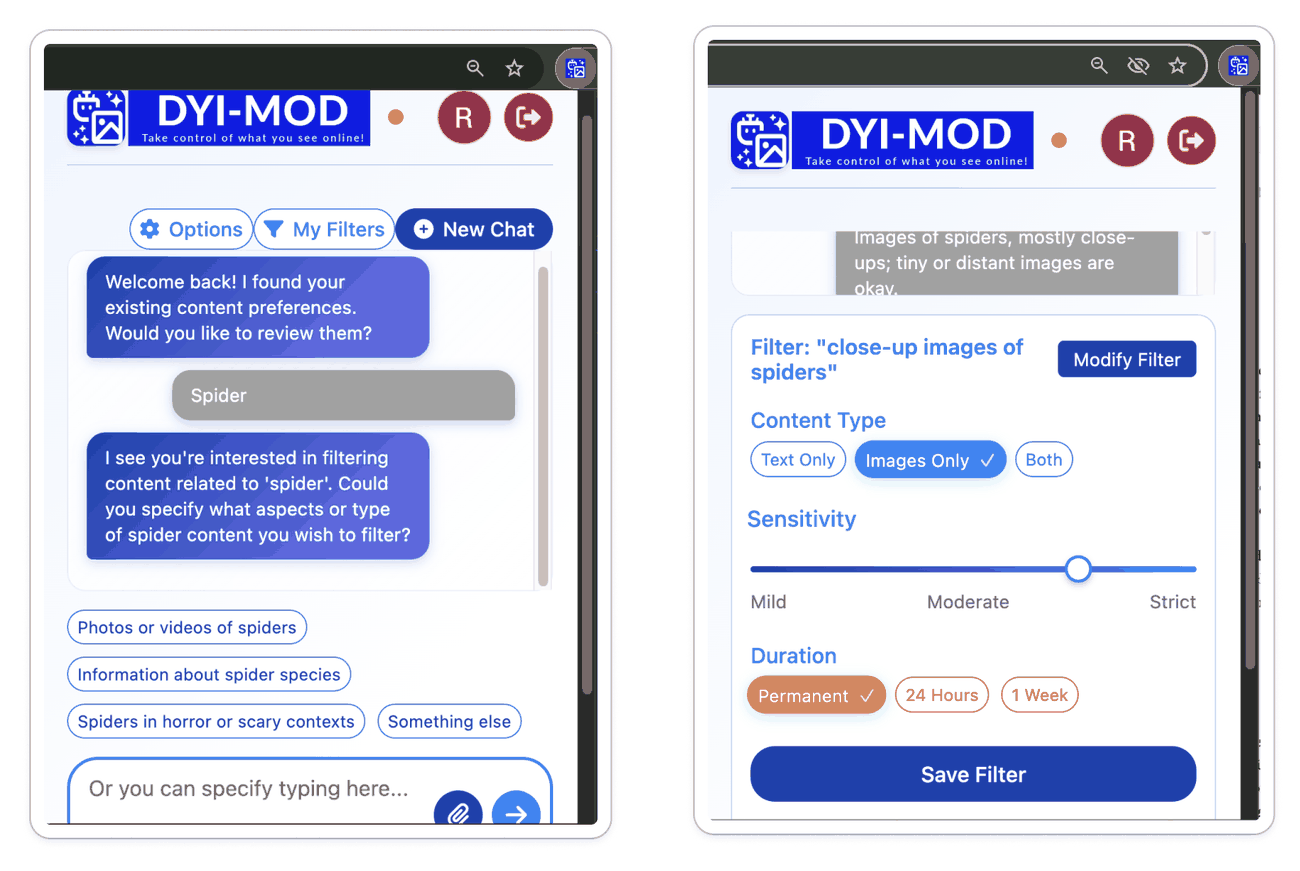
The right-side configuration has three kinds of control: whether it acts on text, images, or both; sensitivity level; and duration. Duration can be 24 hours, one week, or ongoing. Sensitivity here expresses how intense the user’s discomfort is when encountering related content — it is not a guarantee of system recognition accuracy.
Researchers also kept an entry to view the original post and marked processed content. Trial users cared a lot about these controls. Some felt the change was too heavy and would open the original; some only hoped not to suddenly see sensitive content while casually scrolling, while still keeping the option to look actively. Users being able to reverse at any time is what keeps them from being trapped by rules they set earlier.
Settings default to local storage, and can also be used anonymously and export filters. But local settings do not mean content analysis and generation all happen locally — the latter still depends on servers and commercial models. Filters may also involve very private experiences; participants were willing to share with trusted people, yet not necessarily willing to publish their full list.
03 Looking more natural is not necessarily more faithful to what happened
Figure 3 processes the same dinner photo into several versions: removing a local object, replacing with something else, blurring, whole-image stylization, and stylizing only part of the region. Putting these results together makes clear why one “filter strength” slider cannot summarize all trade-offs.
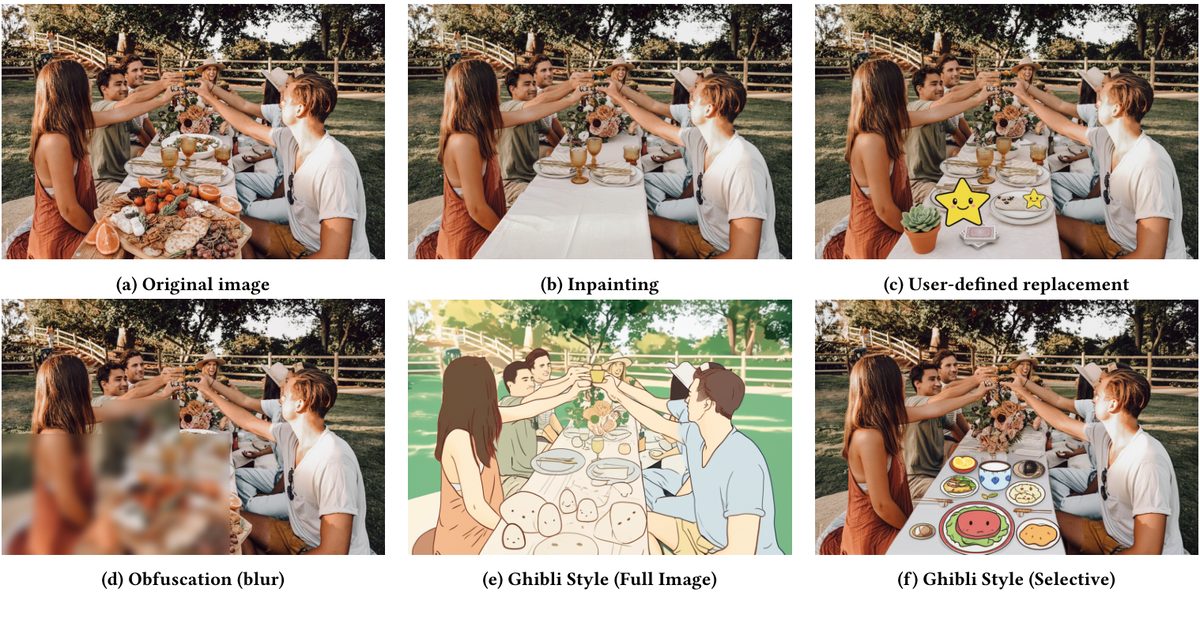
Blur keeps a trace that “something was here,” yet outlines may still make people uncomfortable. Local inpainting can make the scene look natural, yet also generates a scene that did not exist. Animation may lower realism while changing the photo’s tone. Looking easy on the eyes, reducing sensitive detail, and keeping original meaning cannot always be achieved together.
So besides checking whether the edit looks natural and whether original meaning is preserved, the authors also check context risk. A style that fits everyday dinners does not mean it also fits reporting on war or racial violence. Making serious content cute and light, even if visually easier to accept, may also dilute the event itself.
I care more about the boundary here: helping readers get through should not automatically obtain license to rewrite facts and attitude for the original author. The paper lists how authors view these edits as a follow-up question. What has been collected so far is receivers’ use experience — it cannot establish that posters also agree with such presentation.
04 The model’s top-ranked option is not always what users pick
DIY-MOD does not try every edit on every post. Stage one in Figure 4 first matches user rules and filters more promising candidates, usually leaving 3; stage two generates in parallel, then compares results. In the paper’s implementation, GPT-4o handles screening and scoring; semantic edits and stylized images are mainly generated by Gemini 2.0.
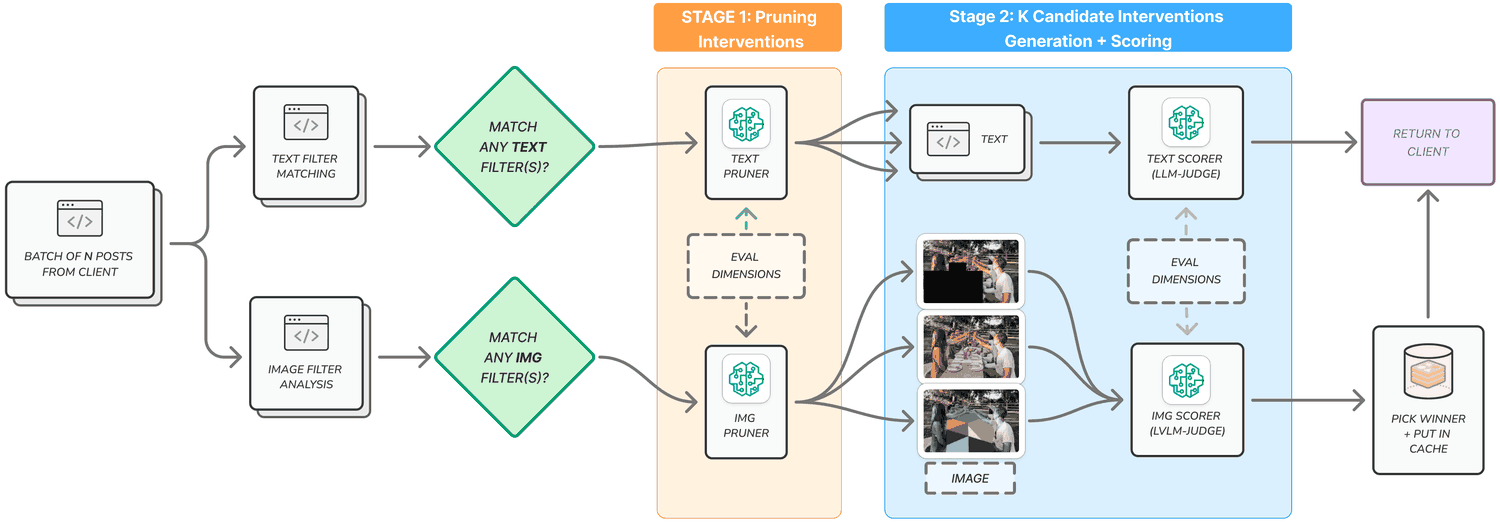
Scoring considers whether the edit looks natural, whether original meaning is kept, whether it is expected to reduce the user’s discomfort, and whether there is inappropriate context change. The last item deducts points. The authors use different models for generation and scoring to reduce the risk of a model favoring its own output. As for emotional safety, this step only gets the model’s prediction — it has not measured users’ actual feelings.
So the authors ran two rounds of user research. Round one had 15 people set filters while browsing and narrating feelings in their own Reddit feeds, about an hour each. Three of them had joined earlier interviews. The limit of short browsing is direct: some people did not naturally encounter related posts, and different edits did not get balanced experience.
Round two invited 12 people from round one back; each compared 10–15 posts related to their rules, about half an hour. Each time two edits were shown side by side: the system’s top-ranked option, and one randomly chosen from ranks 2–5. Left–right positions were randomized; participants expressed preferences for text and images separately.
The statistical model estimated that the probability users chose the system’s preferred option was 63% for images and 79.1% for text. Ranking indeed came closer to user preference than randomly picking a higher candidate, but disagreement on images was still substantial. These two numbers answer which of two edit options people prefer more — they cannot be taken as filter accuracy or safety rates. This comparison also cannot answer whether rewriting beats blocking, still less infer long-term mental-health improvement.
05 After blocking details, do not leave people forever guessing what is hidden there
In preference interviews, two reactions are easy for designers to miss. One participant felt blurred text made them want to know the original more; another disliked seamless removal, because they always felt something was being hidden and began filling in by imagination. Details were covered, yet people did not necessarily stop attending to them.
Sometimes a note explaining why something is hidden is more useful than an unexplained blur; others prefer an artistic version that keeps enough scene information — knowing what happened, so they need not keep guessing. The authors summarize that experience of being able to stop pursuing as cognitive closure.
The same person’s choices also change with a post’s purpose. One participant wanted animal-harm photos they casually scrolled into fully covered, but for related case news they had been following preferred a painted version with reduced detail. Whether content is useful, and whether they want to keep learning right now, changes the standard for “handled well.”
The current selector mainly models from filter descriptions; it does not yet explicitly represent this cognitive closure, nor fully grasp the user’s present reading purpose. With only one long-lived filter rule, it can hardly tell whether this time is casual scrolling or the user tracking something. However many styles are available to choose, they cannot decide for the user whether this post still needs to be understood.
06 Having an edit mark does not mean sensitive detail has already been removed
The appendix adds another set of results beyond user preference. Researchers spot-checked 75 pieces of already-marked text content and 75 images. All text completed edits; of the images, 66 had visual changes, and another 9 were unchanged or changed the wrong region. Of those 66, 62 matched the corresponding user’s filter description.
This is not a complete detection-rate test over all browsed content. Spot-checks started from posts the system had already marked; they did not compute all misses from that. The roughly 89% overview in the main text is also less clear than the appendix’s 66/75 and categories. Still less can “the image did change” be taken directly as “already meeting this person’s need.”
What worries me more is what happens on failure. The appendix states that when all candidates fail to generate, the system keeps the original content while still adding a hint mark. The authors interpret that as a cue reminding users to avoid it. But the original image may still appear; if readers take this mark as already handled properly, they will overestimate protection.
Speed also has bounds. As Figure 5 shows, first loading a batch of typically 25 Reddit posts takes about 5–15 seconds on the critical processing path; image generation continues in the background, with the client polling for results. Cache and prefetch can reduce later waits, but this number cannot be read as every image finishing within 5–15 seconds.
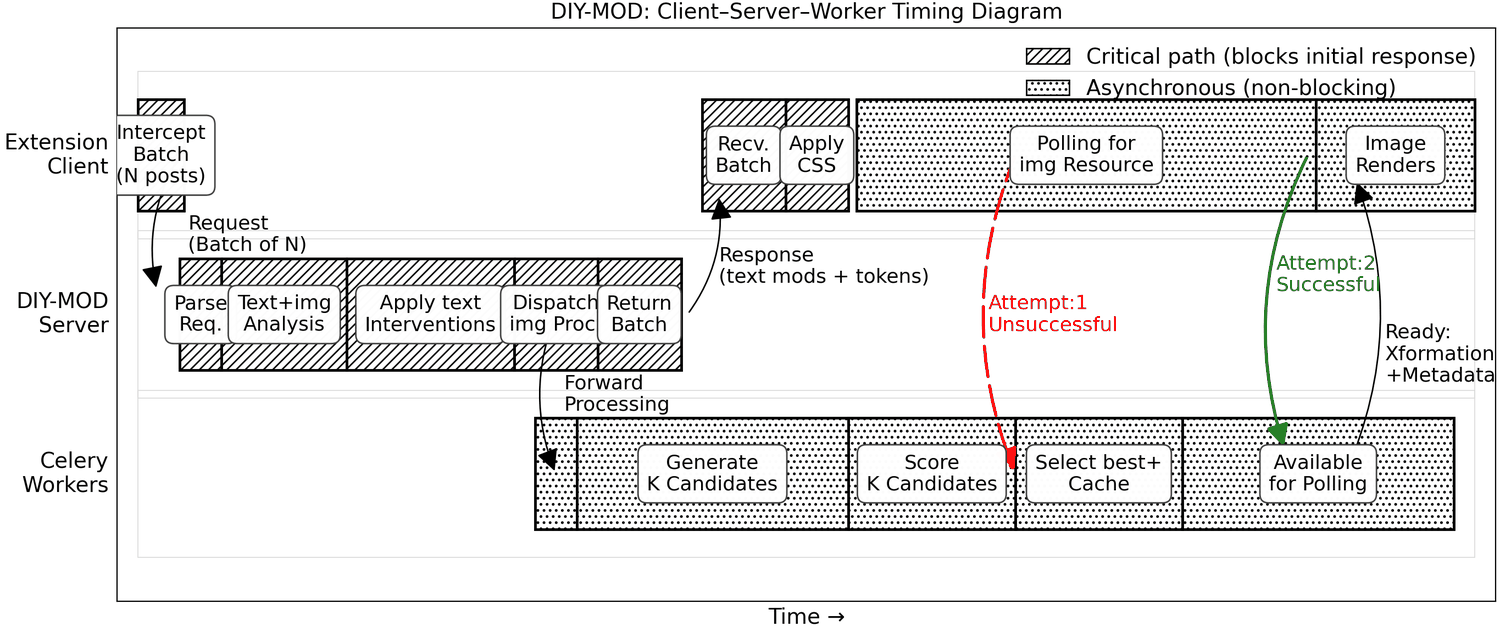
So I would split “matched a rule,” “edit succeeded,” and “processing failed” into clear states, and keep user choice for how to display content on failure. That is a design requirement extended from problems the paper surfaces — not a feature it has already finished. Compared with making every image look polished, first making clear which protections did not take effect is more urgent.
This system currently supports text and images on Reddit; user research was small and short, with no clinical efficacy evaluation. Whether long-term use helps people maintain connection or may solidify avoidance, the authors likewise leave as an open research question. Back to the participant who wanted to see friends’ dinner photos: they wanted to see fewer details, yet did not intend to disconnect from friends. DIY-MOD tries to keep the second half; how much of the first half it can achieve still needs checking post by post.
Paper informationOriginal title: What If Moderation Didn’t Mean Suppression? A Case for Personalized Content Transformation. Authors Rayhan Rashed, Farnaz Jahanbakhsh, both from the Computer Science and Engineering Division, University of Michigan. Published at CHI 2026. Paper link: https://doi.org/10.1145/3772318.3790495
Key termsReceiver-side transformation: Modifying the version the user sees, without changing the original post others receive. Local inpainting: Removing or replacing an image region and generating connecting background. Semantic fidelity: How far edits retain original facts and context. Cognitive closure: Used in this paper for the experience of gaining enough explanation or complete presentation so one need not keep guessing what was hidden.
ReferencesRashed, R., & Jahanbakhsh, F. (2026). What if moderation didn’t mean suppression? A case for personalized content transformation. In Proceedings of the 2026 CHI Conference on Human Factors in Computing Systems (CHI ’26) (pp. 1–22). Association for Computing Machinery. https://doi.org/10.1145/3772318.3790495