CHI 2026 | When AI Speaks in More Detail, Why Do Users Also Say More?
A picture-matching collaboration experiment with 267 people found that when agents give fuller cues, people spend less effort listening to instructions — yet when they speak, they also give more detail. What matters is not only how much is said, but what is said and what both sides can see.

There are two circles on the screen. The AI says: click that circle. You have to look back and forth between the two options. If it adds “the green one,” things get much easier. Those few words do not sound advanced, yet they decide whether the system states the target clearly or leaves guessing to the user.
Next it is your turn to describe an object. If the AI just saved you effort, will you also say less? This CHI 2026 paper observed another direction: collaborating with a more fully describing agent, users also bring more detail when they speak — especially in scenes where they originally need not say so much.
The same person switching roles also changes the effort they pay. Listening to instructions takes less care; when it is their turn to speak, they give a bit more detail. If you only count how many words the AI output, or what score users gave, you will not see both happening at once.
01 This collaboration only changed wording — it did not swap models
The study had participants play a picture-description and matching game with a voice agent. The screen is a nine-grid; five positions hold shapes composed from form, color, and texture. Participants alternately describe a framed target and click a target from the agent’s voice, completing 24 descriptions and 24 matches in total.
The final analysis included 267 British-English native-speaking adults facing agents that were relatively over-informative, minimally informative, or under-informative — group sizes 89, 90, and 88. Here “effort” does not mean how long the model computed, but how many and what kind of recognition cues the agent gave when speaking.
The agent did not call a large model live. Researchers simulated interaction with prewritten scripts and a unified synthetic voice, ensuring the wording each group heard was controlled. So this is a communication-strategy experiment — it cannot rank models. The experiment also forbade location descriptions such as “upper left,” requiring participants to describe object features.
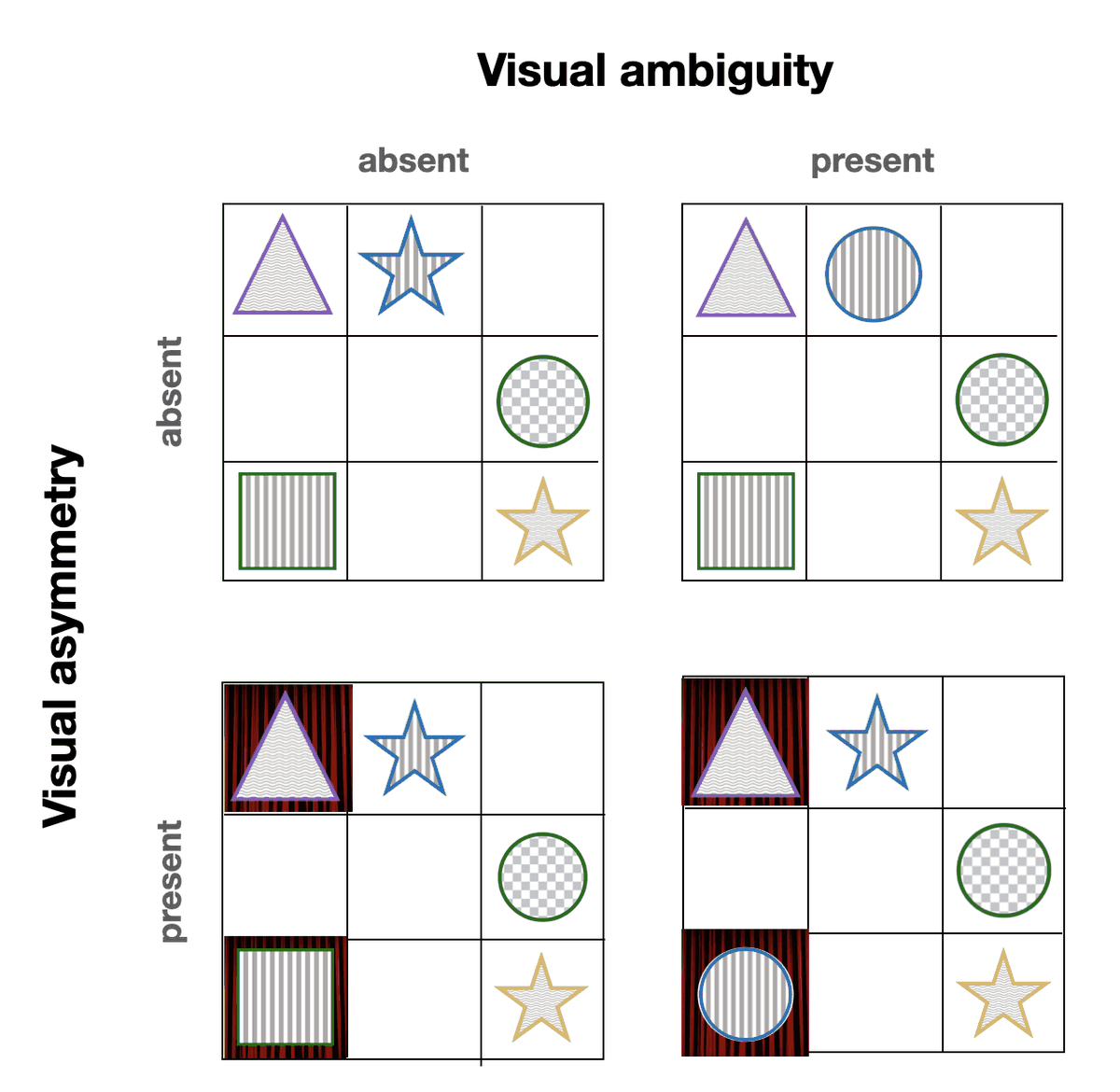
Figure 1 shows four scenes when participants listened to instructions. Horizontally, whether another same-shape object creates ambiguity; vertically, whether there is an object visible only to the participant that the agent cannot see. The curtain in the figure marks that perspective difference. The two factors were manipulated separately so researchers could see whether people were identifying objects or also judging what the agent could see.
02 An “extra” color may be the cheapest cue
First consider when there is only one circle in the scene. Saying “click the circle” is already enough; the more informative group still says “click the green circle.” By the requirement of uniquely determining the target, color is redundant; by how people search the screen, it may help you find the thing faster.
When another circle is also visible, the three groups differ. The more informative group says “the green circle,” the minimal group says “the checkered circle,” and the under-informative group only says “circle.” The first two can both distinguish the target — they just use different cues. What is compared here includes both information amount and whether features are easy to recognize — it cannot be explained only as a word-count effect.
In Figure 2, when a competing object appears in shared view, mean target-selection response times for the three groups are about 1059, 1397, and 2345 ms, in order over, min, under. What the agent left unsaid became the pause before the user chose. Over, min, and under in the figure represent these three groups.
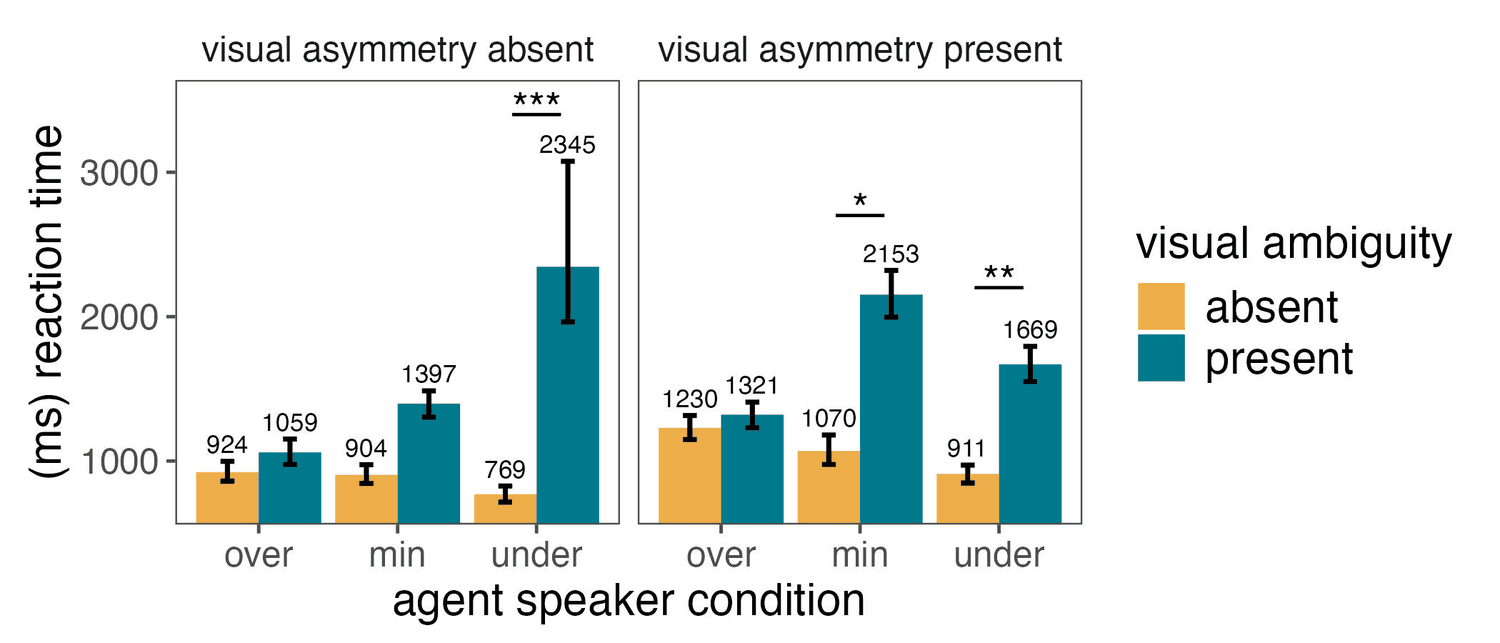
This time has an important limit: researchers subtracted the duration of the agent’s own speech. So it reflects adjusted selection time, not total dialogue duration for the whole round. Saying a few more words can reduce later search — that does not mean that after counting speaking time as well, the whole flow necessarily shortens by the same amount.
03 When both circles are visible, saying only “circle” turns selection into a guess
Slower response is not the whole story. Figure 3 looks only at trials with competing objects: when both circles are in shared view, wrong-selection rates for the three groups are about 1%, 3%, and 51%. The last group is clearly higher, because “circle” is simply not enough to tell the listener which one. This is not measuring AI hallucination rate — it is seeing what happens when necessary information is omitted.
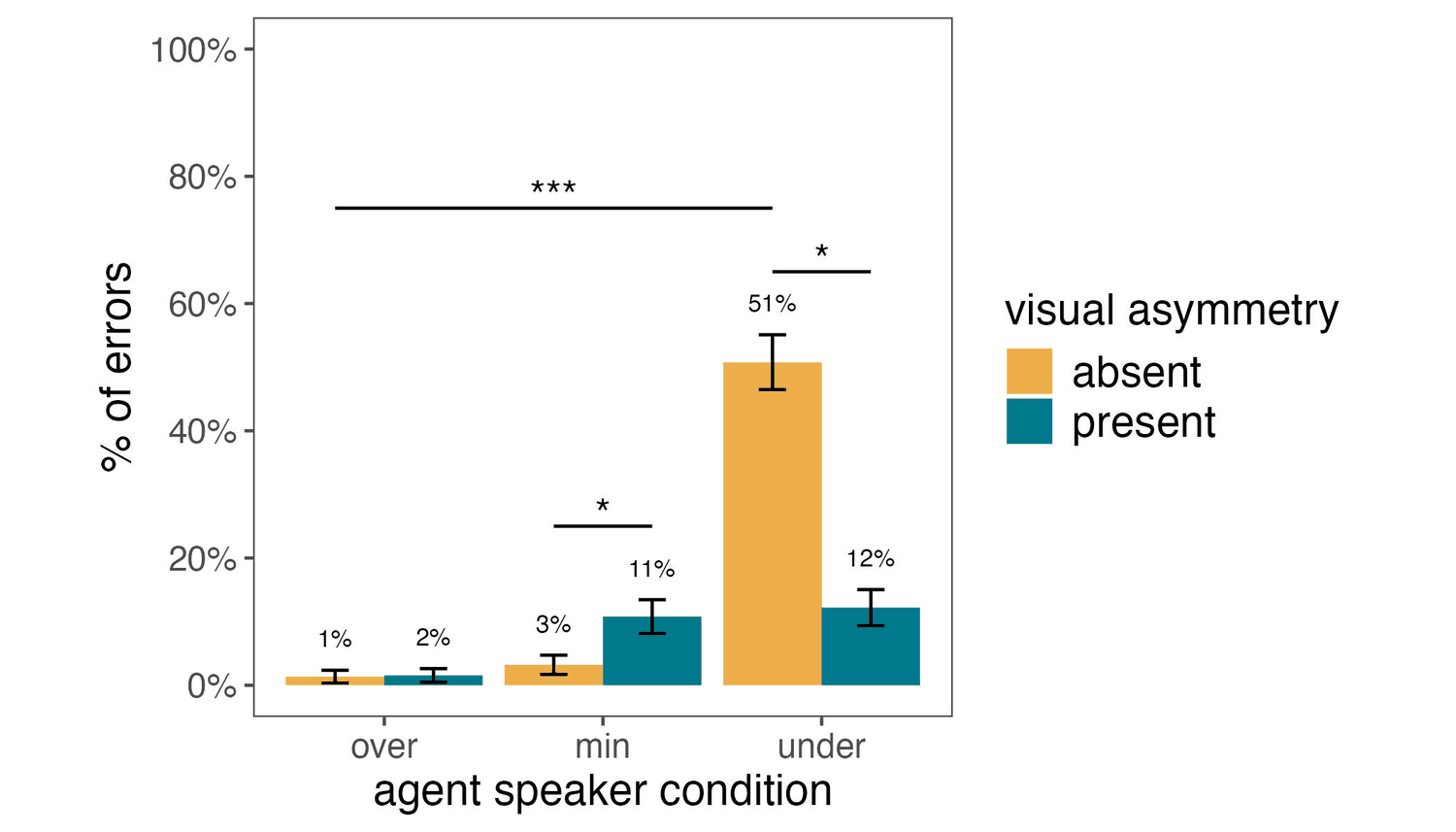
When the other circle is visible only to the user and not to the agent, error rates are about 2%, 11%, and 12%. Users can infer: the agent cannot see the circle in front of the curtain, so it must mean the other one. The group that directly gave color and texture still erred less. Here the min and under groups actually both said only “circle”; group labels refer to overall strategy, not that every round’s line differed.
The same “click the circle,” in the former scene lacks an answer; in the latter can be worked out via the other’s perspective. That difference is useful for design: looking sufficient from the information the system holds does not mean it is equally clear from the picture the user is looking at.
Researchers also recorded whether the mouse moved onto competing objects. They originally planned to analyze dwell time, but 76% of related trials had no dwell, so they switched to a yes/no binary. That metric also showed that when description was insufficient, users more readily moved the cursor toward wrong candidates. Still, it records mouse behavior — it cannot replace eye-tracking or directly measure mental burden.
04 When AI does a bit more, people do not save all that help for themselves
If you only look at the above, the conclusion seems simple: when the agent takes on a bit more description work, users can relax a bit. The paper’s more interesting part appears after the two sides swap roles. People who collaborated with the more informative agent also kept relatively full descriptions when describing objects themselves — they did not compress sentences all the way to the shortest.
In Figure 4’s baseline scene, there is no same-shape competing object and no perspective difference. Mean description word counts for the three groups are 5.63, 4.92, and 4.63, still ordered over, min, under. What is counted here is English words, not Chinese characters. Facing a more fully speaking agent, people also gave a bit more detail even when they could have said less.
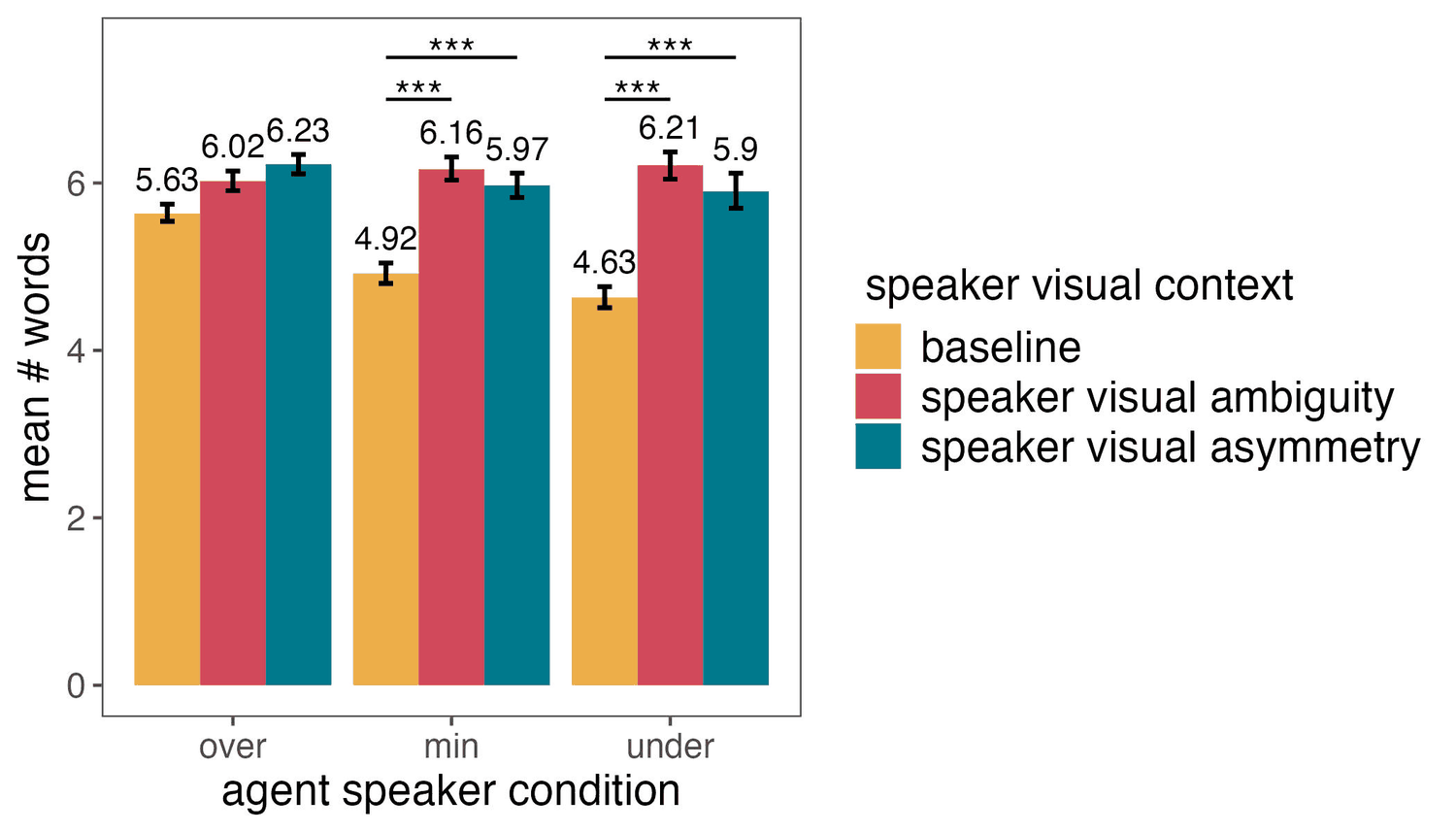
Looking at ambiguous scenes, mean word counts for the three groups are about 6.02, 6.16, and 6.21 — gaps already small. Facing minimally or under-informative agents, users still add description as the task needs, only without always keeping the same amount of detail. As for whether they state all three features — shape, color, texture — agent group also did not significantly change how situation affected that behavior.
A common expectation is: if the other side is less capable, you explain more and fill in for it. This observation instead suggests users also adjust their wording to follow the agent. Questionnaire results afterward especially deserve to be read together: some agents received similar ability ratings, yet users’ description styles facing them differed.
Why say more along with it? The authors discuss imitating the other’s description style and investment in jointly completing the task, and also raise that the game was fairly simple so a few extra words cost little. These explanations have not yet been experimentally separated one by one. Behavioral coordination is visible; whether behind it is reciprocity, language habit, or task strategy cannot yet be concluded for participants.
05 Finding it reliable is not the same as collaborating with it feeling easier
The study also measured people’s views of the agent’s communication ability before and after the formal task. The questionnaire separately excluded 7 low-quality responses, so this part analyzes 260 people and cannot reuse all 267. The scale measures judgment of a communication partner — not satisfaction, and not objective model ability.
In Figure 5, the under-informative agent scored lower. Overall mean scores after the task for the three groups were 4.53, 4.41, and 3.28 on a 1–7 scale. The first two numbers are close: over- and minimally informative groups showed no statistically significant differences on overall score or subscales.
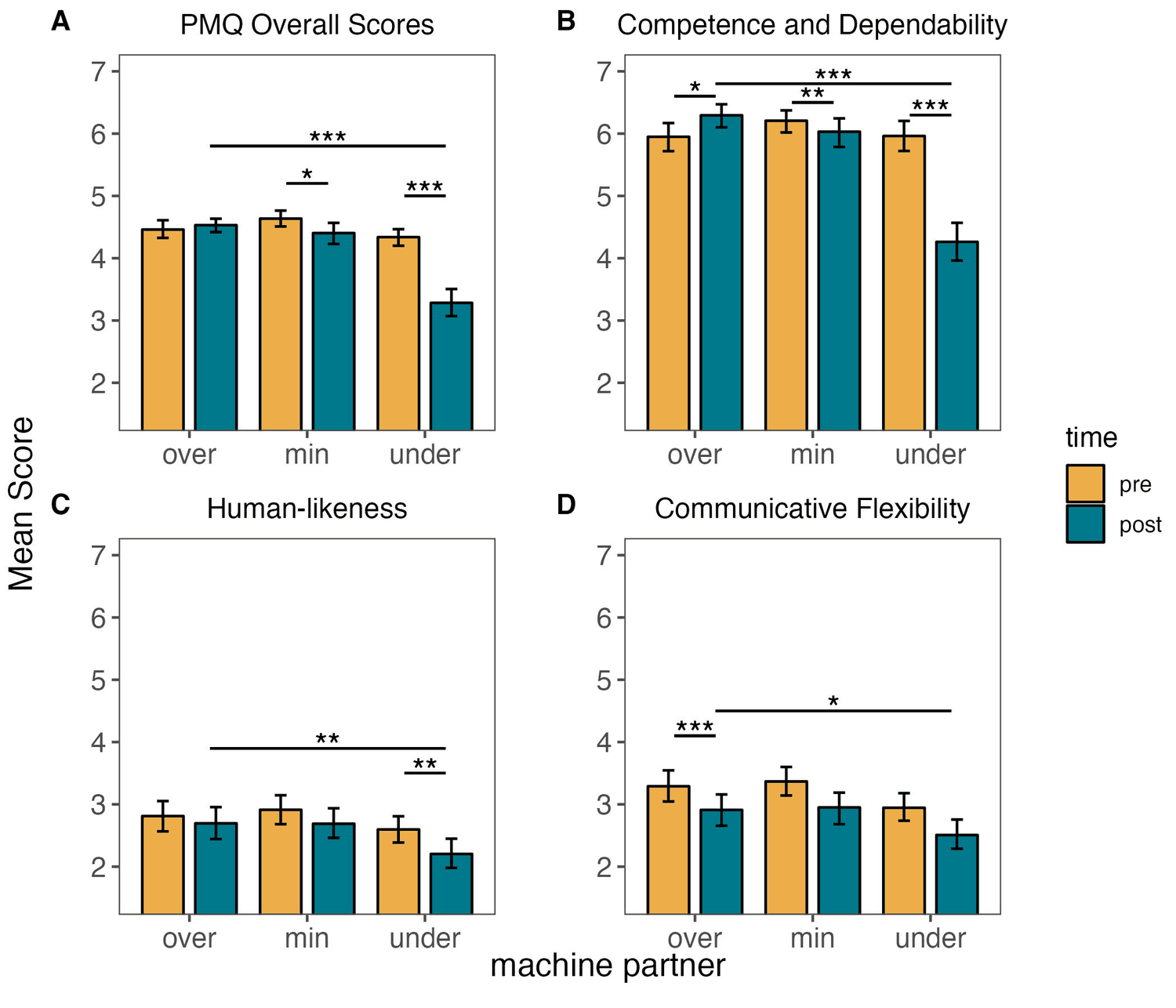
Users’ evaluations of two agents may be close, yet collaborating with one still means more pausing, more identifying, or more handling of perspective difference. Collecting only one post-task evaluation questionnaire easily misses those differences. Of course, no significant difference also does not prove the two strategies are fully equivalent.
I would keep both kinds of evaluation records: how users rate the agent, and how each round they actually find targets and describe. Asking only whether it was usable is not enough; looking only at user input getting longer is also not enough. In this study, the same few extra words mean different things under different roles and scenes.
06 What should be compressed is fluff — not the conditions the other side needs to judge
This study does not endorse long answers. What it mainly manipulated was a few object features — not expanding one sentence into hundreds of words. Color and texture are worth saying more because they help distinguish the target in view. When designing instructions, rather than first requiring shortness, first confirm between which two options the user will hesitate.
For example in remote assembly or visual navigation, the system can first check whether same-type objects appear together and whether both sides see the same content, then decide what to add. From this the paper suggests using over-informative description that varies with situation, rather than reading every attribute every time. Those real scenes are application directions — this experiment did not actually test assembly or driving tasks.
Extrapolation also needs to consider several experimental choices. Participants did not get feedback on whether they or the agent chose right or wrong, could not skip description by pointing to location, and always listened first. In reality, people ask follow-ups, correct, and point for the other side; once those processes join, how description work is shared may differ.
The sample is also limited to British-English native-speaking adults; the task is short, controlled shape matching. The study did not directly measure overall cognitive load, and did not set a human-partner group in the same setting. Comparison with interpersonal collaboration theory comes from existing literature — it cannot be written as the same experiment already proving that human–AI collaboration necessarily follows another set of rules.
I would rather take from this paper a small, concrete check: before deleting “the green one,” see whether the listener has to guess one more time. That a sentence saved a few words cannot alone show that this collaboration saved effort. What also needs looking at together is how the other side then finds, chooses, and — when it is their turn to speak — responds.
Paper informationOriginal title: Help me and I’ll help you: Speakers’ and listeners’ collaborative effort and the division of labour in human-agent collaborative communication. Authors Paola R. Peña, Benjamin R. Cowan, both from the School of Information and Communication Studies, University College Dublin, Ireland. Published at CHI 2026. Paper link: https://doi.org/10.1145/3772318.3790628
Key termsOver-, minimally, and under-informative: Distinguished in this paper by the cues needed to identify a target in a visual scene, also involving description strategies such as color and texture. Visual ambiguity: A competing object with the same shape as the target appears. Perspective asymmetry: Some objects are visible to only one side. Partner model: The user’s judgment of the agent’s ability as a communication partner.
ReferencesPeña, P. R., & Cowan, B. R. (2026). Help me and I’ll help you: Speakers’ and listeners’ collaborative effort and the division of labour in human-agent collaborative communication. In Proceedings of the 2026 CHI Conference on Human Factors in Computing Systems (CHI ’26) (pp. 1–20). Association for Computing Machinery. https://doi.org/10.1145/3772318.3790628