CHI 2026 | Showing AI Debate May Not Build Trust — Transparency Needs to Be Just Right
A 12-person qualitative study shows multi-agent consensus, disagreement, and critique are all double-edged. Users do not want to see all thinking — they want enough information for the moment.

Imagine five AI systems give exactly the same correct answer to one question. The first only tells you the conclusion; the second shows four agents’ individual choices; the next three successively add rationales, a critic, and agent debate.
In principle, correctness has not changed, so trust should not differ much. The experiment was not like that. Some people trusted more after seeing majority opinion; some felt the system was self-checking after seeing a critic pick faults; others, after watching too much argument, suspected the system was trying hard to persuade them.
This CHI 2026 paper catches an easy-to-miss issue: once multi-agent reasoning is placed on the interface, it is no longer only a backend mechanism — it becomes a cue people use to judge whether AI is trustworthy. Those cues can help people think, and can also lead them toward the wrong confidence.
01 The same correct answer can be packaged as five different senses of trustworthiness
Researchers designed five interfaces. V1 shows only the final answer; V2 shows four agents’ choices and majority vote; V3 adds a short rationale for each agent; V4 introduces a dedicated critic that picks faults; V5 lets agents debate over multiple rounds and finally reach consensus.
Figure 1 places the five variants together. From left to right, users see more and more process, and reading cost rises along the way. Researchers did not intend to pick a champion. They treated these interfaces as probes to surface participants’ real judgments about transparency and trust.
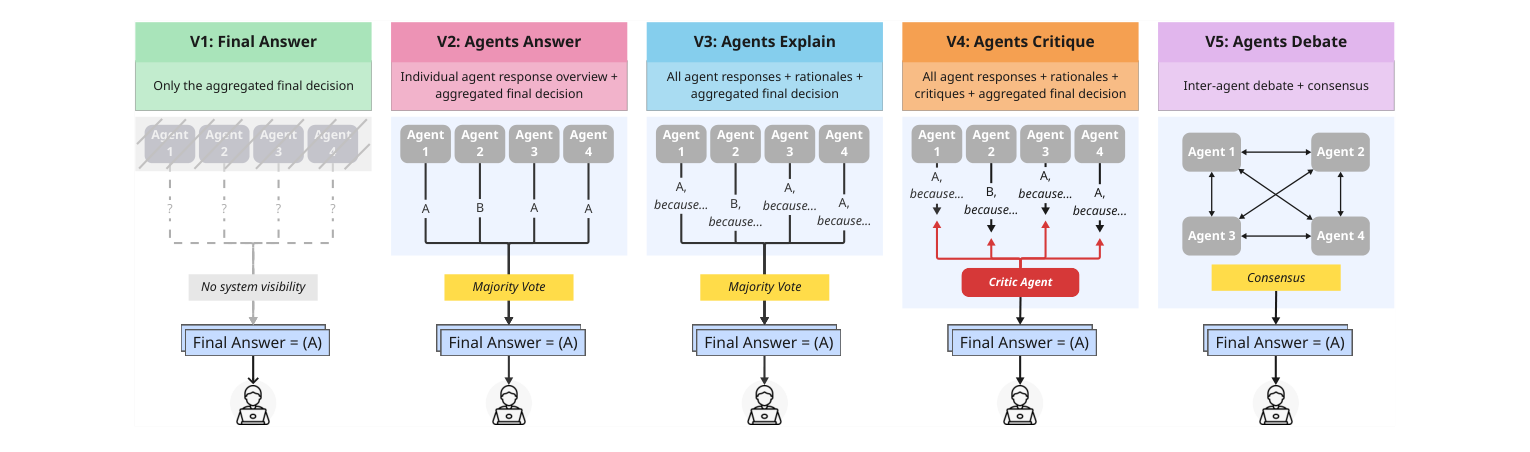
A more important control: all five interfaces’ final answers were identical and correct. Trust differences among participants cannot be simply attributed to who got it right — they come from how people read process cues the interface exposes.
02 The study did not invent five interfaces from scratch — it first dissected 33 multi-agent papers
Authors first retrieved 691 results in the ACM Digital Library, screened down to 92, then added 10 preprints and known works. After full-text screening, they open-coded 33 papers and organized seven interface-design dimensions.
Those seven dimensions fall into four classes: agent count and roles; how visible answers and reasoning are; how disagreement and critique are presented; how agents interact and aggregate a final answer. The five interfaces are five deliberately chosen points in that design space, not an enumeration of every combination.
Then 12 participants, in sessions of about 65 minutes, experienced the five interfaces in turn and completed one factual-query task type and one LSAT-style logical-reasoning task type. Neither required domain expertise, but the latter was more ambiguous and carried higher reasoning load.
Participants did more than rate. They dragged five interface cards onto continuous axes of transparency, helpfulness, and reliability, then explained why they ranked that way. Figure 2 shows before-and-after states of one information-sufficiency ranking.
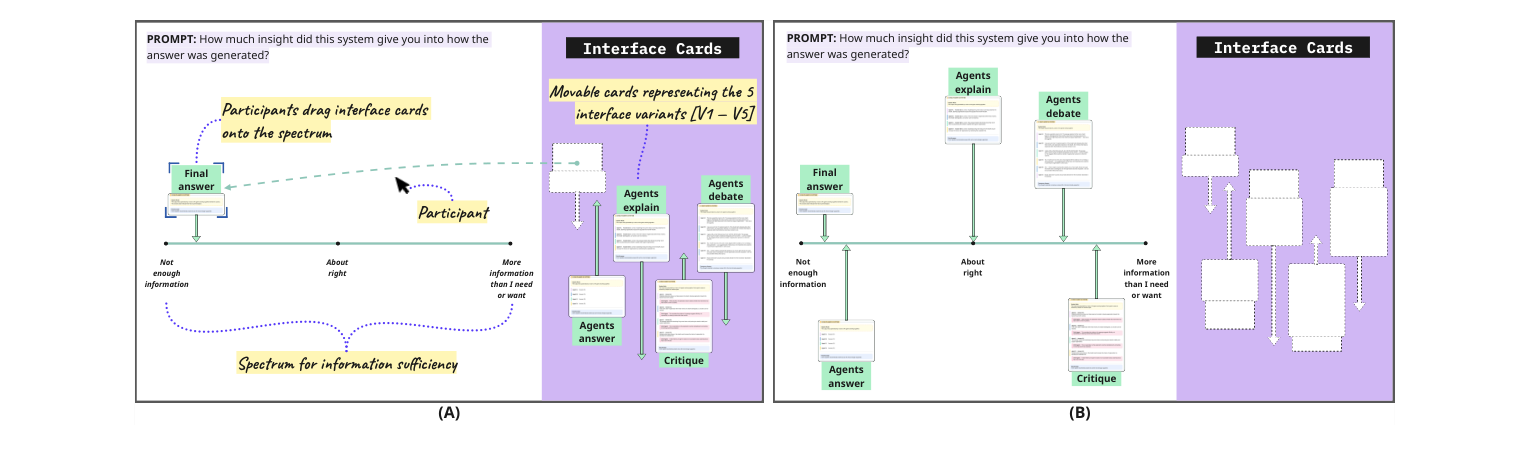
This Comparative Structured Observation is a qualitative, design-oriented method. It is good at surfacing users’ interpretive logic and trade-offs, but is not used to estimate causal effects — every later finding should be read with that boundary.
03 People cast agents as a jury — and casually treat number as strength
Facing multi-agent interfaces, participants actively filled in backend mechanisms. Some imagined an independently voting jury; some thought each agent had a different role; others guessed the system would weight agents differently. Even when the interface did not say, users built a mental model themselves.
Most participants naturally read more agents as stronger and more reliable. Four AIs felt like four people thinking together; eight AIs felt like a larger team. For participants less trusting of AI, more agents also meant more outputs to check.
Here sits a psychological shortcut worth watching: what users see may not be multiple truly independent pieces of evidence, yet multiple avatars and answers on the interface can already borrow the authority of wisdom of crowds. The paper did not verify that large agent counts are more accurate on these tasks, so this subjective sense of reliability cannot be treated as performance evidence.
04 Whether a minority has a reason decides if disagreement is signal or noise
V2 only shows what agents chose, not why. When one of four agents disagreed, most participants hesitated more, and some even wished the interface had not shown that opposition. Disagreement without reasons is only extra uncertainty.
In V3, each agent carries a short rationale. Participants can check whether the minority found a condition the majority missed, or simply took a wrong step. Most people found this version closest to balance between process visibility and reading load. Reasons give people a chance to form their own judgment rather than only accepting the system’s vote.
But majority itself remains tempting. Some participants directly treated majority agreement as evidence of correctness and ignored the minority that lacked enough friends. Some participants realized in interview that majority results could easily persuade or even fool them.
For interface design, showing only a 3-to-1 vote count is not a neutral move. It strengthens the majority’s visual advantage. If the real goal is helping people calibrate trust, the strongest minority rationale should be easier to see — not compressed into a lonely opposing vote.
05 Critics and debate can raise trust — and can make the system look unsure
V4’s critic made many participants feel the system at least knew it could err and was checking itself. Critique also gave raw material for judgment, helping them see weak points in each line of reasoning.
The other side is equally direct. Users must read not only four rationales, but critiques of those four. Some felt the fault-finding proved rigor; others lost confidence in the system’s ability and suggested keeping critique in the background rather than creating excess cognitive noise.
V5’s debate has similar tension. Agents finally reaching consensus can feel like a real discussion happened; on complex logic items it can also show how a wrong line of thought was rejected. But on simple factual queries, long debate can look overdone and even harm trustworthiness.
The cost of transparency is not only a few more paragraphs on screen — it is the system handing the work of checking reasoning to the user. Only when that check is worth it for the current task is more process helpful.
06 What people want is not maximum transparency — it is enough for this moment
The paper uses a Goldilocks zone for that just-right place. When factual queries are simple and users themselves are confident, a concise answer may already suffice. When tasks are more complex, stakes higher, or users lack domain confidence, rationales, disagreement, and critique become more worth expanding. Individual default trust in AI also moves that line.
Eight of 12 participants explicitly wanted progressive disclosure. Give the consensus answer first; when unsure about the conclusion, open individual agents’ rationales, critique, or full debate. The point is not only folding the same transparent content. The interface must first judge what task the user is doing, then let them decide how deep to chase.
Still, just-right only means users feel information is sufficient — not that trust has been calibrated. An interface that happens to show the reasons users want to see may raise subjective trust without helping them catch AI’s mistakes. For people with little domain knowledge, that considerate transparency may even create an illusion of legitimacy.
07 This study found design risks — it has not proven which interface makes people judge more accurately
Evidence from this work suits proposing next-round hypotheses, but cannot support performance conclusions. The sample is only 12 people; tasks are clear-boundary, verifiable factual and logic items; all final AI answers were correct, so the study did not observe whether users can see through majority and consensus when facing real errors.
Also, the experiment fixed a 3-to-1 majority structure; agent count only additionally compared 4 versus 8; it did not systematically vary disagreement ratios, error distributions, or more combinations. Pre-generated, researcher-checked interface content is also not the same as long interaction with real, error-prone multi-agent systems.
Tightening the evidence boundary, what the paper can hold is: users actively treat agent count, explanation, disagreement, critique, and consensus as trustworthiness cues — and all of those cues are two-sided. It has not proven progressive transparency reduces over-reliance, nor that V3 helps people spot errors more accurately. Those are next-step questions for tests with wrong answers and actual decision metrics.
For products, the first step can be simple: stop chasing laying every process in front of users. More worth doing is defaulting to enough information to finish the current judgment, keeping a path to dig deeper, highlighting truly different reasoning paths, and not letting agent count and ornate debate replace verifiable evidence. Good transparent design is not leaving the AI meeting-room door forever open — it is letting users walk in when they need to, and close the door when they do not.
Paper informationOriginal title: Sensemaking in Multi-Agent LLM Interfaces: How Users Interpret Transparency and Trustworthiness Cues
Authors: Saumya Pareek, Jarod Govers, Naja Kathrine Kollerup, Emily Wong, Eduardo Velloso, Jorge Goncalves
Main affiliations: University of Melbourne, Aalborg University, The University of Sydney
Paper link: https://doi.org/10.1145/3772318.3791157
Key termsTrust calibration: Aligning people’s trust in AI as closely as possible with its actual capability — trust when warranted, keep skepticism when error is likely.
Process transparency: Showing users how the system arrived at an answer; in this paper that includes agents’ individual choices, rationales, disagreement, critique, and debate.
Situational sufficiency: Not treating transparency as a volume knob where more is always better, but judging which process information is already enough under the current task, risk, and user state.
ReferencesPareek, S., Govers, J., Kollerup, N. K., Wong, E., Velloso, E., & Goncalves, J. (2026). Sensemaking in Multi-Agent LLM Interfaces: How Users Interpret Transparency and Trustworthiness Cues. In Proceedings of the 2026 CHI Conference on Human Factors in Computing Systems. ACM. https://doi.org/10.1145/3772318.3791157