CHI 2026 | Why Literature Reviews Get Messier — The Switch Between Figures and Text
CrossLit’s user study suggests visual layout suits growing structure, while text suits polishing argument; the real design problem is when to sync the two — and when to stop.

When writing a literature review, many people run back and forth between two desks. One side holds sticky notes, relation diagrams, and paper clusters for probing the field’s structure; the other holds document headings, paragraphs, and citations for turning ideas into testable argument.
Neither side is hard to use; the trouble is they often fail to match. A category just dismantled on the figure still sits as an old section in the document; a new claim already written in prose has not yet landed in the visual space. Maintaining two structures slowly becomes a third job.
The CHI 2026 paper CrossLit does not keep asking whether AI can write the review for people. It asks something more concrete: while ideas are still changing, how can visual structure and textual argument hand off to each other without letting automatic sync destroy what someone has already thought through?
01 A literature review is not a straight line from search to writing
Common tools split the workflow into steps: find papers, then classify, then write. CrossLit starts from the opposite observation: researchers continually walk backward. A new paper may invalidate an old category; a stretch of text that will not come out smoothly may also expose that the original structure never stood.
Figure 1 places that back-and-forth at the system’s center. The left visual editor organizes papers with spatial position, groups, and annotations; the right text editor builds argument with headings, paragraphs, and citations. The two are not merely side-by-side windows — they are two expressions of the same intermediate structure.
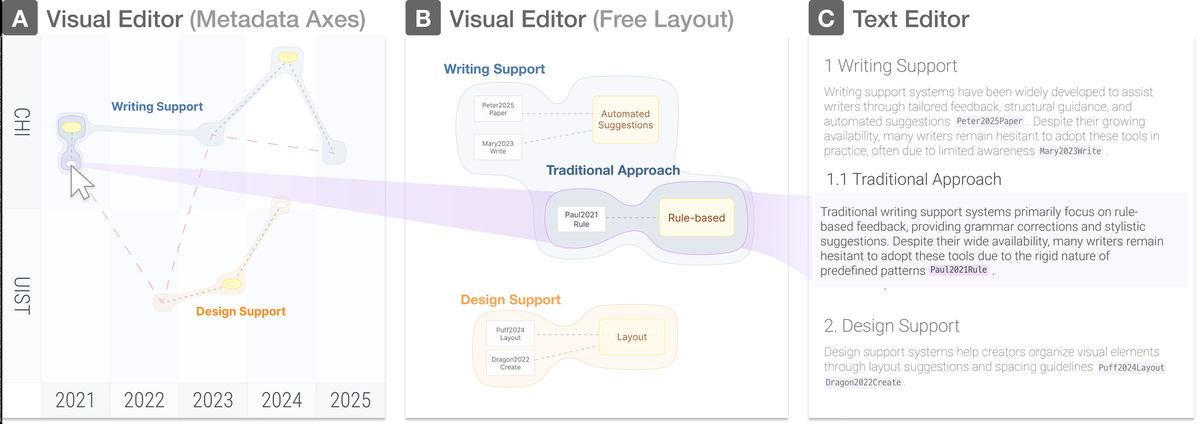
That is also the paper’s most important judgment: visual layout is good at carrying provisional, overturnable relations; text is good at forcing people to fill in order, causality, and evidence. The hard part of reviewing is not choosing one of them, but knowing when to switch expression to think.
02 What syncs is not two copies of content — it is the skeleton behind them
CrossLit builds a one-to-one mapping: groups in visual space correspond to heading levels in text; annotations correspond to paragraph blocks; paper nodes correspond to citations. Moving a paper on the figure updates the text structure; changing section relations in text updates grouping on the figure.
Figure 2 shows this chain with a full scenario: from collecting and classifying papers, to building sections, to revising prose and then adjusting visual structure. Figure 3 is the actual interface, showing how dual editors and paper discovery sit on one work surface.
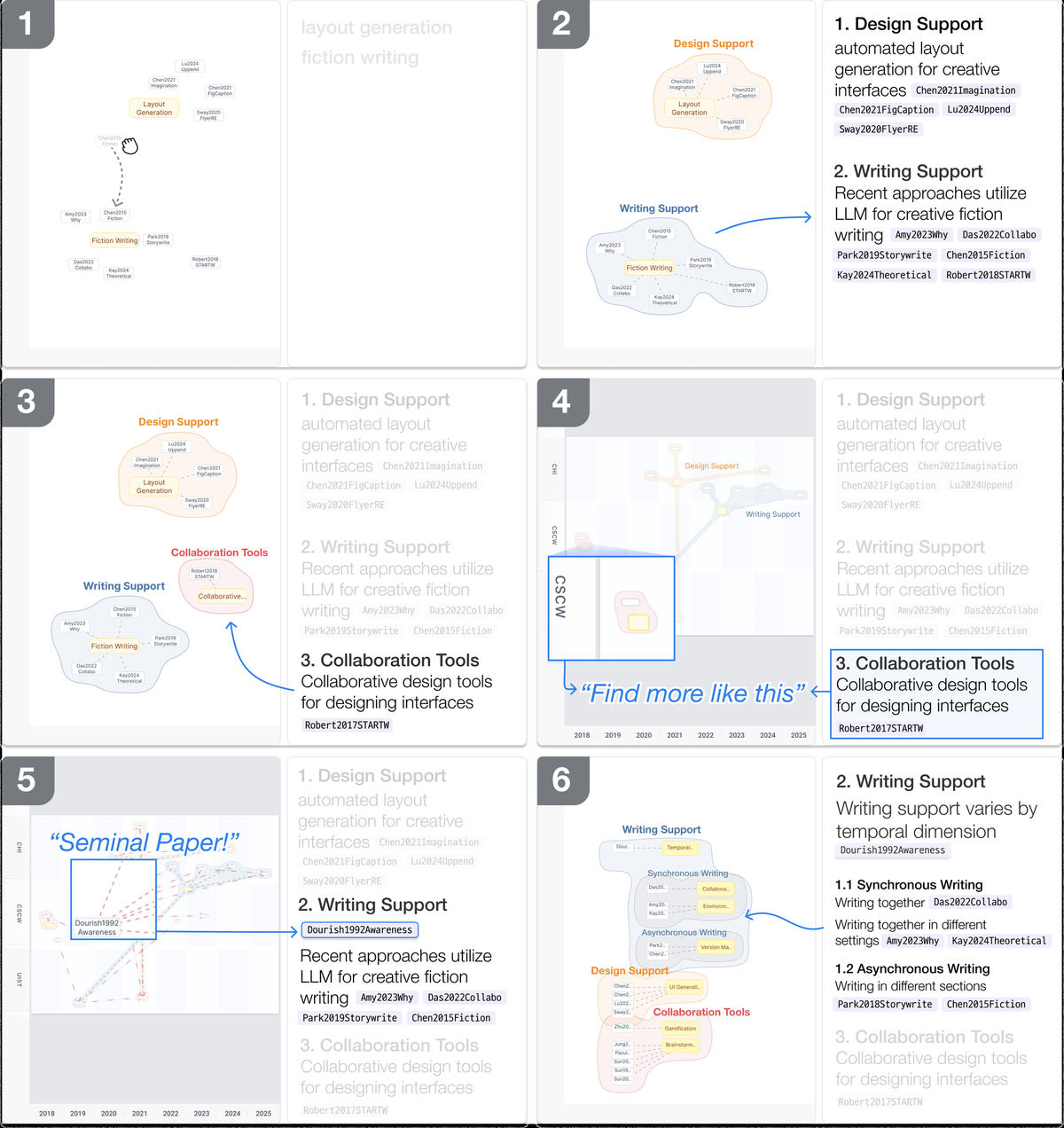
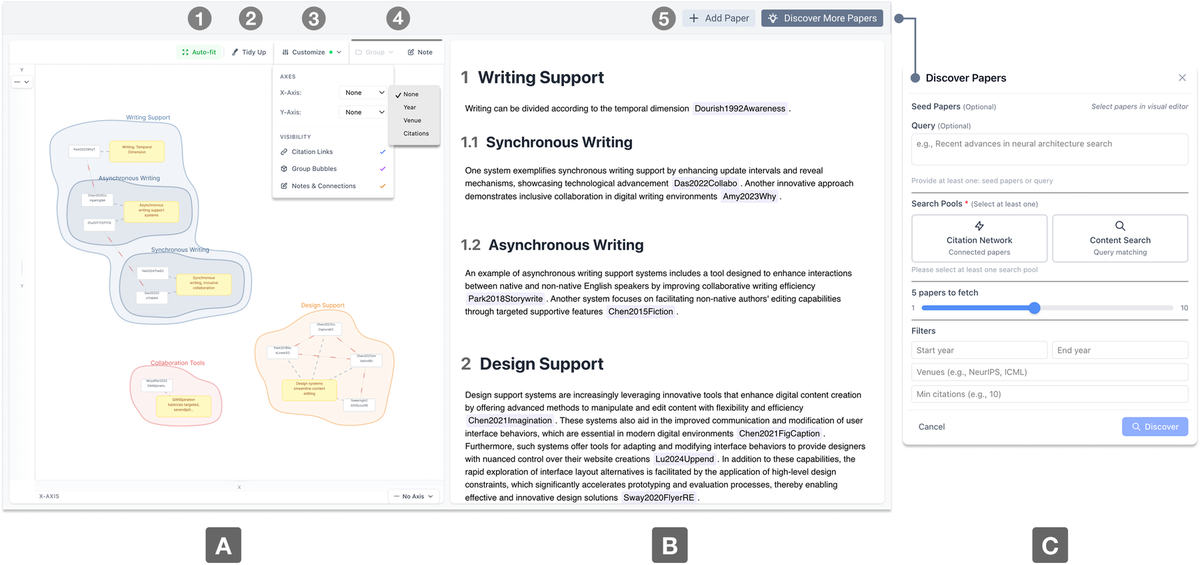
The LLM’s role here is deliberately compressed. It can expand short annotations into prose, or compress prose back into visual notes; when structure changes, it also adds minimal semantic bridging. But the system does not deliver an invisible finished manuscript; generated results stay inside a reviewable, rewritable structure.
Figure 4 shows several visual layouts: researchers can arrange papers by metadata such as year, venue, and citation count, or place freely, build hierarchical groups, or view citation links. The point is not a prettier figure, but letting different arrangements expose different research relations.
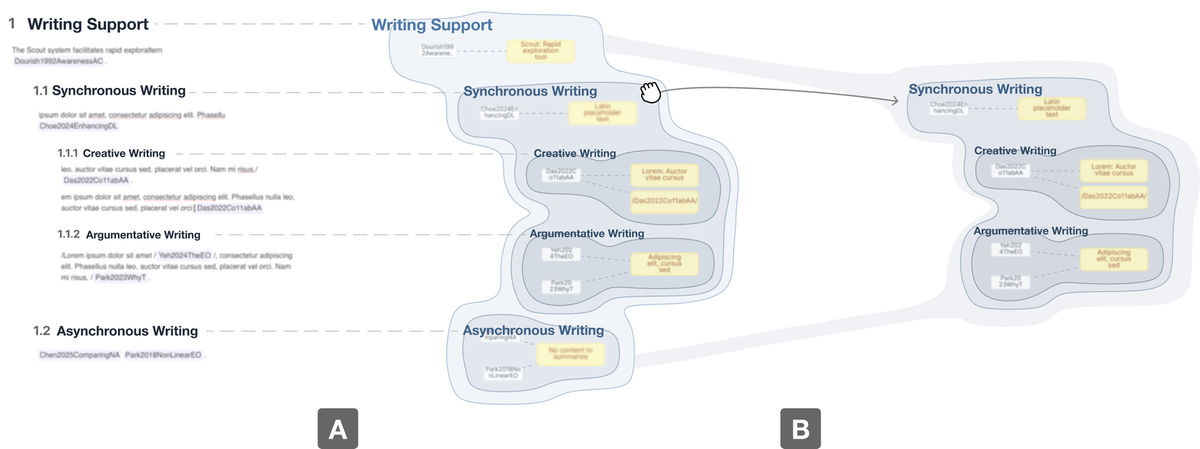
03 Finding papers is not only semantic similarity — it is also position in the scholarly network
CrossLit’s discovery module maintains two candidate pools at once. One expands along the citation network and more easily finds structurally related work inside a field; the other searches by content semantics and more easily crosses existing communities. The system then re-ranks and explains candidate papers relative to the current task.
Users’ actual queries also show the pools are not substitutes. In Figure 5, open exploration mainly used the semantic pool; metadata-centered queries used the citation pool more; goal-clear searches often called both. Association between discovery intent and search pool reached significance, χ²=27.24, p<.001, Cramér’s V=.54.
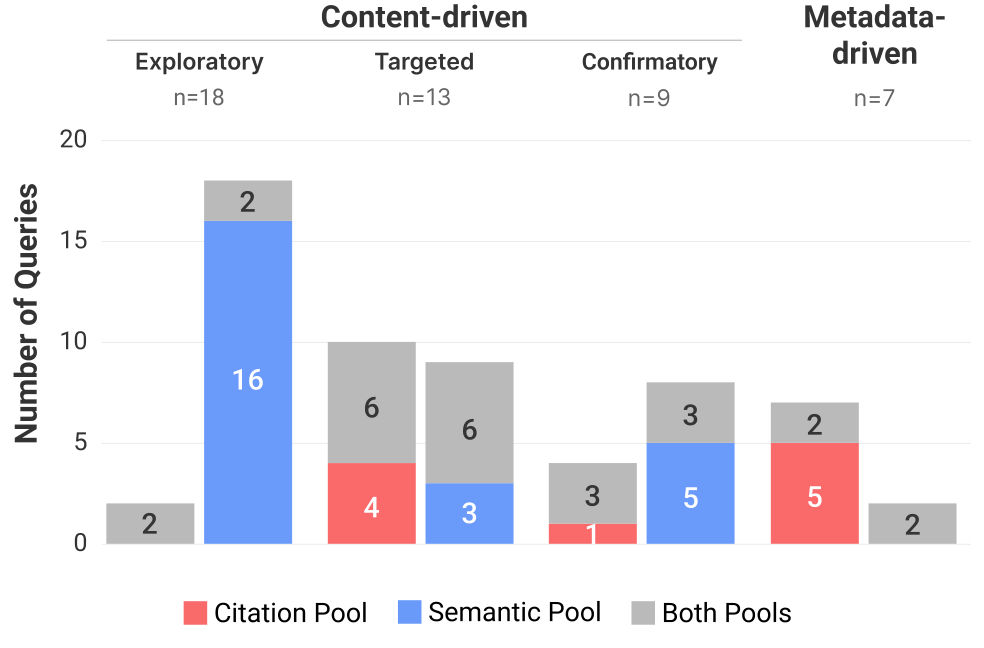
The paper’s appendix also compared three retrieval strategies on 79 related-work sections. Citation retrieval found tighter paper networks; semantic retrieval had higher text similarity; a hybrid sat between them on both metrics. The hybrid did not win across the board. A more accurate reading is: literature discovery has two different kinds of relevance that should not be flattened into one score.
One restrained interaction choice is also worth noting: newly found papers appear in a fixed expected region rather than being auto-inserted into existing structure or rewriting the article. Authors worried that while researchers are still judging where a new paper belongs, changing both editors at once would create double burden.
04 Early stages rely on figures for direction; later stages rely on text to carry argument
Sixteen HCI and related researchers joined the user study — 14 PhD students and 2 master’s students, mean research experience 4.5 years. They first spent 25 minutes preparing their own topic, then 45 minutes using CrossLit on a real literature-review task.
Researchers coded screen actions, think-aloud, and interviews into 731 observation segments and identified 573 cross-type transitions. Figure 6 shows how participants moved across tasks and modalities. Some individuals switched more than 20 times in 45 minutes — not casually opening another panel, but the thinking process itself.
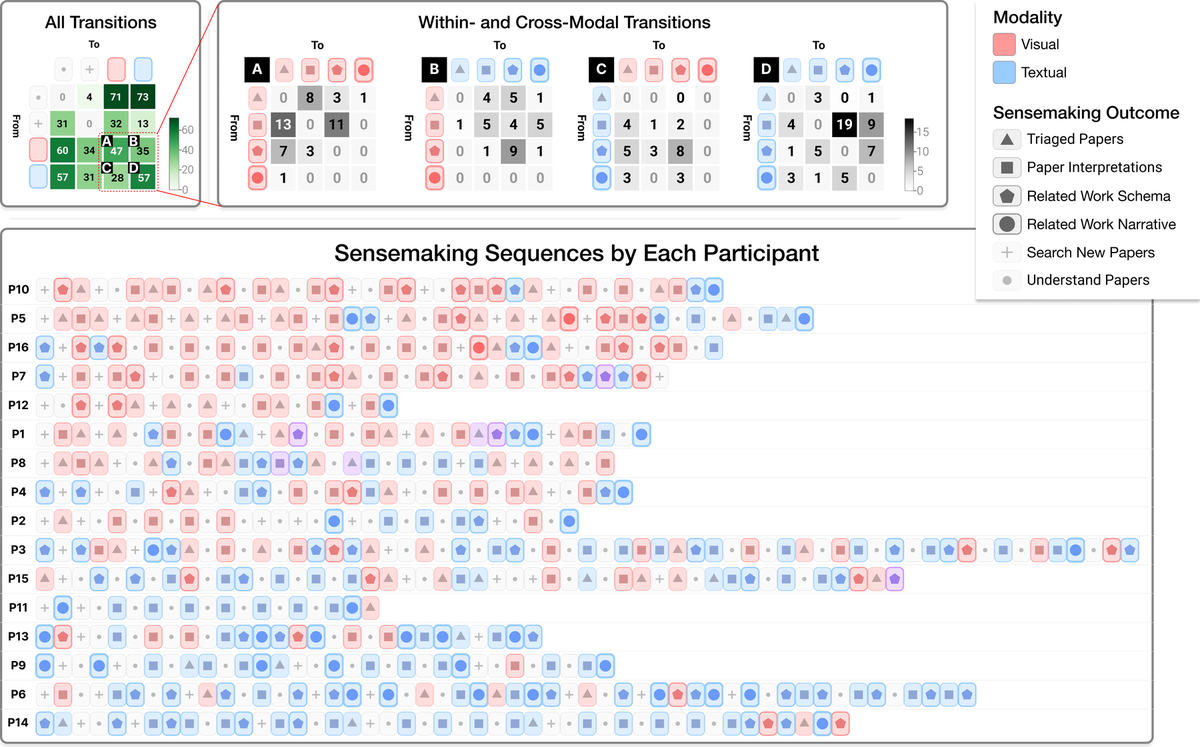
The overall pattern is clear: earlier stages used visual space more; later stages entered text more; cross-modal switching concentrated most when building the review framework. Figures are not only pre-writing visualization, and text is not only an exit after classification. They correct each other in that most unstable middle stretch.
Still, the paper’s lag analysis of transition sequences is exploratory and did not apply Bonferroni multiple-comparison correction. So these patterns suit proposing design hypotheses, not being stated as stable cognitive laws.
05 What the system is liked most for is finding and grouping — not erasing FOMO about missing papers
Participants handled a mean 18.31 papers in CrossLit, ranging from 7 to 41; a mean 11.38 came from hybrid discovery — about 62.2%. Mean System Usability Scale (SUS) was 73.2, above average.
Item ratings are more worth watching. In Figure 7, finding new related papers and organizing papers into meaningful groups scored highest; identifying research gaps and reducing worry about missing important papers scored relatively lower.
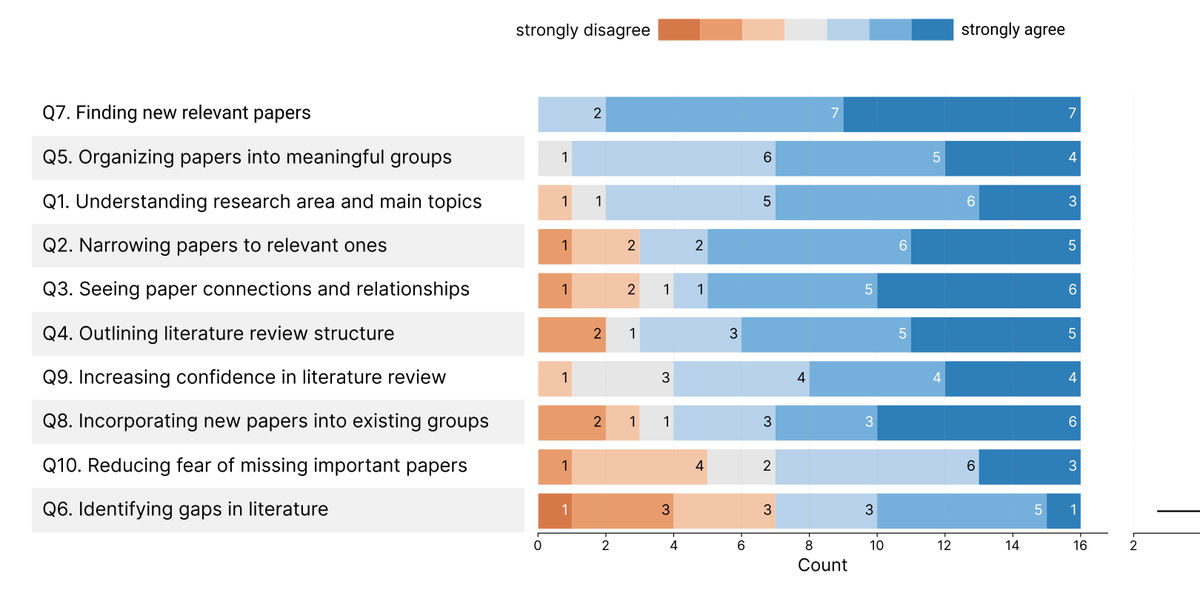
That gap is honest: a tool can make literature operations smoother without automatically answering whether a review is complete. Research gaps are jointly defined by argument and evidence; risk of missing papers also depends on database coverage, query design, and field boundaries. One more figure on the interface does not mean uncertainty vanishes.
06 Automatic sync helps in drafts — and may become damage near final manuscript
One-to-one mapping keeps the two expressions consistent and also brings a practical cost. Participants worried that once they had polished fine argument order and tone in text, one drag on the visual side might destroy those details.
This is not a small interaction bug waiting for a fix; it is a fundamental tension of automation. Draft-stage structure is meant to be overturned quickly, and sync can reduce duplicate maintenance; once argument matures, local order, retention, and deletion in text carry author judgment, and forcing alignment under the same rule again can take control away.
Participants therefore mentioned protected zones, sandbox notes, and multi-version structures. Ideal sync is not always on — it should read content maturity, know what can change automatically, and what must ask people first.
07 Good literature tools need not own the whole pipeline — but must know which layer they sit on
Authors finally split literature review into three layers. The metadata layer carries bibliographic information such as year, venue, and citation relations, usually expressed visually; the schema layer carries groups, themes, and section skeletons, where figure and text need close collaboration; the manuscript layer is near-final argument, where subtle textual order predominates. Figure 8 places CrossLit in the middle schema layer.

That figure also poses a practical design question for AI research tools: is it modifying data, modifying structure, or modifying argument the author has already committed to? Undo cost, explanation responsibility, and authorization differ across the three.
For real literature reviews, CrossLit’s evidence still only covers a stretch. The study had no control tool, so one cannot say it is faster than existing workflows or that final review quality is higher. A 45-minute task cannot cover weeks or months of real writing; the experiment handled at most 41 papers, while real reviews may involve hundreds; collaborative writing was not tested either.
So what is most worth taking from this paper is not a product already proven more efficient, but a renaming of the workflow: the core labor of literature review is not only finding more and writing faster — it is turning still-unsettled relations, step by step, into argument one is willing to own. AI can help ferry structure, but it must also learn to slow its hand when structure matures.
Paper informationOriginal title: CrossLit: Connecting Visual and Textual Sensemaking for Literature Review
Authors: Kiroong Choe, Eunhye Kim, Min Hyeong Kim, Suyeon Hwang, Sangwon Park, Nam Wook Kim, Jinwook Seo
Main affiliations: Seoul National University, KAIST, Boston College
Paper link: https://doi.org/10.1145/3772318.3791418
Key termsVisual sensemaking: Probing relations among papers through spatial position, clustering, links, and annotation — suited to carrying structure that is not yet stable.
Textual sensemaking: Clarifying argument through heading hierarchy, paragraph order, and citation — forcing authors to handle logical bridging and evidence responsibility.
Schema layer: The thematic, grouping, and section skeleton between bibliographic data and final manuscript — also where CrossLit focuses on syncing figure and text.
ReferencesChoe, K., Kim, E., Kim, M. H., Hwang, S., Park, S., Kim, N. W., & Seo, J. (2026). CrossLit: Connecting Visual and Textual Sensemaking for Literature Review. In Proceedings of the 2026 CHI Conference on Human Factors in Computing Systems. ACM. https://doi.org/10.1145/3772318.3791418