CHI 2026 | Chat with Ocean Animals for Three Turns — Do People Become Greener? Only Half Right
A 900-person randomized experiment finds AI ocean characters can boost pro-environmental intention and green choices, yet struggle to shift deeper climate attitudes.
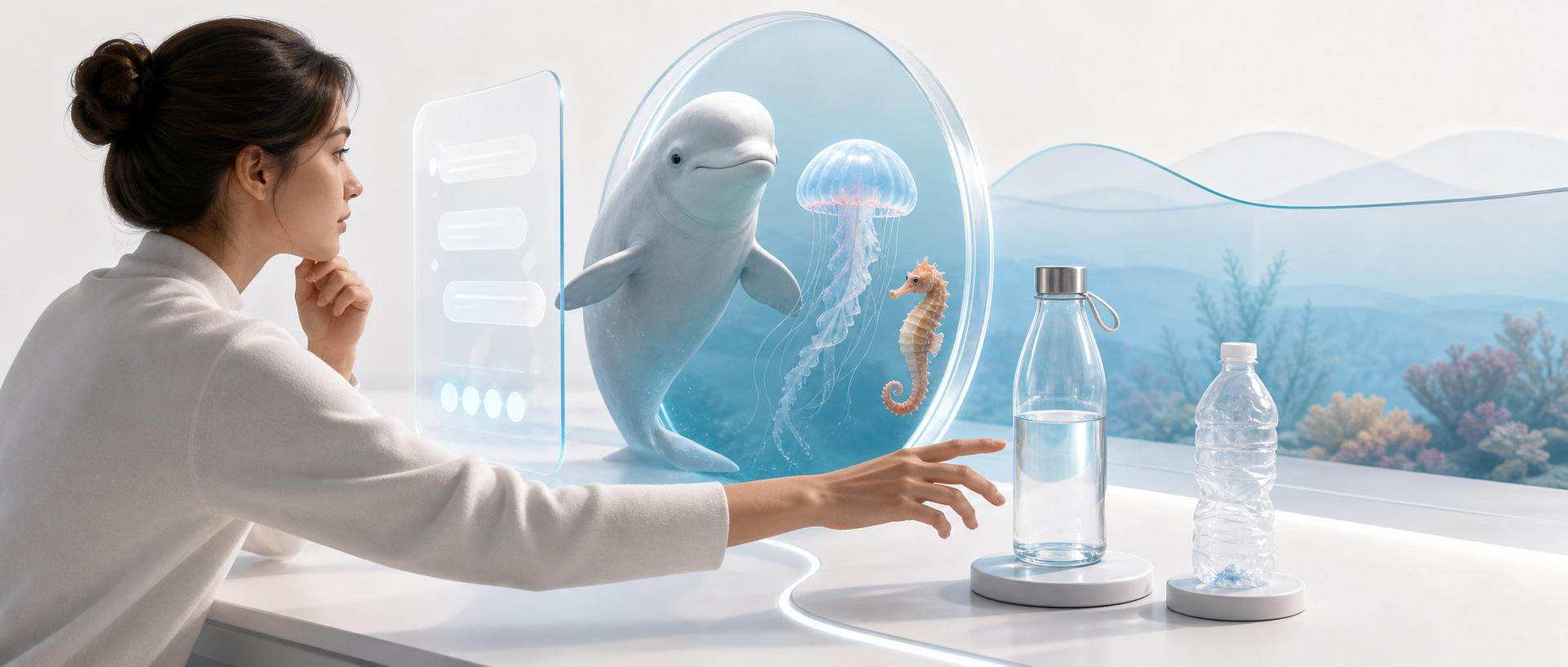
If a beluga whale told you plastic waste was changing its home, would you buy one fewer disposable cup?
That is not a setup from an environmental PSA. The CHI 2026 paper OceanChat really had participants talk with a beluga, a jellyfish, or a seahorse. Each person got at most three turns, then answered climate-attitude questions and chose among everyday products.
The answer is only half right: conversation can push pro-environmental intention and change choices in a simulated shopping task — yet it did not simultaneously shrink perceived psychological distance to climate, nor significantly raise support for climate policy. Once the paper unpacks attitude change, a crack appears: one emotional interaction can nudge the next step, but it rarely moves a person's prior worldview.
01 The point is not more knowledge — it is giving the problem a speaker
Traditional environmental communication often puts scientific facts in front of people: oceans are warming, plastic is accumulating, a species is losing habitat. Information is not scarce; what is missing is why someone should care right now. OceanChat's move is to place abstract consequences inside a character that can respond.
As Figure 1 shows, participants faced not an ordinary chat box but a virtual animal with voice, motion, and an ocean scene. The system used GPT-4o-mini to generate replies, then speech synthesis and 3D character animation to present them. Each answer stayed at two to three sentences; the whole dialogue lasted at most three turns.
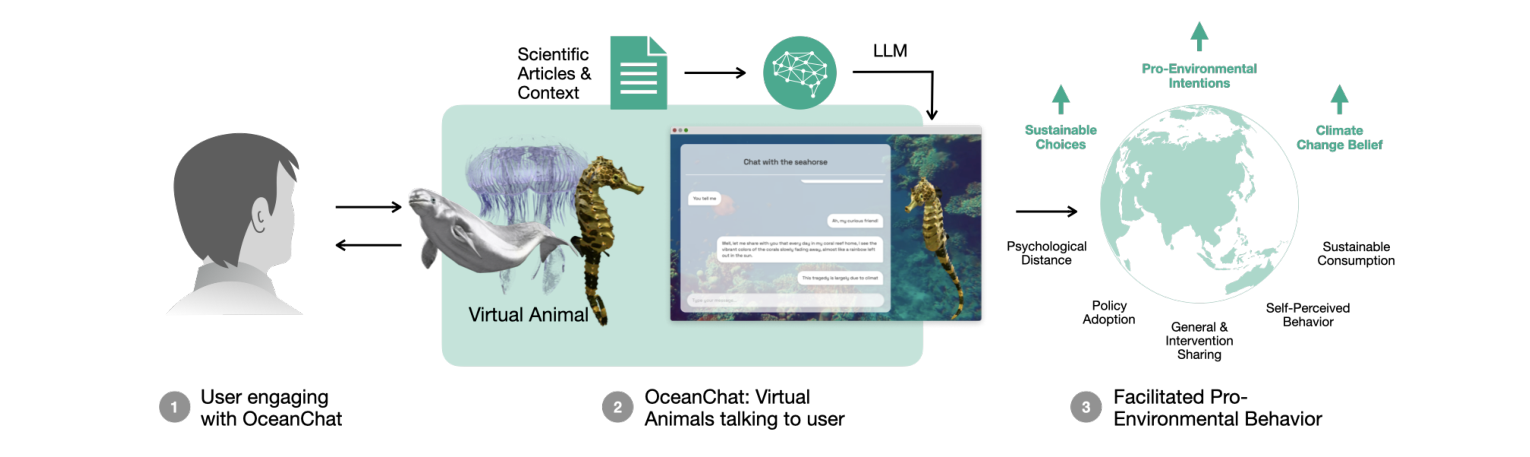
The design turns environmental communication from one-way telling into a relational cue: the ocean animal is not only an object of discussion, but also seems to narrate its own situation. Later results quickly draw a boundary around this design. It helps with action intention — it is far from omnipotent.
02 Nine conditions, built to separate conversation, story, and species
The study used a 3×3 between-subjects experiment. Communication mode had three levels: static scientific information, static character narrative, and conversational character narrative; ocean animals also had three: beluga, jellyfish, and seahorse. The two factors combined into nine conditions with random assignment.
As Figure 2 shows, the study first measured participants' prior environmental attitudes, then presented the intervention, then examined beliefs, intentions, choices, character perceptions, and sharing behavior. Recruitment began with 900 people; after consent, attention checks, and data-quality filters, effective samples for different outcome models ranged from 683 to 782.
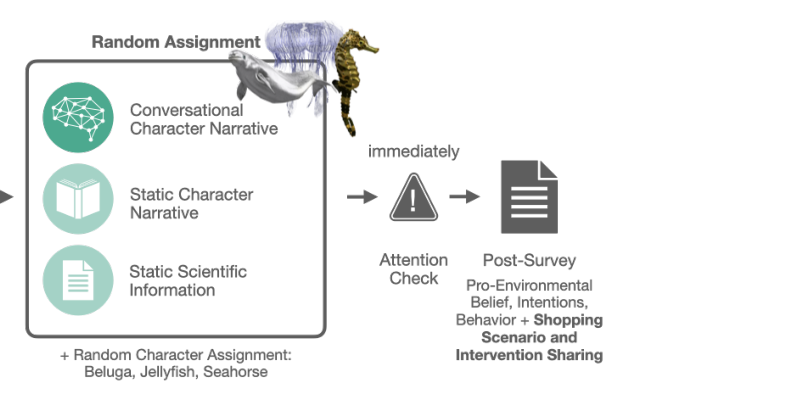
Figure 3 places the three communication conditions together and shows what the authors really wanted to answer: if static scientific information is already complete, does adding a character story help? If a story already exists, what more does live conversation bring?
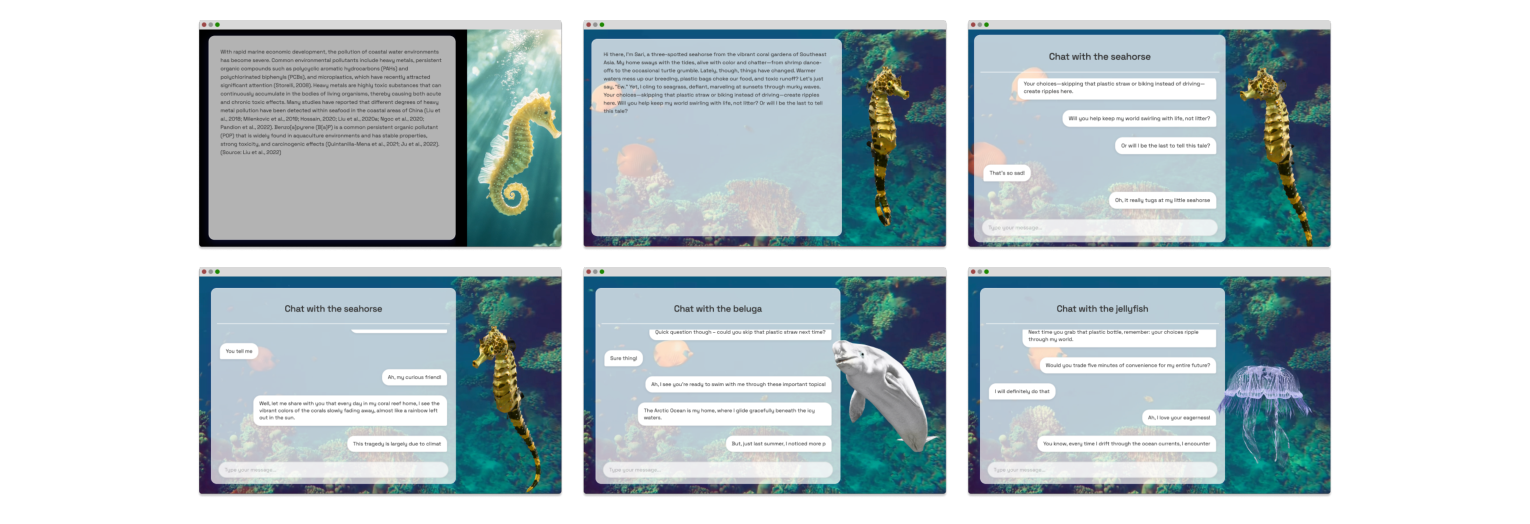
The three conditions were not controlled with perfect tightness. Word counts were matched as much as possible, but live dialogue naturally requires more dwell time, so interaction duration may remain a residual confound. The paper does not attribute every difference to the large model; it acknowledges that interaction form, character presentation, and investment of time changed together.
03 The weighty measure is not saying you like green — it is how you choose on the spot
If you only ask whether participants are willing to act environmentally, answers easily absorb social desirability. Authors therefore added a simulated shopping task: choose between glass and plastic bottles, refillable and single-use packaging, glass cups and plastic cups — as in Figure 4.
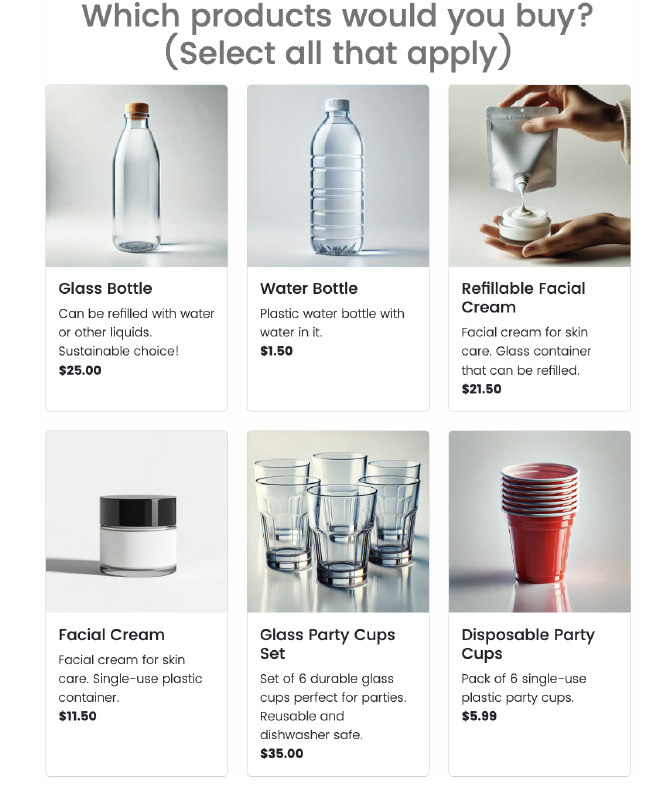
The task is still not real consumption, but it is closer to concrete decision-making than attitude scales alone. Participants must trade off price and sustainability, not only state a position that sounds correct.
The study also ran a prior trial with 100 language-model simulated users and 300 language-model reviewer agents; Figure 5 compares synthetic and real-sample distributions. The two can show similar trends on some items, yet show significant distributional differences on sustainable-consumption pretest, posttest, and change.
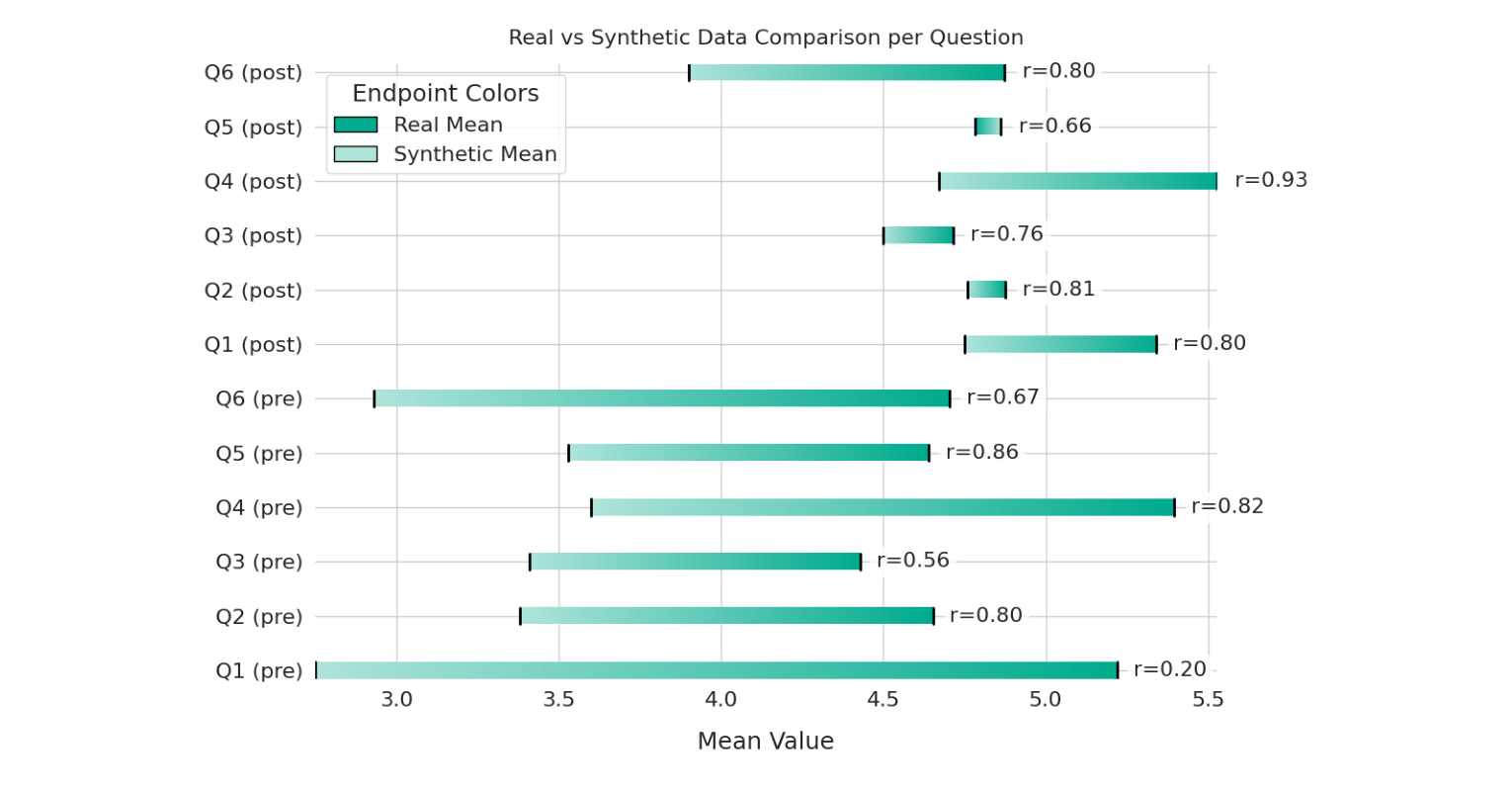
So in this paper, synthetic agents can only help check prompts, flow, and usability — they cannot replace human behavioral evidence. Once distributions diverge, the boundary is clear: models can rehearse an experiment, but cannot prove how humans will change.
04 Conversation pushed immediate choices — it did not rewrite a whole climate worldview
In the human sample, conversational characters most stably raised pro-environmental intention, standardized regression coefficient β=0.173, p<0.001. On sustainable choices in simulated shopping, the effect was β=0.342, p=0.031 — the largest relative change the paper emphasizes.
Figure 6 converts near-significant or significant results into relative change and makes the contrast clearer: conversational characters exceed static character narrative on both pro-environmental intention and sustainable choice.
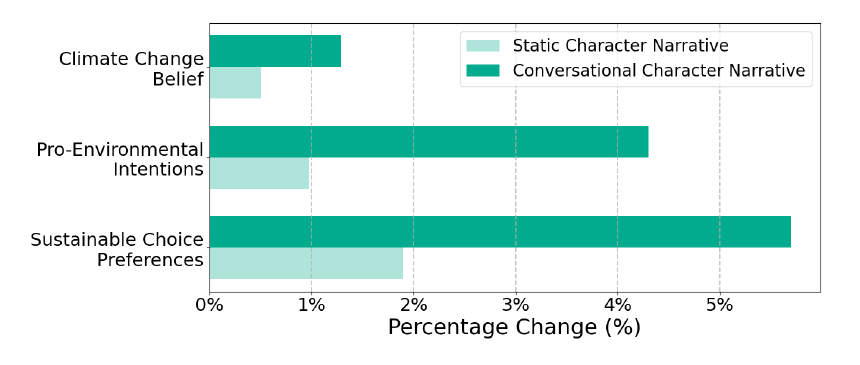
The other half did not move with them. Climate-change belief landed on the boundary, β=1.286, p=0.050; sustainable consumption patterns showed only a marginal trend, p=0.079. Psychological distance did not change significantly, p=0.717; climate-policy support also did not, p=0.535.
A short dialogue behaves more like a behavioral trigger than a belief reinstall. It can make people willing to do something next; it is not enough to pierce existing political stance, responsibility judgments, and long-term life structure. Prior attitudes explained a good share of outcomes; the intervention more often added force to an existing inclination.
05 Empathy can push choices — but more interactive does not make the character more alive
Among perception variables, empathy tied most tightly to behavior. Higher empathy for the animal predicted more sustainable choices, β=0.404, p<0.001. Character likability predicted climate-change belief, β=0.783, p=0.026.
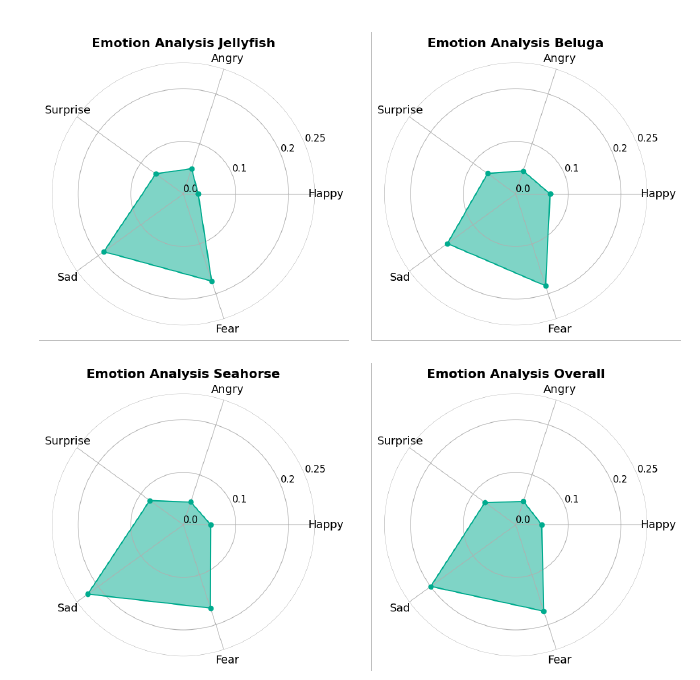
Emotion in chat text offers side evidence. Figure 7 shows sadness as the most prominent emotion across the three animal conditions, then fear. Many participants were not merely repeating green slogans — they were responding to harm the ocean animals faced.
Interaction also produced a counterintuitive result. Figure 8 shows that, versus static scientific information, character narrative raised anthropomorphism, likability, intelligence, and felt safety — yet the conversational condition lowered perceived aliveness, β=-0.222, p=0.010.
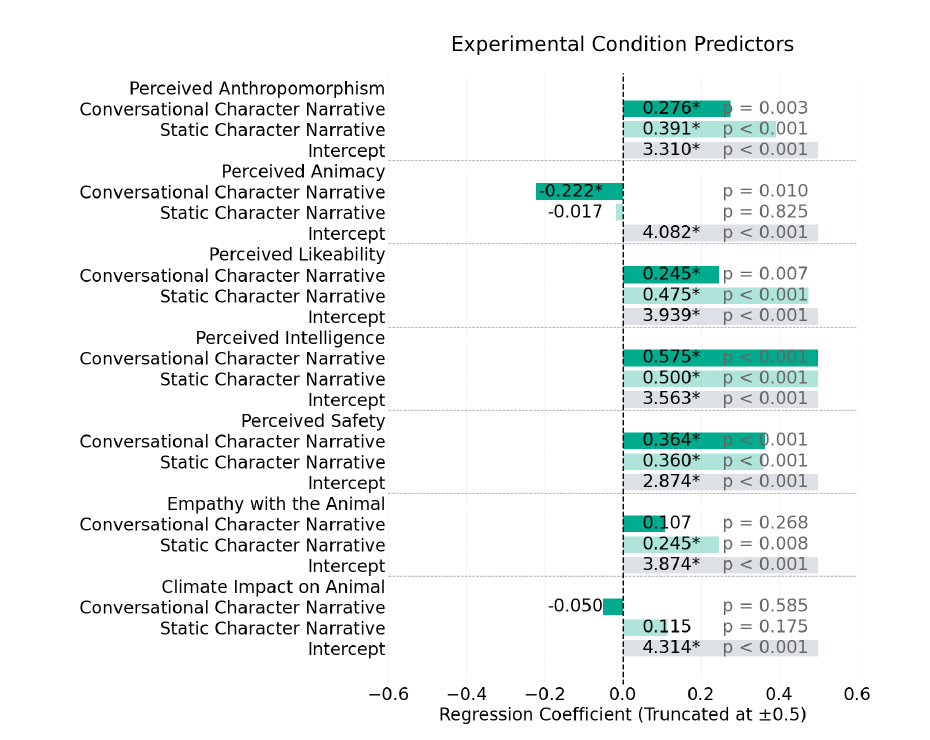
The paper thus conjectures that once a character begins responding in real time, participants more easily notice system boundaries and artificial traces. That mechanism was not directly tested and should not be written as settled fact. What is clear: being better at talking is not the same as seeming more alive; interactivity and aliveness are not one scale.
Species differences are also not a simple cuteness ranking. Belugas scored higher on likability, intelligence, and empathy; jellyfish were seen as more anthropomorphic and raised participants' awareness of climate impact more than seahorses. Charm, anthropomorphism, and persuasive effect may be driven by different cues.
06 Designing green AI should aim at the next step — not promise belief change
Bring these results back to product design, and the first decision is which layer of change the system should push. If the goal is a concrete, low-threshold green choice, short character dialogue may have value; if the goal is policy stance, long-term consumption habits, or overall understanding of climate risk, one three-turn chat is clearly not enough.
In product design, relational feeling needs to connect to clear action. After the character tells its situation, offer a choice that can be completed now, with price, convenience, and alternatives in view. Moving users without a realistic path leaves emotion stuck on the screen.
Qualitative feedback also exposes that gap. Participants said they would use fewer straws or switch to reusable bags — and also that green goods cost more, personal action feels small, and firms and governments bear more responsibility. These are not excuses after failed messaging; they are constraints behavior change already faces.
What the paper proves most solidly is that short-term intention and simulated choice can be pushed. It has not shown lasting effects, nor observed real purchases and long-term behavior; different species mainly changed appearance and narrative cues, not deeply different interaction strategies. Future work still needs longer horizons, real settings, and preregistered analyses to know how far this step can go.
Paper information
Original title: "OceanChat: The Effect of Virtual Conversational AI Agents on Sustainable Attitude and Behavior Change"
Authors: Pat Pataranutaporn, Alexander Doudkin, Pattie Maes
Affiliation: MIT Media Lab
Venue: CHI 2026, Barcelona, Spain
Paper link: https://doi.org/10.1145/3772318.3791760
Key terms
Psychological distance: How far people feel climate change is from themselves — in time, space, social relation, and probability. It did not change significantly, meaning one conversation may not make climate risk feel more immediate.
Anthropomorphism and aliveness: Anthropomorphism attributes human traits to a character; aliveness is feeling the character truly acts autonomously. Related, but results show they do not rise together with interaction.
Synthetic participants: Experimental users played by language models. Useful for early flow checks, not as substitutes for human samples when inferring human behavior.
References
Pataranutaporn, P., Doudkin, A., & Maes, P. (2026). OceanChat: The Effect of Virtual Conversational AI Agents on Sustainable Attitude and Behavior Change. In Proceedings of the 2026 CHI Conference on Human Factors in Computing Systems. Association for Computing Machinery. https://doi.org/10.1145/3772318.3791760