CHI 2026 | Helping Kids Reflect with AI Is Hardest Not in Follow-ups, but in Knowing When to Stop
Rules keep the teaching path on track; the LLM handles flexible follow-ups. A robotics camp study finds that responding more does not mean understanding deeper.

Many educational dialogue systems face the same tradeoff: design strictly by teaching theory, and the system is reliable but stiff; hand the conversation to an LLM, and it sounds more natural — yet may not know which interactions actually help learning.
This CHI 2026 paper tries stacking the two. A rule-based state machine holds the reflective teaching path; the LLM steps in only when a student's answer is too thin, decides whether to keep probing, and generates a new contextual question.
It sounds like a steady compromise. Once the system entered a real summer camp, results did not follow the design diagram: some children did say more, while others felt the robot was "asking the same thing in different sentences," and some replied "leave me alone."
This exploratory study with only 9 participants does not prove that a hybrid architecture raises learning outcomes. Its greater value is putting a neglected design problem on the table: educational AI must decide not only what to say next. It also has to understand what a child is doing, how they feel, and when it should shut up.
01 Rules know teaching but not change; LLMs know change but not teaching
Traditional educational dialogue systems often use decision trees or finite state machines. Researchers can encode goal-setting, planning, monitoring, and reflection into dialogue paths; behavior is predictable and easy to check against teaching theory. The cost: scripts only handle answers designers foresaw. Once students say something unexpected, the dialogue easily breaks.
LLMs fill exactly that gap. They can generate follow-ups from what a student just said, with more flexible tone than fixed templates. But a general language model does not know which learning theory reflective dialogue should follow, and does not naturally understand why "making hair for a robot" is an important design activity in a particular camp.
So the authors did not let the LLM take over the whole conversation. In Figure 1, the backbone remains a finite state machine grounded in self-regulated learning theory, guiding students through goals, plans, current activity, design changes, emotion, and identity as a technical creator. The LLM is embedded only at open-response judgment nodes.
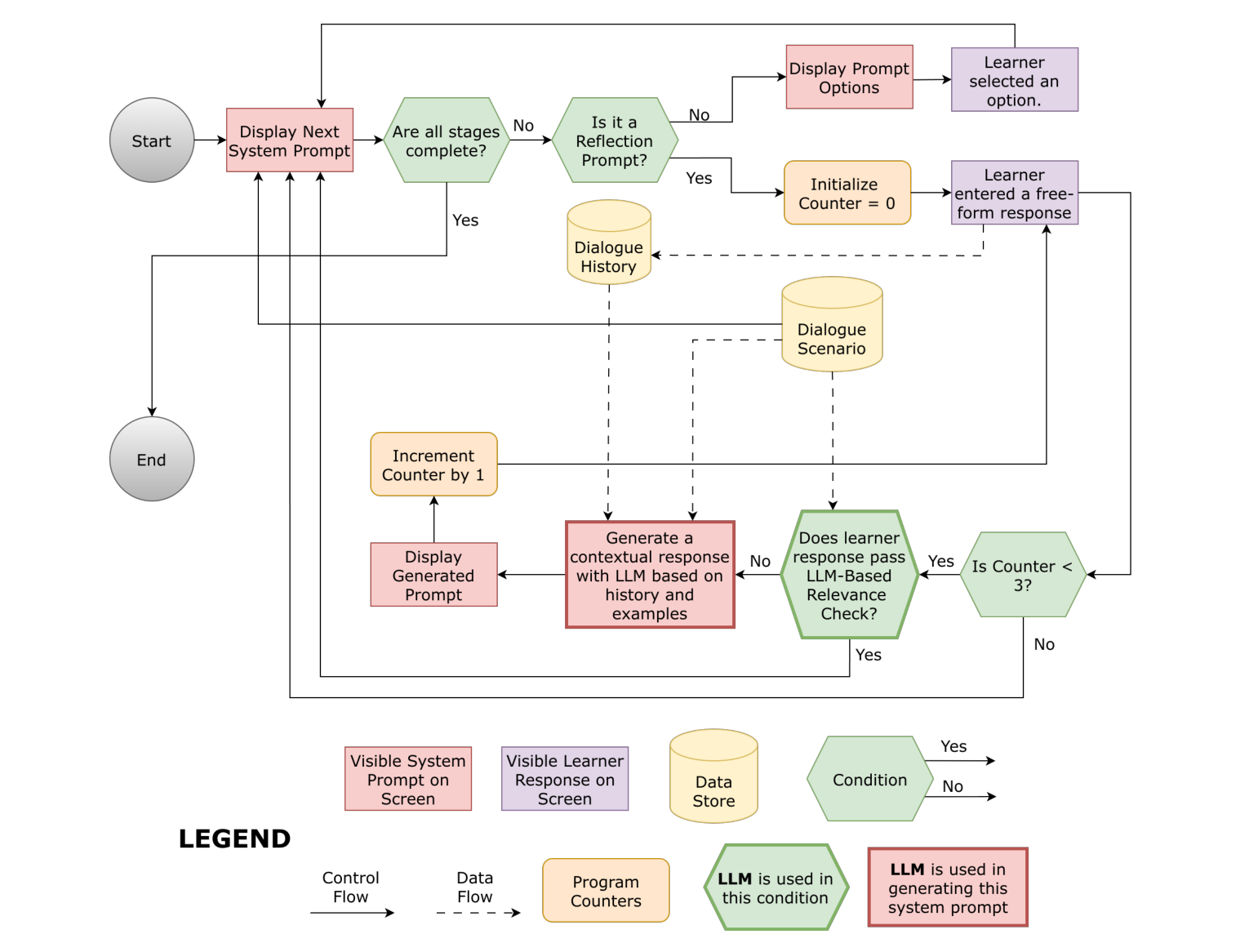
The architecture's tradeoff is clear: educators decide where the dialogue goes; the model only handles local uncertainty along the path. Generative capacity is locked onto a theory-predefined track, rather than letting the model invent teaching goals on the fly.
02 The LLM has only two jobs: judge sufficiency, then decide how to follow up
Each LLM intervention has two stages. First is a relevance check: given the current question, the student's answer, dynamic fields, and 5 to 10 few-shot examples, the model outputs YES or NO on whether the answer contains enough relevant, concrete reflective information.
If the answer passes, the state machine advances; if not, stage two starts. The model reads the current task, the last 10 dialogue turns, and examples, then generates one follow-up for that student. The system allows at most three consecutive follow-ups, then forces forward to avoid endless loops.
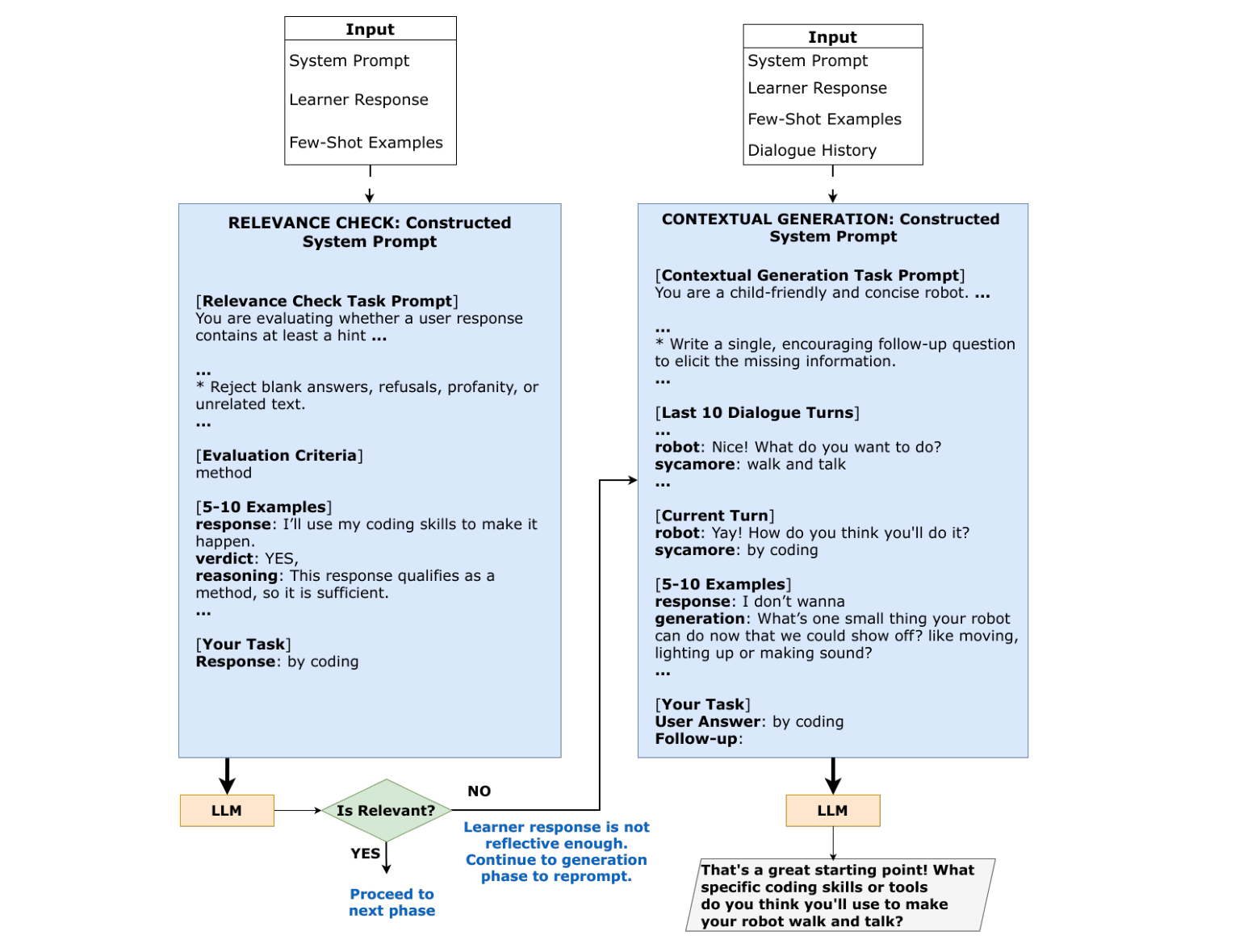
Authors chose the last 10 turns rather than full history to reduce long-context drift. The underlying model was LLaMA-3.1-8B-Instruct deployed in a controlled AWS environment — not GPT-4 or Gemini — partly because children's dialogue data is privacy-sensitive. The technical point is not that bigger models are always better, but that structure, examples, and stop conditions constrain what the model may do.
That gating logic also plants later contradictions. The system only sorts answers into "enough" and "not enough": not enough → follow up; enough → leave. Whether an answer deserves deeper probing, whether the student is already annoyed, whether the topic matters to this child — those are not in the same judgment.
03 The study did not happen in a lab — it happened in a camp where kids were building robots
The system was placed in a two-week, culturally responsive robotics summer camp. Children used the Hummingbird Robotics Kit, sensors, lights, actuators, and a Blockly environment to make their own robot protégés, then showed them on a robot runway. Activities included programming, but also appearance, identity, story, and peer collaboration.
Fourteen fourth- through eighth-graders attended the camp; 10 joined dialogue and interviews. One was excluded for a technical fault; the paper analyzes the remaining 9, ages 9 to 13 (mean 10.89). Seven identified as Black or African American, one as Black and American Indian, one as American.
Each student talked with the system for about 5 to 10 minutes, then did a semi-structured interview of about 8 to 15 minutes. The interface supported keyboard and voice input and replied in text and speech, but no student used voice input in this study.
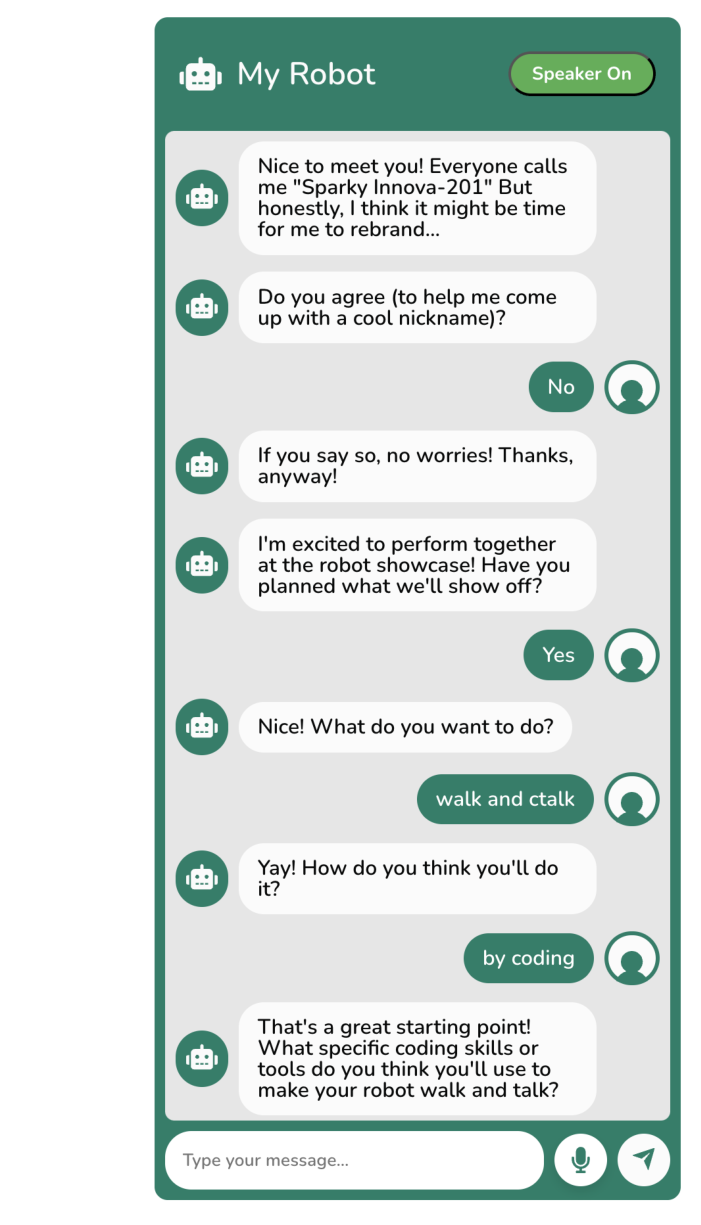
The interface shows this was not an open chat box. Menu options, fixed questions, and free answers alternated; LLM follow-ups sat inside the rule flow. Children faced not a casually chatty robot, but a system with clear rights to ask and to control pace.
Nine dialogues contained 357 turns total: 144 student answers, 88 of them open. Open answers averaged only 3.89 English words; system replies averaged 14.41. Dialogues lasted about 6 minutes on average; the LLM triggered 2.66 times on average.
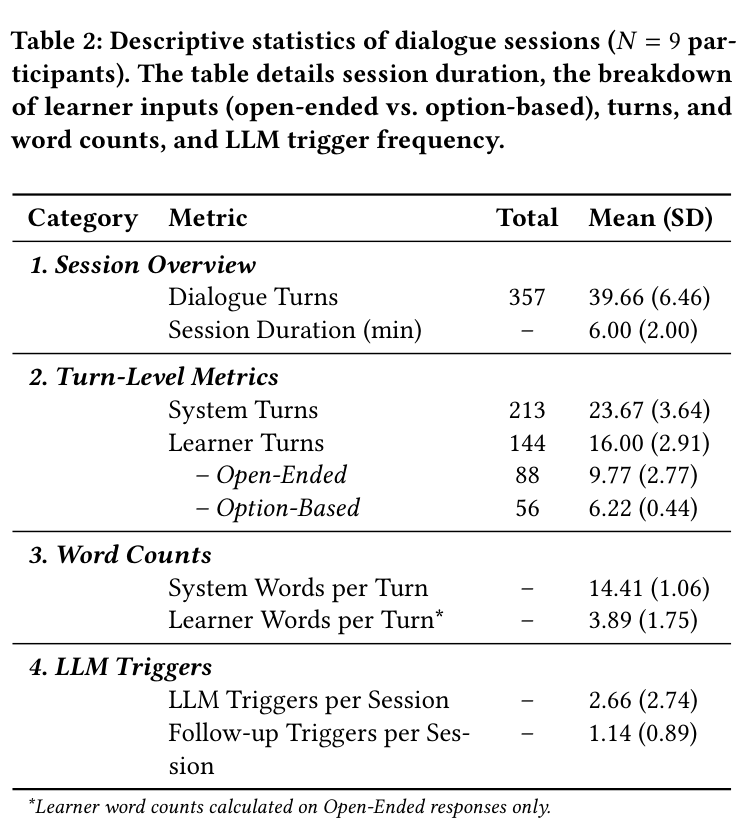
These numbers caution against treating "generated lots of dialogue" as engagement. The system said far more than the children; LLM interventions were few. The few follow-ups matter more: when they help a child expand, and when they push someone out of the conversation.
04 Follow-ups can lengthen answers — but success is not universal
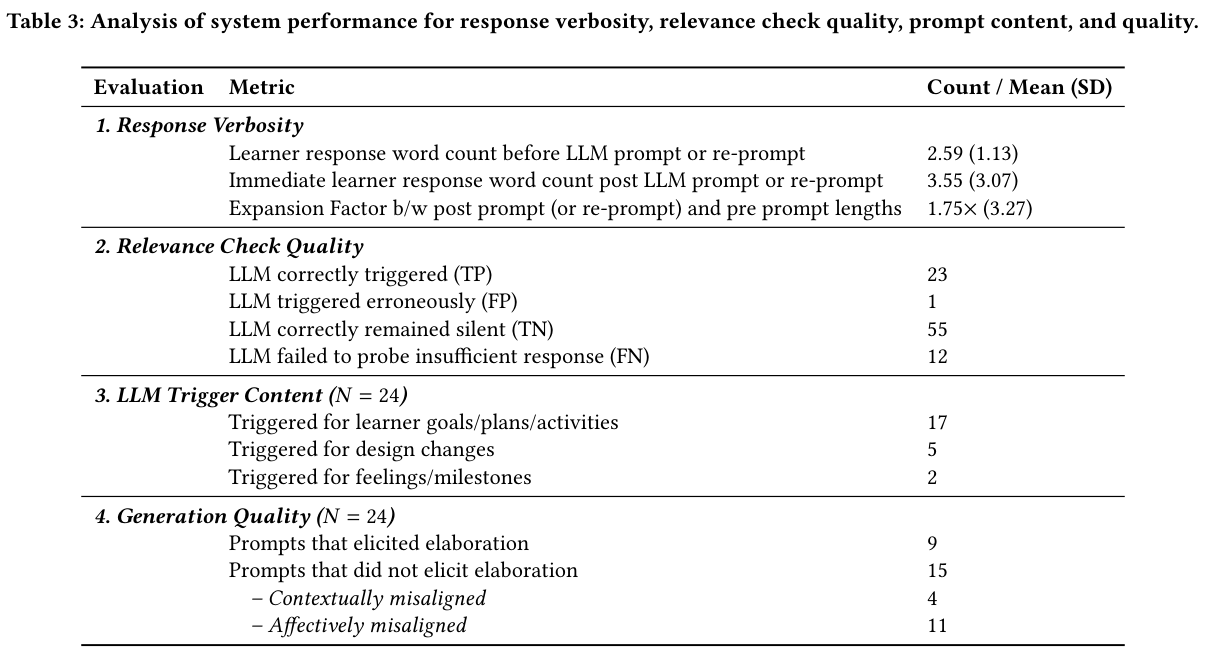
Before LLM follow-ups, student answers averaged 2.59 words; the immediate next answer averaged 3.55 words, about a 1.75× expansion on average. But the standard deviation was 3.27: some expanded from 1 word to 10, others shrank from 5 to 2. The mean rise is a real observation; individual reactions were highly inconsistent.
All 88 open answers went through relevance judgment. Versus human coding, the model disagreed 13 times: 1 false trigger when it should not have followed up, and 12 clearly insufficient answers that were not probed further. The system ultimately generated 24 follow-ups: 17 on goals, plans, and activities; 5 on design changes; 2 on feelings or milestones.
The sharpest result is in the last part of Table 3: of 24 LLM follow-ups, only 9 produced richer answers; 15 did not. Among unsuccessful follow-ups, 4 had situational misalignment and 11 had emotional misalignment.
Successful cases were usually concrete. A student said they did "coding" today; the system asked what specifically; the student then explained making the robot move and speak a math problem. Another first said "the same" and "idk"; the system acknowledged uncertainty, asked why, and the student voiced worry about not knowing how to program.
Longer answers cannot be equated with deeper reflection. The study used word counts and turn counts as proxies for participation and reflection, plus qualitative coding of content; there were no learning scores, pre/post tests, or control groups. Safer claim: some situationally aligned follow-ups prompted more concrete expression — not that the system has been proven to improve learning.
05 The system's worst error was judging a child's world as irrelevant
Robot design in the camp included programming and hardware — and also hair, lashes, clothing, and identity expression. The model's idea of a "robot" stayed closer to traditional engineering tasks. When a student said they finished the robot's hair and lashes, the system replied that this seemed unrelated to today's work.
Situational misalignment is worse than ordinary factual error. The system holds the right to advance the dialogue; once it labels an expression "irrelevant," it asks the child to answer in language the system accepts. In recorded cases, a student mentioned hair design repeatedly without acknowledgment and finally replied "idk." The model seemed to promote reflection while narrowing what counts as valid creative activity.
Emotional misalignment is more direct. After a student clearly said "leave me alone," the system did not treat refusal as a stop signal and kept asking whether they would share one small thing about today or the robot. The three-follow-up cap prevents technical infinite loops; it does not solve relational overreach: the child has exited, and the system still ranks task completion above exit will.
Interview evaluations therefore split. Some students liked that the robot cared what they did and appreciated the encouraging tone; others found questions repetitive, boring, or too many. Some wished to be the asker; some were uncomfortable that AI knew their name. For young learners, there is no one fixed boundary between "patient follow-up" and "persistent interrogation."
06 A true hybrid architecture still needs three judgments: situation, emotion, and the right to exit
First, situation. Domain knowledge must come from the concrete learning environment. Few-shot examples did not teach the model what hair and accessories meant in this camp. Future systems could use RAG, course materials, past design cases, or students' own robot descriptions to supply local context — rather than expecting a general model to guess.
Second, emotion and willingness to engage. Relevance checks cannot only ask whether content is enough. Refusal, brush-offs, and successively shorter answers may mean reducing follow-ups, switching to suggestions, or ending. Stopping interaction is not dialogue failure; it should be a normal act of respecting the learner.
Third, leave room for how children choose to reflect. Some like questions; some prefer discussion or receiving advice. Some are willing to treat the dialogue agent as their robot; others feel the default voice has nothing to do with their design. A fixed "asker" role stabilizes structure — and may block co-construction and peer-like exchange.
The best reminder this paper leaves: in educational settings, an LLM should not assume it ought to say the next sentence merely because it still can generate one. Theory constraints answer where the dialogue goes; true responsiveness still asks another question: does this child still want to walk with you right now?
Evidence boundaries belong here too. Only 9 students; no pure rule system or pure LLM control; dialogue happened after children left the robot workbench, possibly weakening reflective concreteness. Different branches showed different prompts; most interviews were in pairs. The paper offers a design case and qualitative insight, not a generally extrapolable effect conclusion.
Paper information
Original title: Hybrid LLM-Embedded Dialogue Agents for Learner Reflection: Designing Responsive and Theory-Driven Interactions
Authors: Paras Sharma, Yueping Sha, Janet Shufor Bih Epse Fofang, Brayden Yan, Jess A Turner, Nicole Balay, Hubert O. Asare, Angela E.B. Stewart, Erin Walker
Primary affiliations: University of Pittsburgh, Carnegie Mellon University, Bowie State University
Venue: CHI 2026, Barcelona, Spain
Paper link: https://doi.org/10.1145/3772318.3791582
Key terms
Self-Regulated Learning: A cycle in which learners plan, monitor, and adjust around goals, and respond to and reflect on outcomes and process.
Finite State Machine: Controlling dialogue paths with predefined states and transition rules so the system advances along the instructional design.
Relevance check: The LLM judges, from the current question, student answer, and examples, whether the answer is relevant and concrete enough to continue the flow or to generate a follow-up.
References
Sharma, P., Sha, Y., Fofang, J. S. B. E., Yan, B., Turner, J. A., Balay, N., Asare, H. O., Stewart, A. E. B., & Walker, E. (2026). Hybrid LLM-Embedded Dialogue Agents for Learner Reflection: Designing Responsive and Theory-Driven Interactions. In Proceedings of the 2026 CHI Conference on Human Factors in Computing Systems. ACM. https://doi.org/10.1145/3772318.3791582