CHI 2026 | Add an AI Classmate — Small Classes of Two May Benefit Most
This CHI 2026 paper designs AI as a teacher-triggered virtual peer and observes how it reshapes student talk in Japanese elementary classrooms.
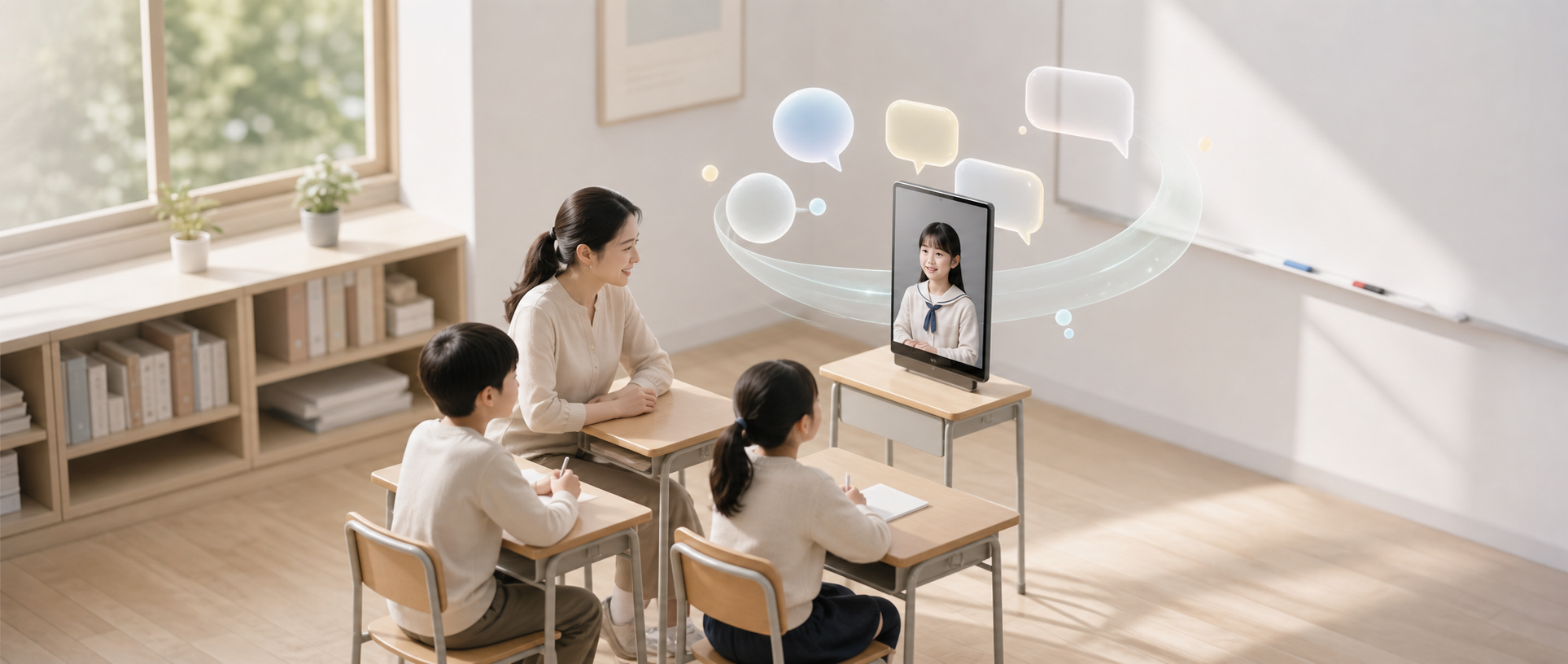
When a class has only two children, discussion runs into a simple problem: students are not unintelligent, and teachers are not unskilled — there are simply too few ideas to collide with.
What makes peer learning valuable is often not that someone gives the right answer, but that someone asks an unfinished question or offers a slightly skewed explanation, forcing others to make their own thinking clear. In real classrooms, that kind of active speaker does not always appear. Small classes lack numbers; large classes invite silence.
The interesting move in this CHI 2026 paper is that the authors do not turn AI into an answer-giving teacher, nor let it finish students' work. They design it as an "AI classmate" that asks questions, summarizes, and occasionally gets things wrong. The real question is not whether AI can be smarter, but whether it can restore missing peer interaction in class.
📌 Paper information
Original title: Design and Evaluation of a Photorealistic AI Virtual Peer in Elementary Collaborative Classroom
Authors and affiliations: Satomi Tokida, Koki Usui, Godai Tanaka, Shin Osuga, Masanori Kayano, Yuta Itoh, Yoshio Ishiguro. Authors are affiliated with The University of Tokyo, AISIN CORPORATION, University of Yamanashi, Institute of Science Tokyo, and related institutions.
Venue: CHI 2026, Barcelona, Spain.
Paper link: https://doi.org/10.1145/3772318.3791450
The paper is not really asking whether AI can teach
Many AI education products place AI in the role of teacher or teaching assistant: explaining concepts, grading answers, generating practice. In elementary classrooms, though, discussion often fails not for lack of explanation, but for lack of a peer who can get others to speak.
The authors call this role an active learner. Such a student asks questions, reveals confusion, offers incomplete answers, and sometimes states a view worth rebutting. Its value is not authority; it is creating an entry point into discussion.
In Japanese and East Asian classroom contexts, students often become more concerned with others' gaze as they grow older, and may hesitate to say "I don't understand" directly. At the same time, Japan's declining birthrate has produced many small schools. The paper notes that in 2024, among Japan's public elementary schools, 8.8% had five or fewer classes, and 33.0% had six to eleven classes. In extremely small classes, a grade may have only one or two students, so the chance of an active peer emerging drops structurally.
So the core of this paper is not letting AI answer for the teacher. It asks: can an AI virtual peer artificially supply the peer influence that classrooms are missing?
Saya's key design: like a classmate, but not fully free
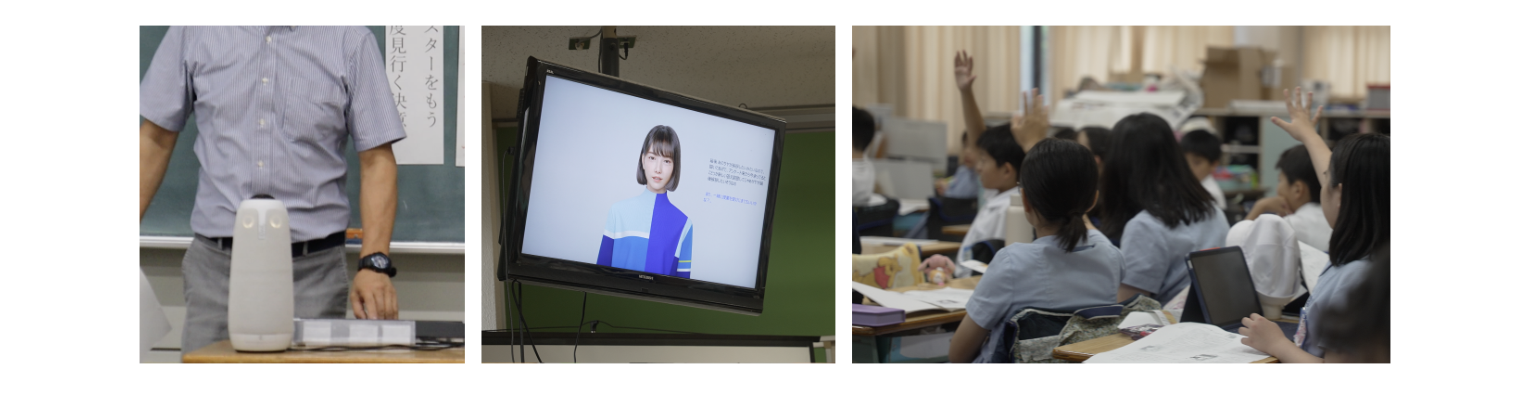
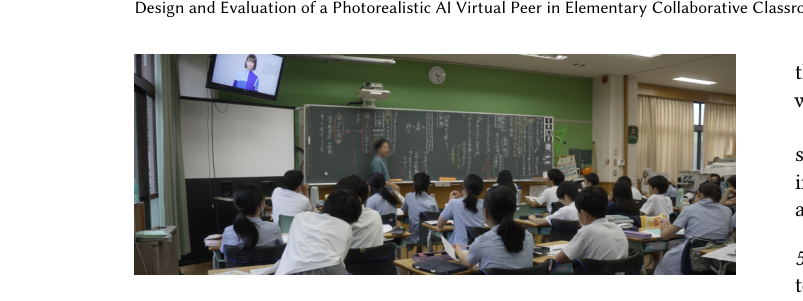
The system is called Saya. It is a photorealistic 3D CG virtual peer that appears on classroom displays and joins discussion as a student peer. To keep Saya from becoming an uncontrolled chatbot, the system uses a restrained design: the teacher decides when it speaks, and which kind of speech act it uses.
That matters. An elementary classroom is not an open chat room; teachers need to hold instructional goals, pacing, and psychological safety. If AI interrupts whenever it wants, it can break discussion; if it only follows a fixed script, it easily becomes a prop. Saya takes a middle path: content is generated by GPT-4o-mini, but timing and speech type stay under teacher control.
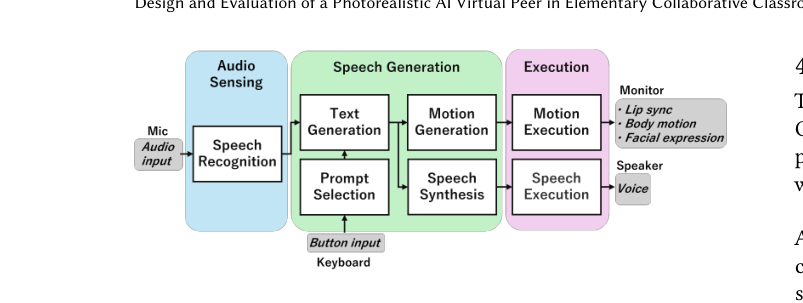
As Figure 2 shows, the system recognizes the ongoing discussion from classroom audio, combines pre-prepared teaching materials with the live dialogue history, and generates a response based on the button the teacher presses. Saya then presents that response through voice, facial expression, and bodily movement.
Five speech acts: not to seem more human, but to be a more useful peer
In formative interviews with 12 elementary teachers, the authors distilled three design requirements: AI should stand in the peer position, not as a teacher assistant; it should model questioning and expressing confusion; and it must leave instructional control with the teacher.
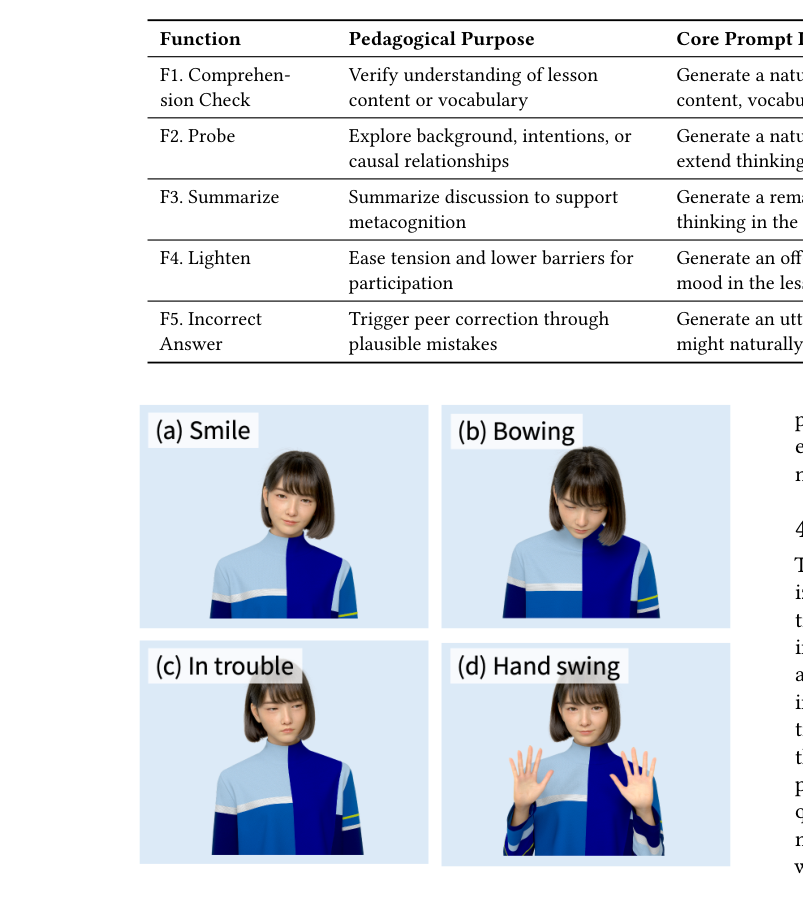
The initial system included understanding checks, probing, summarizing, lightening the mood, and incorrect answers. After a preliminary study, the authors replaced "understanding checks" with "expanding viewpoints," because teachers found classrooms needed a peer who could introduce new perspectives — especially in small classes.
The final five speech acts are: Expand, introducing a new viewpoint not yet present; Probe, asking for reasons and detail; Summarize, recapping discussion progress; Lighten, using lighter talk to lower the cost of speaking up; Incorrect Answer, offering a plausible but wrong understanding so students can safely rebut it.
The value of this taxonomy is that it does not define AI's goal as "being correct." Sometimes an incomplete, slightly naive, or discussable mistake brings AI closer to the peer role classrooms need.
The preliminary study revealed a subtle problem: if AI feels teacher-operated, it stops feeling like a classmate
The authors first ran a preliminary study in a sixth-grade Japanese language class with 33 students. Acceptance was high: all 33 said they would want to learn with Saya again. Teacher feedback also exposed several key issues.
First, button control is clear, but if students feel Saya is produced by the teacher's press, it shifts from "classmate" to "teacher's loudspeaker." Second, hanging Saya on a front-of-room screen reinforced a tool-like presence. Third, some answers ended in overly formulaic phrases — always tossing out something like "what do you all think?" — which weakened the sense of real interaction.
Before the formal field study, the authors therefore made several changes: placing displays at students' eye level so Saya looked seated in the room; reducing overly explicit traces of teacher–Saya control; having teachers invite Saya to speak in more natural ways; and refining prompts and pre-class example utterances so replies better matched instructional intent.
Formal classroom study: gains in large classes, clearer change in small ones
The formal field study used two contrasting Japanese elementary classrooms: a large class of 27 and a small class of only 2 students. Both used whole-class discussion tasks in Japanese language arts and compared ordinary lessons with Saya-participating lessons.
System latency was classroom-usable. From button press to Saya starting to speak, the large class averaged 3.48 seconds and the small class 3.54 seconds. Teachers found the delay acceptable; some even said the waiting motion made Saya look as if it were thinking carefully.
Speaking-time results are telling. In the large class, the student speaking share rose from 19.0% to 24.3% — 1.28× the baseline — but absolute student speaking time went from 460 seconds to 446 seconds, almost unchanged. In other words, large-class change came more from total lesson length and shifts in teacher talk share than from students simply saying more.
The small class looked different. Student speaking share rose from 14.0% to 29.0% — 2.07× — and absolute speaking time grew from 379 to 713 seconds. Both students increased: Student A from 207 to 413 seconds, Student B from 172 to 300 seconds.
These results make the paper's claim finer-grained. Saya is not equally effective in every classroom. Its clearest value may appear where human peer interaction is already structurally scarce.
Why small classes benefit more: AI supplies not answers, but a third voice
In the small class, Saya functioned like adding a "third voice" to a two-person discussion. That voice need not be more authoritative; it supplies perspectives that would not otherwise appear naturally.
A key observation: in the small class, students did not passively accept Saya's claims — they rebutted them. When Saya proposed that "December represents the harshness of nature," a student replied that "I think it's a bit different" and used textual evidence to justify the judgment.
That shows Saya did not become an answer source, but a discussable interlocutor. By the end of the lesson, both students had changed their initial conclusions. The teacher found this unusual, because they typically would not revise their views so readily.
Student feedback supports the same point. Both small-class students hoped to keep using Saya; one said words appeared that "were not originally inside me," and the other noted that new opinions emerged that two people alone would not have thought of.
Large classes are more complicated: AI talk still needs the teacher to catch it
Large classes were not without value. Teachers observed that students listened to Saya more attentively and chose words more carefully when speaking with her. Saya's summaries also helped teachers pull different groups' views back up to a higher level — connections among events.
But large-class challenges were clearer too. Teachers had to handle many student contributions and Saya's talk at once, then reconnect them to lesson goals. Teachers in the paper explicitly noted high cognitive load. In other words, an AI virtual peer does not automatically lighten the teacher's burden; in large classes, it may add a new information source that must be integrated.
There is also a more sensitive risk: some students may treat AI views as correct answers. Teacher T14 warned that for students who struggle to think independently, Saya's opinions may be mistaken for authority. The boundary of an AI peer must be restated: it should catalyze discussion, not referee answers.
What this paper reminds AI education products
First, the classroom role of AI must be defined clearly. If it is a teacher, it carries responsibility for accurate explanation and evaluation; if it is a peer, it may ask, show confusion, err, and be rebutted. Role confusion directly damages the instructional mechanism.
Second, teacher control is not a backward design — it is necessary in educational settings. Saya's button system looks insufficiently "autonomous," but it preserves teachers' pedagogical agency. The hard part is balancing control and authenticity: AI must neither barge in nor look like a remote-controlled toy.
Third, small and large classes should not share one AI strategy. Small classes need viewpoint diversity; large classes need lower teacher integration load. Future systems that adapt speaking frequency, type, and autonomy to class size and discussion complexity may come closer to real deployability.
Evidence strength: real classrooms are precious, but conclusions should stay bounded
The paper's strength is the field study. It does not only let students chat with AI for a few turns in a lab; it enters real Japanese elementary classrooms, with teacher preparation, lesson pacing, student acceptance, and on-site device constraints. That gives it more realism than many concept demos.
The evidence boundary is also clear. The formal field study covers few classrooms, and the small class has only two students; the period is a single lesson, so novelty effects cannot be ruled out. Willingness to interact with a photorealistic AI classmate on first sight does not guarantee effectiveness after a full semester.
Moreover, teaching materials were not fully identical across conditions, so ordinary and Saya lessons may confound text topic, teacher questioning style, and student interest. The 1.28× and 2.07× figures should not be read as pure causal effects of Saya; they are better treated as preliminary evidence from real classrooms.
Beyond the limits, the question most worth pursuing
What I find most worth pursuing is not the photorealistic image itself, but the role boundary of an "AI peer."
How smart should an AI peer be? If it summarizes too well, students may treat it as the standard answer; if it is too naive, teachers spend effort correcting it. When should it take initiative, and when stay silent? Are its errors random, or teacher-designed discussable misconceptions? Those questions decide whether AI promotes discussion or makes noise.
Saya in the paper offers a pragmatic direction: first give teachers trigger control, then let AI generate peer-like replies within limited functional categories. It does not chase full autonomy — and for that reason comes closer to a deployable form for school classrooms.
Key terms
🧑🤝🧑 AI Virtual Peer: An AI virtual classmate. It is not a teacher or teaching assistant; it joins classroom discussion as a peer and shapes interaction through questioning, summarizing, and adding viewpoints.
🗣️ Active Learner: A student who is willing to ask, answer, express confusion, or offer a different view. The paper argues that such students lower the psychological threshold for others to speak.
🎛️ Teacher Control: Saya's speech is not fully autonomous; teachers select timing and type by button, keeping AI from drifting off instructional goals.
🪜 Pedagogical Agency: Teachers still hold pacing, goals, and judgment; AI remains a schedulable instructional resource.
References
Tokida, S., Usui, K., Tanaka, G., Osuga, S., Kayano, M., Itoh, Y., & Ishiguro, Y. 2026. Design and Evaluation of a Photorealistic AI Virtual Peer in Elementary Collaborative Classroom. In Proceedings of the 2026 CHI Conference on Human Factors in Computing Systems. ACM. https://doi.org/10.1145/3772318.3791450