Towards Naturally Interactable Edu-Metaverse Teaching Assistant for CAVE
An in-depth exploration of collaborative learning strategies within metaverse environments, focusing on the intersection of virtual reality technology and educational pedagogy to create more engaging and effective learning experiences.
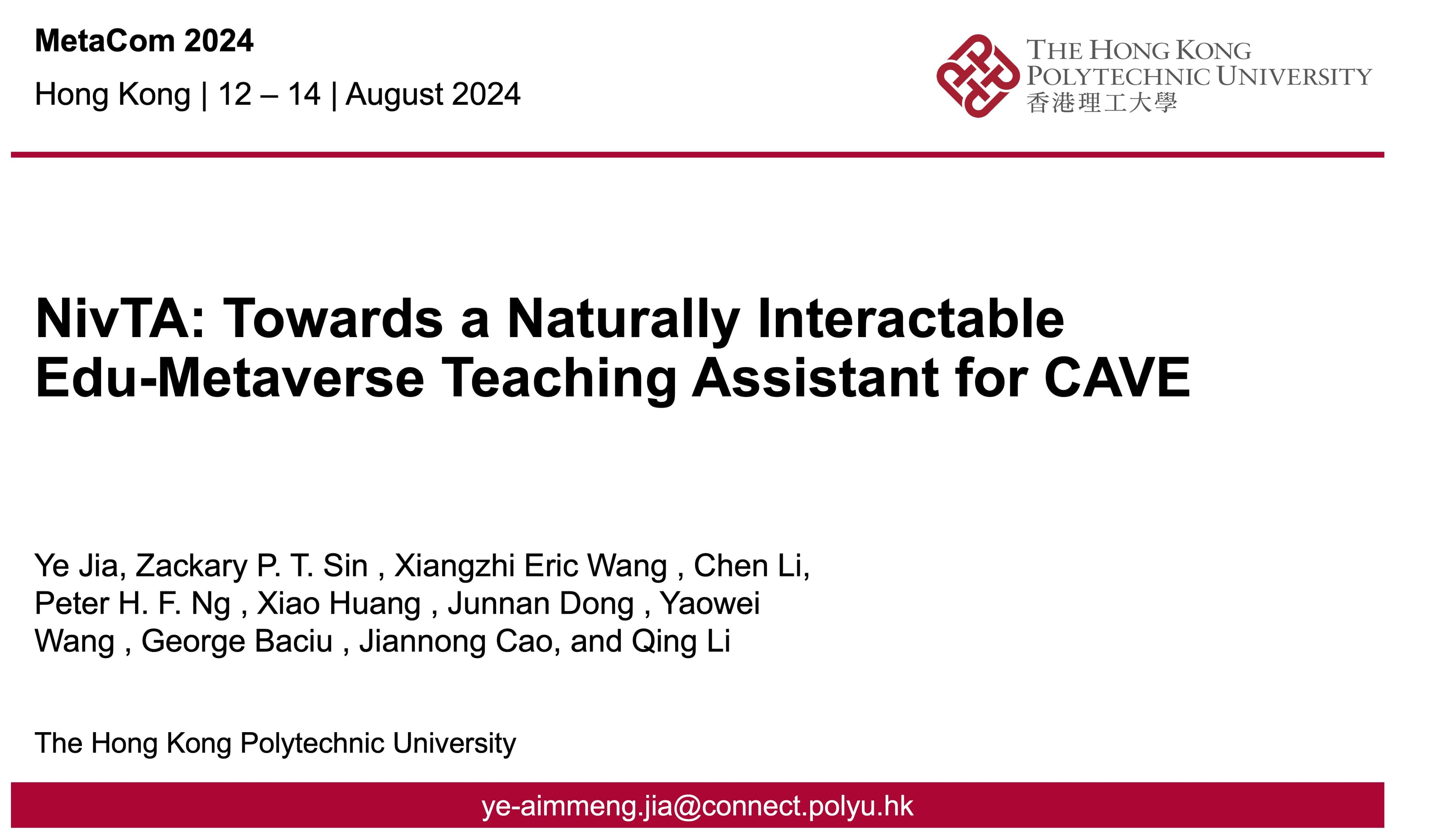
Video recording
Open videoPresentation slides
Open slidesAbstract
This presentation explores the development of natural interaction interfaces for educational metaverse environments, with a specific focus on CAVE (Cave Automatic Virtual Environment) systems. We examine how intuitive gesture-based and voice-based interactions can enhance the learning experience in immersive educational settings.
Key Topics Covered
- CAVE Systems: Understanding the architecture and capabilities of Cave Automatic Virtual Environments
- Natural Interaction: Implementing gesture recognition and voice commands for intuitive user interfaces
- Teaching Assistant Integration: Developing AI-powered assistants that respond to natural language and gestures
- Educational Applications: Real-world use cases and implementation strategies
- User Experience Design: Principles for creating seamless interaction experiences
Research Methodology
Our research involved extensive user studies with both students and educators, utilizing advanced motion capture technology and natural language processing to develop intuitive interaction paradigms.
Results and Implications
The findings demonstrate significant improvements in user engagement and learning efficiency when natural interaction methods are employed in CAVE environments. These results have important implications for the future of immersive education technology.
Technical Implementation
We discuss the technical architecture, including gesture recognition algorithms, voice processing systems, and the integration of AI teaching assistants within the CAVE environment.
Future Directions
The presentation concludes with a discussion of emerging trends in natural interaction technology and their potential applications in educational metaverse environments.
Conclusion
Natural interaction interfaces represent a significant advancement in educational technology, offering more intuitive and engaging learning experiences in immersive environments. Future research should focus on scalability and accessibility to ensure these benefits reach all students.