A scoping review on the role of virtual walking intervention in enhancing wellness
npj Digital Medicine2025Published online
Abstract
Virtual walking has the potential to be an adjunct to traditional physical therapy. This scoping review aims to synthesize evidence on the characteristics, effectiveness, feasibility, and neurological mechanism of virtual walking interventions on health-related outcomes. Articles in English were retrieved from twelve databases (January 2014–October 2024). Thirteen interventional studies were included, focusing on three types of virtual walking: passive observing moving (71.4%), arm swing locomotion (21.5%), and foot tracking locomotion (7.1%). Most studies (84.6%) involved individuals with spinal cord injuries, while the remaining studies focused on lower back pain (7.7%) and lower limb pain (7.7%). Over 70% of studies lasted 11–20 min, 1–5 weekly sessions for 10–14 days. Statistically significant findings included pain reduction (84.6%), improved physical function (mobility and muscle strength), and reduced depression. Mild adverse effects (fatigue and dizziness) were transient. Neurological evidence indicates somatosensory cortex activation during virtual walking, possibly linked to neuropathic pain.
What We Know About Virtual Walking
Virtual walking — using VR to simulate the experience of walking, whether through passive observation, arm-swing locomotion, or foot tracking — sits at the intersection of digital health, neurorehabilitation, and immersive technology. It is not a single intervention but a family of techniques united by a shared premise: that the brain's walking-related circuitry can be activated, and potentially retrained, through virtual rather than physical movement. This scoping review is the first systematic attempt to map the evidence landscape.
The review screened twelve databases covering January 2014 through October 2024, identifying 13 interventional studies that met inclusion criteria. The number is small — 13 studies in a decade — which is itself a finding. Virtual walking is not a mature field with dozens of RCTs; it's an emerging area where most published work is exploratory.
The Shape of the Evidence
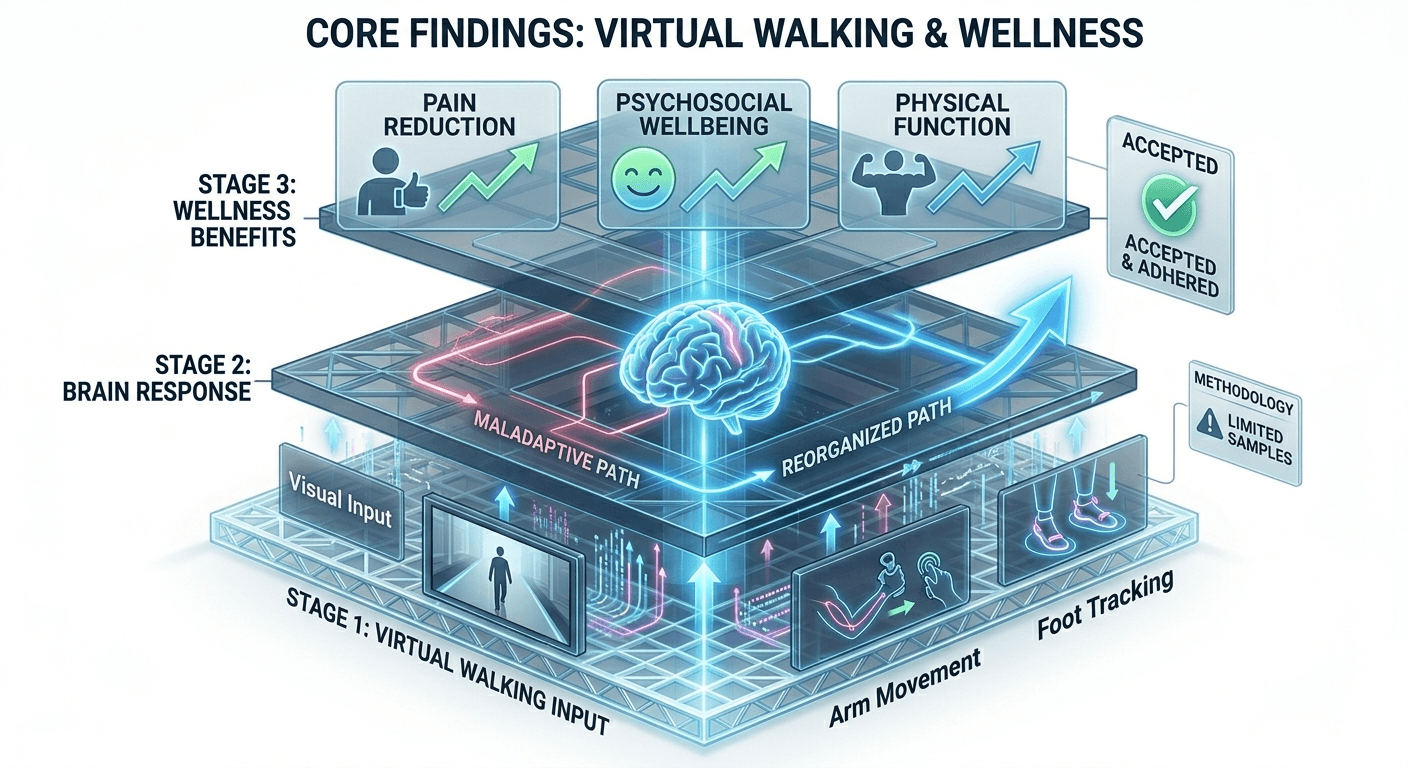
Three intervention types dominate: passive observing moving (71.4% of studies), where participants view a first-person walking simulation without physically moving; arm swing locomotion (21.5%), where arm movements control virtual walking speed and direction; and foot tracking locomotion (7.1%), where foot sensors or treadmills drive the virtual movement. The distribution is telling: the easiest technique to deploy (passive observation — essentially a 360-degree walking video) accounts for nearly three-quarters of the literature. The more technically demanding techniques that might produce stronger embodiment effects are barely represented.
The population concentration is even starker: 84.6% of studies focused on spinal cord injury (SCI) patients, with the remainder split between lower back pain and lower limb pain. This concentration makes sense clinically — SCI patients have a clear neuropathological target for walking-related interventions — but it means the evidence base for other populations (stroke, Parkinson's, amputation, chronic pain more broadly) is essentially absent. Whether virtual walking benefits generalize beyond SCI is unknown.
The dosing pattern is consistent: over 70% of studies used sessions of 11–20 minutes, delivered 1–5 times per week, over 10–14 days. This is a light intervention by rehabilitation standards, and the consistency is likely an artifact of what's practical in a research setting (short sessions reduce dropout, short study durations fit grant cycles) rather than what's clinically optimal.
What the Evidence Shows
Three outcome domains show statistically significant effects:
-
Pain reduction (84.6% of studies). This is the most robust finding, and the neurological evidence provides a candidate mechanism: somatosensory cortex activation during virtual walking, observed across multiple studies, may interfere with neuropathic pain processing. The hypothesis — not yet confirmed causally — is that virtual walking engages the same cortical real estate that neuropathic pain occupies, essentially competing for neural bandwidth.
-
Improved physical function, including mobility measures and muscle strength. Whether these improvements reflect actual physiological change or increased confidence in movement (reduced kinesiophobia) is unclear from the current evidence.
-
Reduced depression. This is the least expected finding and the most intriguing. If virtual walking improves mood in SCI patients — who face substantial psychological comorbidities — the mechanism could be anything from the distracting effect of immersive VR to the activation of motor planning circuits that are linked to mood regulation. The studies don't disentangle these possibilities.
Adverse effects (fatigue, dizziness) were mild and transient, and no study reported cybersickness severe enough to cause dropout. This is noteworthy because cybersickness is a persistent concern in VR research; the low incidence here may reflect the brevity of sessions and the passive nature of most interventions (less optical flow = less sickness).
The Gaps That Define the Field
The most important contribution of a scoping review is often the map of what's missing. Here, the gaps are substantial:
- No studies on active locomotion techniques with clinical outcomes. Foot tracking and arm swing exist as technical demonstrations but haven't been tested against pain, function, or mood in controlled designs. Given that active movement likely produces stronger embodiment and motor cortex activation than passive observation, this is the most consequential gap.
- No long-term follow-up. The longest study duration was 14 days. We have no evidence on whether virtual walking effects persist, decay, or compound with extended use.
- No dose-response data. The field has converged on 11–20 minute sessions without testing whether 5 minutes or 45 minutes would work better, or whether daily sessions outperform weekly ones.
- No comparative effectiveness studies. Virtual walking has not been compared against conventional physical therapy, pharmacological pain management, or other digital interventions. Without these comparisons, "virtual walking works" is less useful than "virtual walking works better/worse than the standard of care."
- Mechanism studies are correlational, not causal. Somatosensory activation during virtual walking is observed, but whether this activation causes pain reduction, or is merely correlated with it, has not been tested through experimental manipulation (e.g., varying the intensity of somatosensory engagement and measuring the dose-response of pain).
Where This Sits
This review is methodologically straightforward — it follows PRISMA-ScR guidelines for scoping reviews — but its value is in consolidation. Before this paper, the virtual walking literature was scattered across rehabilitation journals, VR conference proceedings, and clinical neurology outlets, with no common vocabulary or shared framework. The review provides both: it taxonomizes the intervention types, maps the population distribution, and identifies the outcome domains where evidence is strongest and weakest. It is a foundation for grant proposals and trial designs, not a clinical practice guideline.