PockeTA: Virtual Teaching Assistant Platform with Course Context
ICWL 20252025Accepted
Abstract
Teaching assistants (TAs) are essential for scalable, high‑quality university education, yet most institutions face persistent constraints in TA-to-student ratios, limiting timely feedback and personalized support. At the same time, large language models (LLMs) are rapidly being adopted in education, but typical deployments treat them as generic chatbots, lacking course awareness, pedagogical grounding, and meaningful integration with instructors’ workflows. In this work, we present PockeTA, an ubiquitously accessible virtual teaching assistant platform that tightly couples LLM-based multi-agent intelligence with a teacher-controlled, graph-based knowledge base (K-Cube). PockeTA provides a personified avatar interface on both desktop and mobile, supports multimodal interaction (text, document sharing, interactive drawing), and is deeply aware of course structure and materials through K-Cube integration. Student interactions are continuously collected, organized as learning analytics, and visualized to help instructors monitor learning progress, identify misconceptions, and refine teaching. We describe the overall system design, including its multi-agent architecture and knowledge-graph integration, and report initial findings from a beta deployment with university students. Early user feedback indicates that PockeTA complements human TAs by providing always-available, context-aware support, while giving teachers unprecedented visibility and control over the virtual assistant’s behavior and course context. Our results suggest that PockeTA offers a promising path toward scalable, course-grounded virtual TAs that go beyond generic LLM interfaces to support both learners and educators.
The TA Bottleneck
University courses, particularly in technical disciplines, depend on teaching assistants to provide the individualized feedback that lectures cannot. But TA-to-student ratios are constrained by budget, availability, and institutional policy. Most students get fewer contact hours with instructors than they need, and the bottleneck is structural — hiring more TAs doesn't scale. LLM-based tools (ChatGPT, Khanmigo, custom GPTs) have been proposed as a solution, but they operate outside the instructional loop: they answer student questions without awareness of what was taught, what comes next, or what the instructor considers important. PockeTA attempts to close this loop by making the virtual TA both course-aware and instructor-observable.
The Two-Sided Architecture
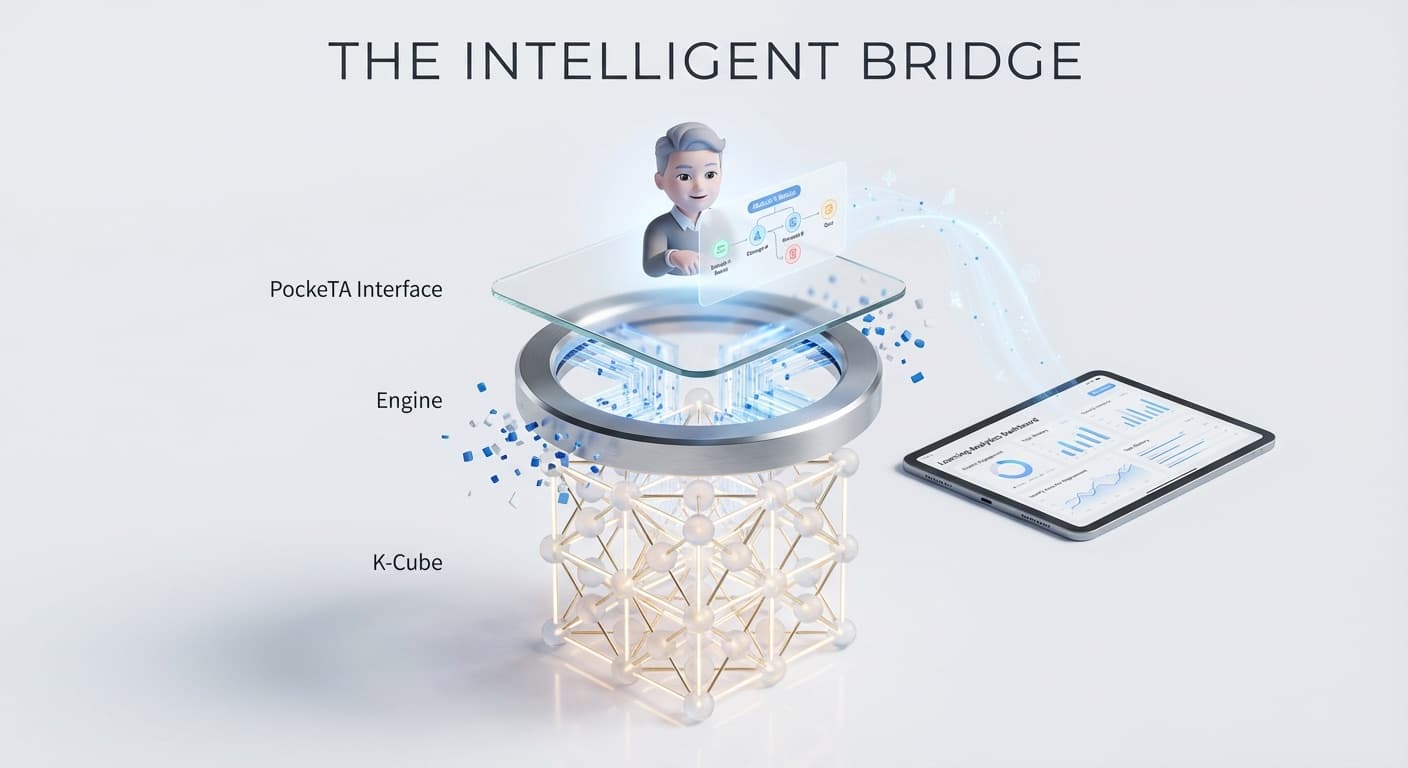
PockeTA's design is organized around a distinction that most LLM-for-education tools collapse: the student side and the instructor side.
Student side: A personified avatar interface accessible on both desktop and mobile, supporting multimodal interaction — text chat, document sharing, and interactive drawing on shared whiteboards. The interface is designed to feel like talking to a human TA rather than typing into a chatbot. The multi-agent LLM architecture assigns different agents to different responsibilities (one agent handles course content questions, another handles administrative queries, a third manages the drawing and visual explanation functionality), reducing the hallucination risk that comes from a single agent trying to do everything.
Instructor side: A learning analytics dashboard that collects student interaction data — what questions are being asked, which concepts are generating confusion, where students are spending time — and visualizes patterns. This is the system's most significant contribution. Instead of the virtual TA operating as a black box between the instructor and the student, the instructor can see what the TA is being asked and how it's responding. They can identify misconceptions emerging across the class, spot topics that need re-teaching, and adjust the TA's behavior by modifying the underlying knowledge graph.
The K-Cube knowledge graph is the bridge between the two sides. It provides the TA with course structure and domain knowledge (making answers contextually grounded), and it provides the instructor with a structured representation of what the TA "knows" — which they can audit, extend, and correct. A generic LLM asked about gradient descent will give a generic answer; PockeTA, through K-Cube, knows that gradient descent was introduced in week 3, builds on the week 2 material on partial derivatives, and leads into the week 5 assignment on neural network training.
The Deployment Signal
Unlike many edu-metaverse papers that report on controlled lab studies, PockeTA was deployed in a beta with actual university students using the system as part of their coursework. The paper reports "initial findings" — early-stage, qualitative, not a controlled experiment — but the deployment context matters. It means the system was robust enough to handle real student traffic, that the knowledge graph was populated with actual course content, and that the instructor analytics surfaced real teaching insights rather than hypothetical ones.
Early feedback indicates that students used PockeTA as a complement to human TAs rather than a replacement — asking it quick clarification questions they might not bother a human TA with, while saving complex conceptual questions for office hours. This division of labor (routine queries → AI, deep questions → human) may be the most practical deployment model for virtual TAs, and it's one that the "AI will replace TAs" narrative misses entirely.
How This Relates to NivTA
PockeTA is the successor to the NivTA system presented at MetaCom 2024. The evolution is instructive: NivTA was a CAVE-VR-based system optimized for immersive, co-located interaction in a physical lab. PockeTA abandons the CAVE form factor entirely in favor of desktop and mobile platforms. The reasoning is practical — a TA that requires students to physically visit a VR lab is a TA that students won't use at 11pm when they're studying for an exam. The shift from immersive hardware to ubiquitous access represents a design judgment: for virtual teaching assistants, availability beats immersion. The personified avatar is retained (preserving the social presence benefits from NivTA), but the delivery channel is pragmatic.
Boundaries
The evaluation is preliminary. The paper reports on a beta deployment with user feedback, not a controlled comparison against a baseline (e.g., PockeTA vs. ChatGPT vs. human TA alone). Learning outcome data, rigorous engagement metrics, and long-term retention measures are not reported. The multi-agent architecture is described conceptually but the specific agent designs, their interaction protocols, and the fallback mechanisms when agents disagree are not detailed enough for replication.
The learning analytics dashboard processes student interaction data, but the paper does not address privacy considerations — students asking a virtual TA questions may not expect those questions to be visible to their instructor. Managing the tension between instructor visibility (pedagogically useful) and student privacy (ethically necessary) is a design challenge that the current system does not fully resolve.
The K-Cube knowledge graph, as in NivTA, must be manually constructed per course. The platform's scalability across dozens or hundreds of courses depends on KG construction efficiency, which is not demonstrated. And the beta deployment, while encouraging, was at a single institution with courses taught by the research team — the step from "works for us" to "works for anyone" is where most educational technology platforms fail.
Publication history
Paper Accepted
Our paper has been accepted on October 23, 20202520.