Towards Effective Collaborative Learning in Edu-Metaverse: A Study on Learners’ Anxiety, Perception, and Behaviour
Proceedings of the International Conference on Web-based Learning (ICWL) 20242024
Abstract
In the evolving landscape of educational technology, EduMetaverse presents a unique technological platform for collaborative learning (CL), which can be especially useful in distance learning settings. Researchers have taken a keen interest in the potential of Edu-Metaverse for enabling and improving CL; however, the effects of various factors on CL behaviours and performance still need to be fully understood. This study used a within-subjects design involving 32 participants (16 females and 16 males) to investigate how learners’ attributes and environmental attributes affect CL in Edu-Metaverse. The participants were randomly assigned to groups of four for a CL session in Edu-Metaverse. The confirmatory factor analysis revealed that various behavioural metrics in Edu-Metaverse mediated the effects of trait anxiety and virtual space satisfaction on CL performance; perceived understanding of messages, under the umbrella of social presence, also had a direct effect on CL performance. These insights underscore the importance of optimising interactive, perceptual, and social components to make CL more effective in Edu-Metaverse.
What We Already Knew and What We Didn't
By 2024, the edu-metaverse literature had established that collaborative learning (CL) could happen in VR and that learners generally reported positive experiences. What was missing was a mechanistic account: through what pathways do individual differences and environmental perceptions actually affect how people collaborate and what they learn? Without this, design recommendations were essentially guesswork — make the space nicer, reduce anxiety, improve communication. This paper provides the mechanistic account.
The Study Design
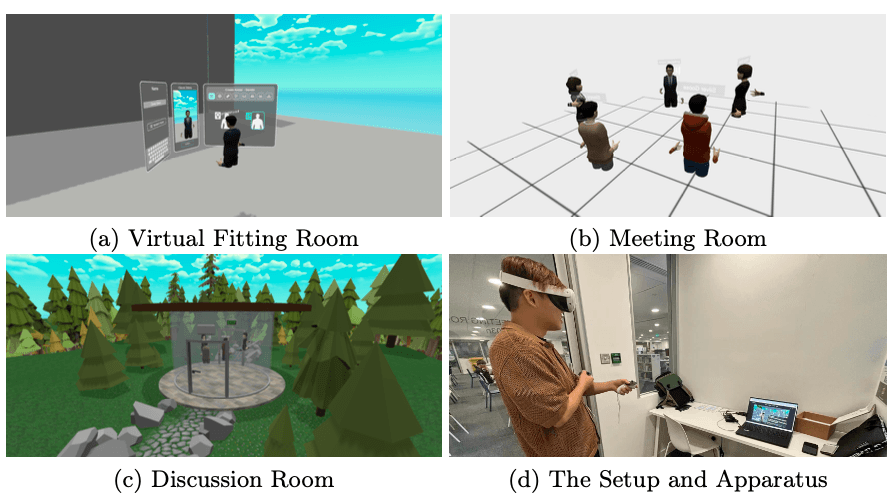
Thirty-two participants (16 female, 16 male) were randomly assigned to groups of four for a collaborative learning session in an Edu-Metaverse environment. The within-subjects design exposed all participants to the same virtual collaborative space, controlling for platform variation. The authors measured three categories of variables:
- Learner attributes: trait anxiety (a stable individual difference in anxiety proneness)
- Environmental perception: virtual space satisfaction (how comfortable and usable participants found the VR environment)
- Social-perceptual factors: social presence, specifically operationalized as perceived understanding of messages — do you feel your teammates understand what you're saying?
The outcome was collaborative learning performance, assessed through group task completion. Behavioral metrics in the metaverse (interaction frequency, communication patterns, navigation behavior) were measured as potential mediators.
The Path Model
The headline result is a structural model in which behavioral metrics in Edu-Metaverse mediate the effects of both trait anxiety and virtual space satisfaction on CL performance. This is more specific than it sounds. It means:
- Trait anxiety does not directly suppress learning — it suppresses the behaviors that enable learning (participation, verbal contribution, exploratory movement). Fix the behavior, and you may bypass the anxiety barrier.
- Virtual space satisfaction does not directly boost learning — it enables the behaviors that produce learning. A well-designed space makes people move, talk, and interact more; those behaviors then drive performance.
- Perceived understanding of messages has a direct effect on CL performance, unmediated by behavioral metrics. This is the one factor in the model that doesn't go through a behavioral pathway — if you feel understood, you learn better, regardless of how many times you clicked on something.
The practical implication is non-obvious: if you have limited resources to improve a collaborative metaverse experience, invest first in communication clarity (reducing misunderstanding), second in environmental usability (reducing friction that suppresses interaction), and third in anxiety interventions (which matter, but through behavioral channels that the first two also influence).
Why This Matters for Design
The distinction between mediated and direct effects is the paper's most actionable insight. Many edu-metaverse platforms invest heavily in graphical fidelity and spatial features under the assumption that a "better" environment directly improves learning. This model suggests otherwise: environment quality matters insofar as it changes what people do. A visually stunning virtual classroom where nobody talks is worse than a low-poly space with rich interaction. The behavioral metrics are the mechanism; everything else is infrastructure.
The direct effect of perceived message understanding also reframes the social presence conversation. "Social presence" in VR is often treated as a byproduct of avatar realism or spatial audio fidelity. This study suggests a different emphasis: presence is primarily about being understood, which depends as much on communication protocols, turn-taking design, and feedback signals as on rendering quality. A well-designed non-verbal cue system (nodding, pointing, reaction gestures) may contribute more to CL performance than photorealistic avatars.
Boundaries
The sample is modest (32 participants) and drawn from a university population, limiting generalizability to other age groups and cultural contexts. The within-subjects design controls for individual differences in platform response but limits the ability to compare across different metaverse platforms — we don't know whether these path coefficients would replicate in a different VR environment with different interaction mechanics. The CL session was a single session; long-term collaborative dynamics (trust-building, role negotiation, group norm formation) are outside the model's scope. And trait anxiety was measured as a stable attribute, but state anxiety — how anxious participants felt during the VR experience — was not separately modeled, so the distinction between "anxious people collaborate less" and "people who got anxious in this particular VR session collaborated less" remains unresolved.