Towards an edu-metaverse of knowledge: Immersive exploration of university courses
IEEE Transactions on Learning Technologies2023
Abstract
Metaverse, an alternative universe for play, work and interaction, has become a captivating topic for academia and industry in recent times. This opens the question on what a metaverse for education, or edu-metaverse, should look like. It is believed that this metaverse for learning should be grounded by a pedagogical theory. Particularly, we propose a constructivist metaverse learning theory with eight actionable principles to guide the edu-metaverse and its applications. With this metaverse learning theory, we further propose the framework for an edu-metaverse; it is essentially walkable yellow pages that connect knowledge. The core idea is to combine the structure of knowledge graphs and the immersion of virtual reality in order to facilitate association, exploration and engagement in learning. Our current prototype for this edu-metaverse vision, K-Cube VR, is also presented. We have tested K-Cube VR for the introduction of course topics to our students and the results indicate that our edu-metaverse framework benefits students by providing a focused environment and structured learning on the topics of a course, akin to a mind map. Overall, in this paper, we present an edu-metaverse design that is rooted in a constructivist pedagogy that already shows promising results from a pilot user study via our metaverse prototype.
The Core Problem
By 2023, "metaverse for education" had become a buzzword with no pedagogical backbone. Platforms existed (Engage, Mozilla Hubs, Horizon Workrooms) but they were being used as virtual classrooms — 3D video conferencing with avatars — without a theory of how the metaverse's spatial affordances could support learning specifically, rather than just telepresence generically. This paper attempts to fill that gap at the architectural level: it asks not "can we teach in VR?" but "what should an edu-metaverse be designed to do?"
The Constructivist Metaverse Learning Theory
The paper's first contribution is a pedagogical theory tailored to metaverse learning, grounded in constructivism but operationalized into eight actionable principles. These are not abstract values; each is a design constraint that directly shapes the platform architecture:
- Embodiment — learners are represented as avatars with spatial presence; learning happens through situated action, not passive observation
- Active Learning — the environment must afford manipulation, experimentation, and construction, not just navigation
- Social Interaction — multi-user co-presence with communication channels that support collaborative knowledge building
- Contextual Learning — knowledge objects are placed in meaningful spatial contexts that reveal relationships
- Scaffolding — the environment guides learners through progressively complex concept structures
- Exploration — free spatial navigation through knowledge, supporting self-directed discovery
- Association — spatial proximity and visual links encode conceptual relationships (near = related)
- Engagement — immersive presence sustains attention through environmental richness
The key move here is that these principles are testable. They are not a philosophy; they are a spec. You can look at a metaverse learning platform and ask: does it satisfy principle 4? Principle 7? This operationalization is what distinguishes the framework from earlier vision papers.
The Knowledge-Graph-Driven Architecture
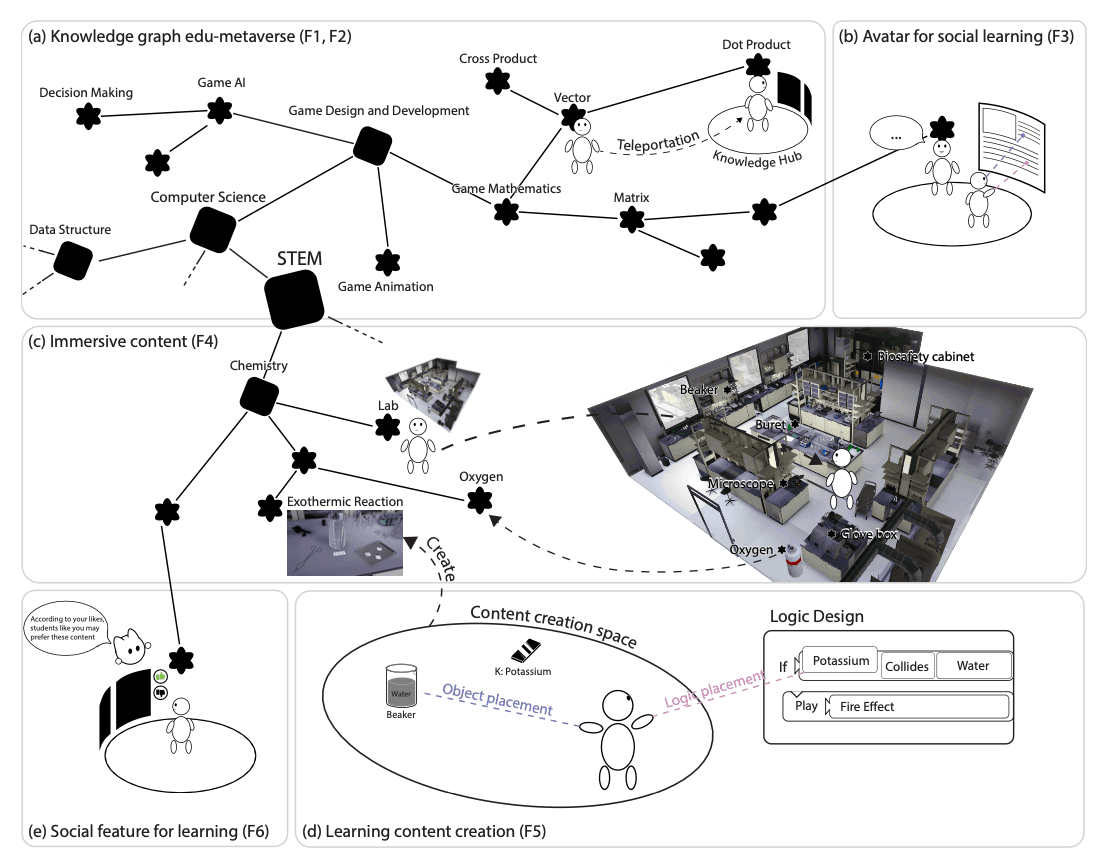
The second contribution is the framework itself: an edu-metaverse structured as a walkable knowledge graph. The core idea is deceptively simple — concepts become spatial nodes, relationships become navigable edges. A course on machine learning, for instance, becomes a landscape where "supervised learning" is a region, "neural networks" is a connected sub-region, and "backpropagation" is a node within it. Walking from one concept to another is navigating the knowledge structure.
This matters because it exploits a property that VR uniquely possesses: spatial memory. Humans are better at remembering locations than lists. By mapping conceptual structure onto spatial structure, the framework gives learners a cognitive scaffold — the mental map of "where things are" becomes a proxy for "how things relate." This is fundamentally different from a 2D mind map or a wiki; it uses embodied spatial cognition as a learning mechanism, not a display technique.
K-Cube VR and the Pilot Study
The third contribution is K-Cube VR, a prototype built on this framework. K-Cube presents course topics as interconnected 3D nodes in a persistent virtual environment. Each node contains learning materials (slides, videos, interactive content) and links connect related topics across courses. Students navigate the knowledge space freely or follow guided paths.
The pilot study, conducted with university students exploring course topics in K-Cube VR, found three effects: students reported focused attention (the immersive environment reduced distraction compared to web browsing), structured understanding (the spatial layout helped them organize relationships between topics), and higher engagement with course introductory materials compared to traditional syllabi or LMS pages. The study is small — it tests introduction to course topics, not complete course delivery — and the authors acknowledge that the effects may be partially attributable to novelty. But the signal is directionally consistent with the spatial-cognition hypothesis: if knowledge is structured in space, learners build better mental models of that structure.
What This Enables and What It Doesn't
The edu-metaverse framework provides a design language that did not previously exist. Before this paper, the conversation was "VR + education = ?" After it, the conversation becomes "which of the 8 principles does your platform satisfy, and how does your knowledge graph encode domain structure?" This is a meaningful advance in specificity.
The boundary is clear: the framework has been validated for course topic introduction — helping students understand what a course covers and how its concepts relate — not for full course delivery, not for assessment, not for skill acquisition. Generalizing beyond orienteering tasks requires evidence the paper does not provide. The 8 principles are derived from constructivist theory, not from empirical decomposition — a study that isolates each principle's contribution to learning outcomes is the natural next step. And the knowledge graph construction is manual: scaling this to hundreds of courses requires automation that K-Cube does not demonstrate. The paper opens a research program; it does not close one.