IJHCS 2026 | Meditation Needs Prompts Too? More Control May Not Mean More Calm
In a 48-person trial, the group that generated their own VR scenes scored higher on mindfulness but showed no extra anxiety relief. Some treated prompting like gardening; others worried about performing poorly. When resting, when does authorship become a burden?
Put on a VR headset and you meant only ten quiet minutes. Now the system offers another choice: write the place you want to go, and let AI generate the view in front of you. Forest, lake, a warm sky — all yours to decide. It sounds more thoughtful than picking among a few presets.
But some people do begin to relax, while others start wondering: is my description good enough, and will the next image be worse? A randomized controlled trial with 48 people found that the group generating their own scenes scored higher on mindfulness after practice, yet anxiety reduction was not clearly better than choosing ready-made scenes.
What I find most worth reading is that the paper does not treat participation in creation as always good. When someone comes here to rest, more decision rights can also mean more work to do. That poses a practical question for generative AI experience design: when should you invite people in, and when should you let them stop?
01 Writing your own prompts adds more than choice
The authors discuss two kinds of control separately. Picking among lakeside, forest, and coast is selection; describing an image in your mind and watching it become the surrounding environment is authorship. Both can change the scenery, but the latter adds a layer of personal intent: why this landscape looks as it does is tied to what you just wrote.
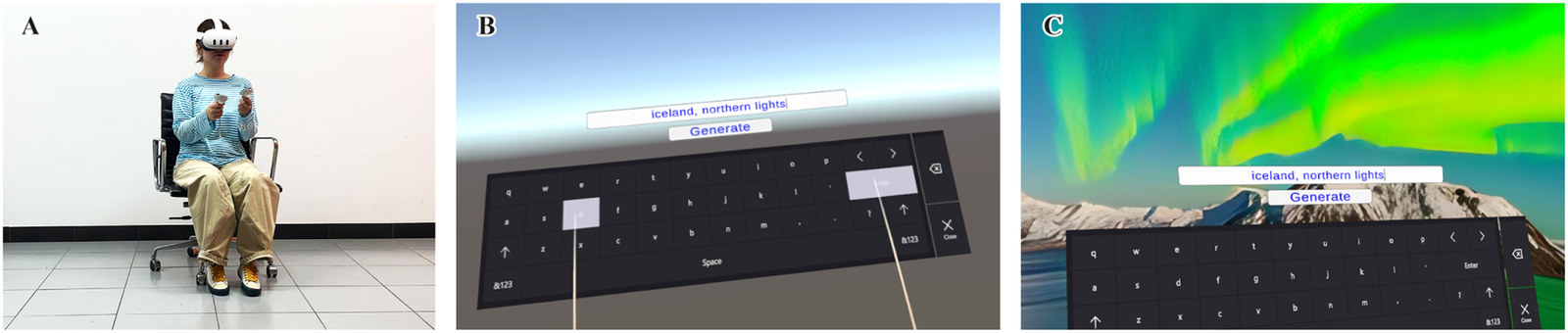
Figure 1 shows the apparatus and input interface. Participants wore a Meta Quest 3, typed one or two short descriptions on a virtual keyboard, and the system generated panoramas via Stable Diffusion and ComfyUI, then presented them in Unity. This is not a one-sentence generation of a walkable, touchable full 3D world.
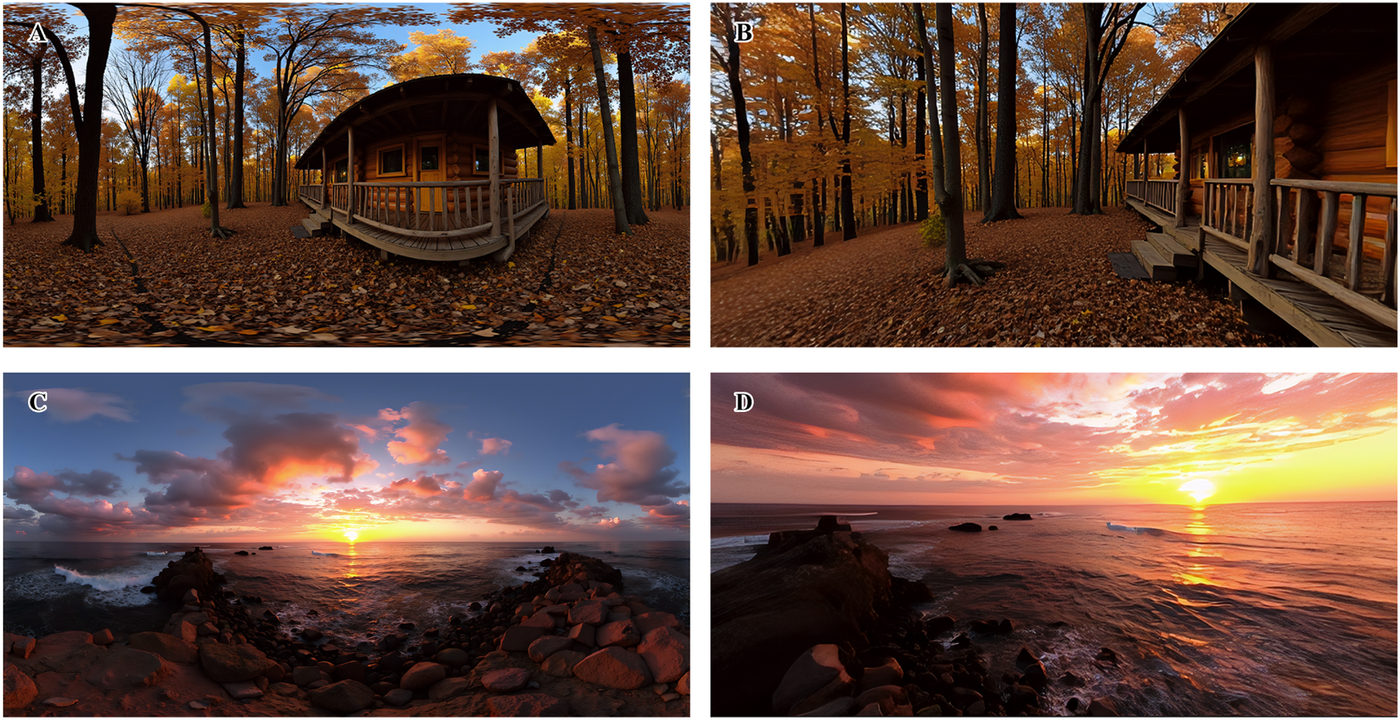
Both groups used static 360-degree natural panoramas. The paper’s “8K” refers to panorama source resolution — not the headset’s display resolution, and not real-time scene motion. The authors kept presentation form as aligned as possible in order to observe experiential differences from the semantic authoring step.
Figure 2’s upper row shows sample scenes and in-headset views for the generation condition; the lower row shows presets. They are not a simple good-versus-bad image contrast. The generation group obtained more personalized content and also invested effort in describing and adjusting — those two parts were not separated in this experiment.
02 The control group also had choices — the difference is who authors
The study ultimately included 48 university students aged 18–25, 24 per group. They had screening-identified subclinical anxiety symptoms; this is not a clinical trial for people with diagnosed anxiety disorders. Participants had no prior immersive VR experience and no formal mindfulness training.
The generation group could generate one scene first, then add up to two more generations; the preset group chose among lakeside sunset, forest clearing, and seaside sunrise, with up to two switches. Both groups heard the same ten-minute guided breathing audio and could encounter at most three scenes. So the control condition was not stripped of all control.
Generation also meant waiting. Each took about 20–30 seconds; the ten-minute practice started timing after the first image finished, and during later generations the old scene remained visible. That avoided waiting on a black screen, but did not remove uncertainty about results; later interviews show some people worried during that wait that the image would fall short of expectations.
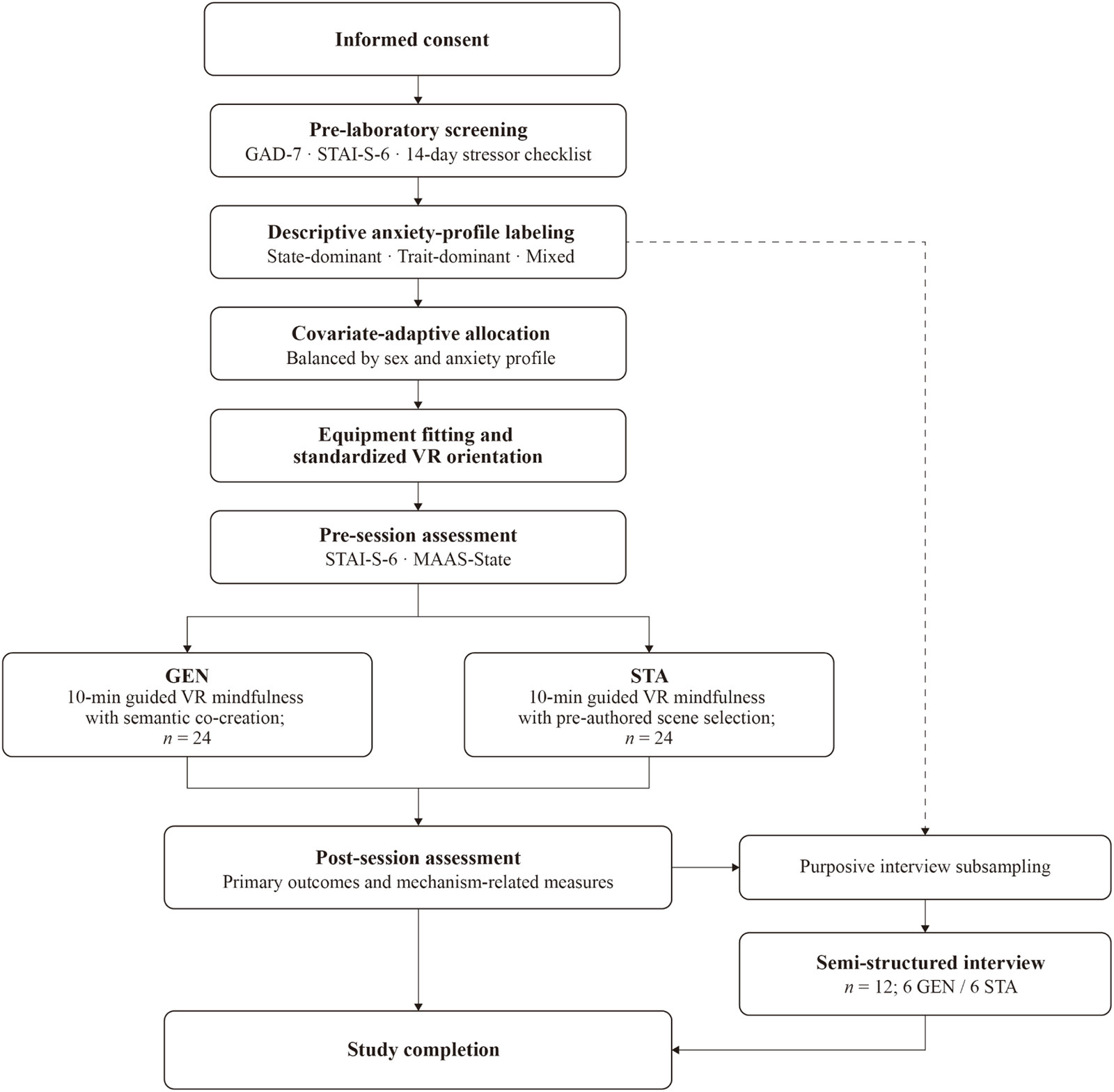
As Figure 3 shows, researchers measured before and after practice, then interviewed six people from each group. Questionnaires compared short-term change; interviews asked why the same feature delighted some and overwhelmed others. Interviewees were purposively selected — one cannot compute how common a feeling is across all users from that alone.
03 A signal of greater focus cannot be read straight as greater anti-anxiety effect
After controlling for baseline scores before practice, mean state mindfulness was 3.56 for the generation group and 3.08 for the preset group, both with SE 0.16. The scale is reported as item means on a 0–6 range. The primary analysis p-value was 0.039, partial η² 0.09 — supporting higher post-practice scores for the generation group.
With another analysis approach, though, the conclusion is less stable. Comparing change scores directly between groups, the direction was the same but p = 0.058, missing the commonly used 0.05 threshold. Highlighting only 0.039 would omit that uncertainty.
Anxiety results deserve separate telling. Both groups reported decreases after practice, but the baseline-adjusted between-group difference had p = 0.828; change-score comparisons also found no difference. In other words, this trial did not detect extra anxiety relief from self-generating scenes — the mindfulness-score advantage cannot be moved onto anxiety.
Figure 4 shows state mindfulness on the left and state anxiety on the right. The lines plot unadjusted before/after means with one SE; p-values marked on the figure come from ANCOVA and should not be read as if the line endpoints were the adjusted means above. Reading both figures together makes it harder to miss the paper’s most important divergence.
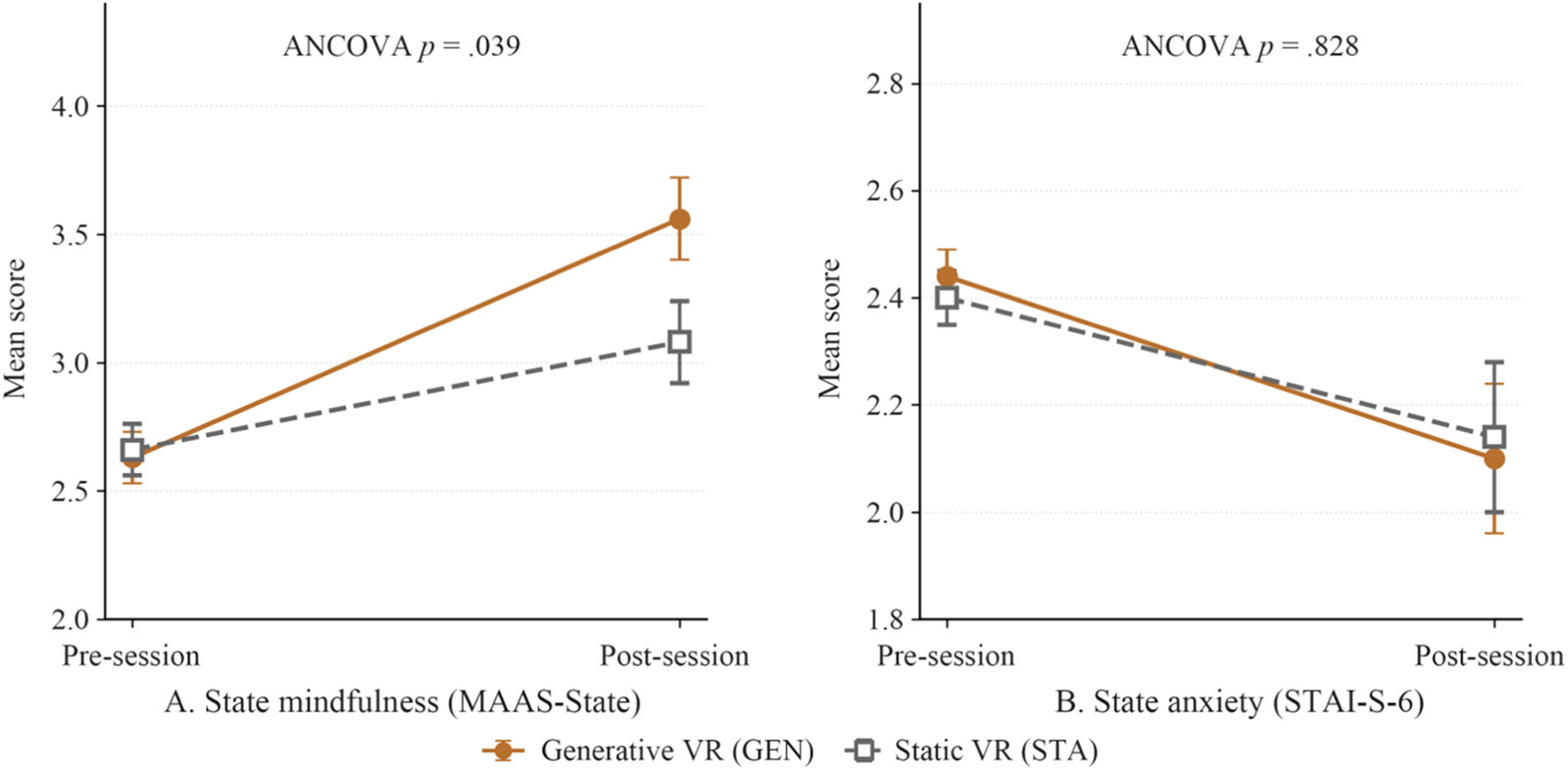
Both groups declining also does not prove a therapeutic effect of VR or AI. There was no no-intervention group; breathing guidance, rest, and other shared factors were not separately ruled out. And finding no between-group difference does not prove the two approaches are fully equivalent either.
04 Stronger authorship feelings do not mean the psychological mechanism is proven
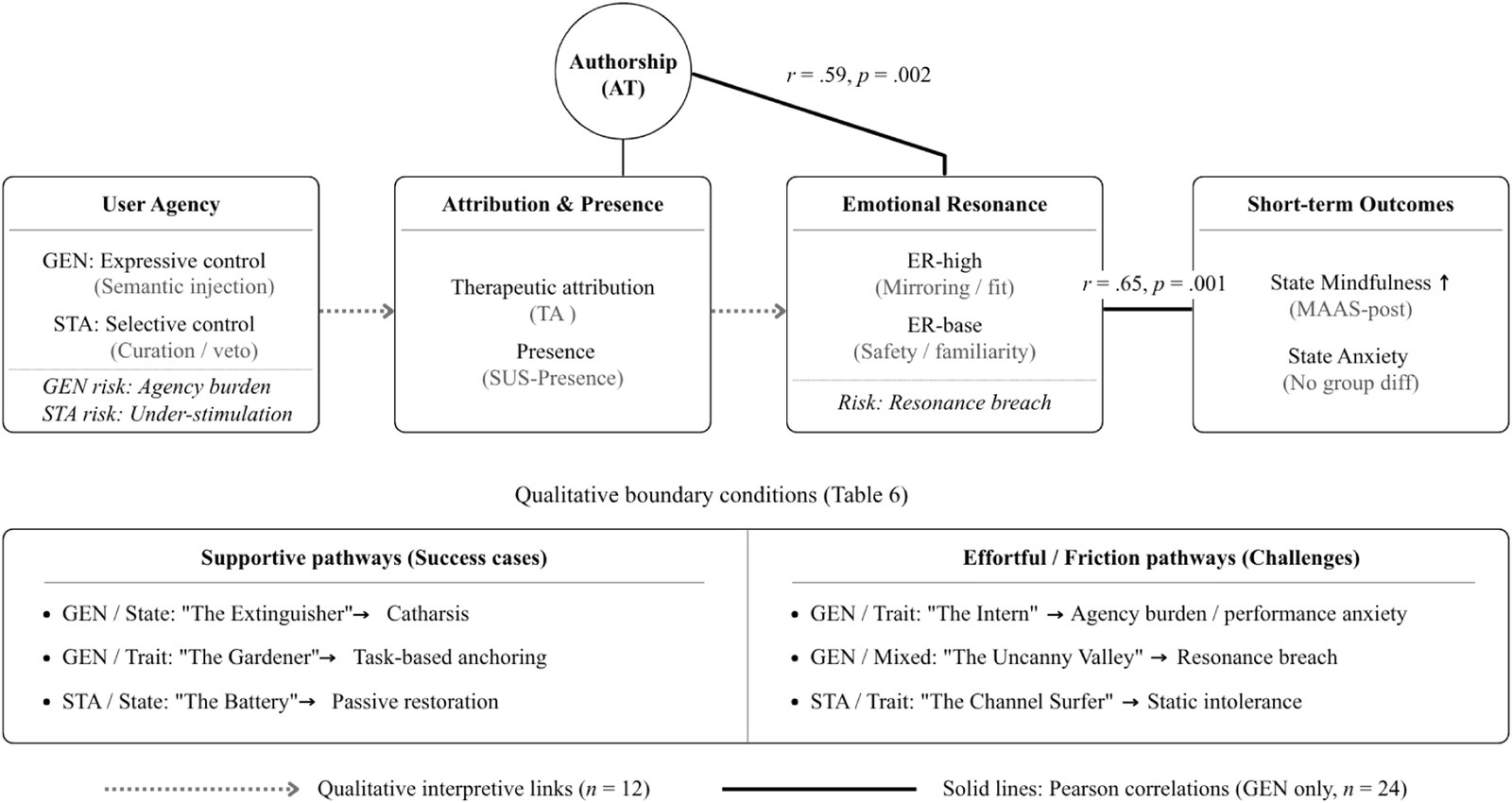
The authors’ proposed account: authoring one’s environment may make people feel more that they participated in forming the space, and more willing to attribute improvements in feeling to their own actions. Figure 5 is the paper’s theoretical framework. It links agency, generative presence, self-attribution, and affective resonance — it is not a causal path diagram already validated by data.

On the questionnaire, the clearest differences were on study-authored measures of expressive control and creator feeling: generation group 4.46 and 4.25; preset group 3.00 and 3.11; Hedges’ g 1.81 and 1.33. That fits the manipulation: people who wrote prompts more readily felt they participated in creation.
More general autonomy and competence measures did not detect between-group differences; existing attribution scales likewise. Not every scale was flat — spatial presence was higher — but the largest gaps appeared on self-authored items that directly asked about expression and creation experience. Feeling one participated in creation, and a general lift in autonomy, remain two different things.
Within the generation group, creator feeling correlated with affective resonance, r = 0.591; affective resonance correlated with post-practice mindfulness, r = 0.652. But these are simultaneous self-reports collected after practice. People who felt overall good may rate every item high — correlations do not tell us which came first.
Self-authored scales also lack independent psychometric validation, and multiple exploratory tests had no multiple-comparison correction. These results are not enough to claim AI improved mental health by strengthening creator identity. Affective resonance also measures how well people feel the scene fits them — not that the system truly understood emotion.
05 Some tended a garden; others felt handed another assignment
Generation-group P11 likened repeatedly adjusting the scene to gardening: having a moderate thing to do kept attention from being wholly occupied by worry. P04 stressed in interview realizing they could actively change the scene and attributing the soothing feeling to their own actions. This relays participants’ experience — not an adjudication of where therapeutic effect comes from.
Generation-group P15 reacted the opposite way. Writing prompts linked, for this participant, to a task of delivering a good solution — worry about being creative enough, about poor results, unease while waiting. The same authorship permission became performance pressure. The system did not score people; people began scoring themselves.
A more concrete failure came from P47: a generated scene’s cat had unnatural paws and eyes; the stillness also felt uncomfortable and interrupted meditation. The system filters prompts for violence, self-harm, and similar content, but cannot block this kind of visual dissonance. Content that does not hit a safety word list does not guarantee the person who sees it feels at ease.
The preset group was not only passive and bored. P14 recalled a grandmother’s village from a ready-made scene — familiarity itself could move emotion; P02 only wanted a short rest and did not want to spend more mental effort for rest. Of course, some could not stand static scenery and grew bored and ruminative. Fewer operations are not naturally better — nor are more.
Figure 6 summarizes these differently directed experiences. Solid lines mark exploratory correlations within the generation group; dashed lines mark interview-supported interpretive links. In particular, anxiety-type labels on the figure must not be used as assignment rules: the sample is small, opposite experiences appear under the same labels, and the study did not establish rules for choosing features by type.
06 Letting people not author should also count as a form of control
For designers, this material suggests a choice: first offer scenes one can enter directly, then let people who want to express gradually modify — rather than making a blank prompt box a required step for rest. The authors also discuss staged control and prompt support. Those remain design suggestions; this experiment did not compare which guidance scheme works best.
Equally worth keeping is the right to refuse. Preset-group P44 cared more about excluding unwanted views than owning as many options as possible. If participation count becomes the quality metric, that need is easy to miss. Someone who stops generating may lack interest — or already be satisfied, or finally willing to stop.
The study also lacks a useful control: another group watching the same generated content without writing prompts themselves. That would move closer to asking whether the difference comes from scenery that fits better, or from hands-on authorship. The authors’ proposed matched playback control aims to further separate those accounts.
Back to this trial: 48 students, one ten-minute practice, no long-term follow-up, no physiological measures. Far from promising sustained anxiety improvement. I prefer to take it as a product-design reminder: just because AI can let everyone author, do not assume everyone wants to be an author right now.
Paper informationOriginal title: From control to authorship: Exploring how user agency relates to generative presence and therapeutic self-attribution in AI-driven VR mindfulness.
Authors: Kuan Zhang, Junping Xu, Yuming Wang, Kewei Zhang, Jinho Yim. Primary affiliations are Kookmin University (Korea) and Zhejiang University; corresponding author Jinho Yim. This post is a third-party research reading.
Venue: International Journal of Human–Computer Studies, volume 218, article 103928, volume year 2027; published online 3 September 2026. The “2026” in the title refers to the online publication year. Paper link: https://doi.org/10.1016/j.ijhcs.2026.103928.
Key termsState mindfulness: this study measures present attention to and awareness of experience — not long-term mindfulness ability, and not clinical recovery. State anxiety: anxiety felt in the moment; the two outcomes must be judged separately.
Generative presence: beyond feeling situated in an environment, feeling one participated in creating it. Therapeutic self-attribution: attributing perceived improvement to one’s own actions — measuring people’s explanations, not an objective adjudication of therapeutic cause.
ANCOVA: used here to control pre-practice differences when comparing post-practice scores. Exploratory correlation: describes whether two scores rise and fall together; alone it cannot establish causation or mediation.
ReferencesZhang, K., Xu, J., Wang, Y., Zhang, K., & Yim, J. (2027). From control to authorship: Exploring how user agency relates to generative presence and therapeutic self-attribution in AI-driven VR mindfulness. International Journal of Human–Computer Studies, 218, 103928. https://doi.org/10.1016/j.ijhcs.2026.103928