IJHCS 2026 | People Dare Ask AI About Sexual Health — Why Do Some Still Not Trust It?
After 62 people used the app for a week, scores rose for sexual-health knowledge, confidence, and risk-avoidance intention — yet information credibility and chat privacy remain separate concerns. STI Shield splits fixed lessons from open dialogue, connecting hard-to-ask questions with step-by-step learning needs.

Someone asking a chatbot about sexual health does not mean they already feel at ease. Some trust the answer’s content and still worry: will this chat be seen by others, and what will it be used for? In this study’s interviews, both attitudes appeared in the same person.
Researchers built a mobile app for African young adults: learn through stories and quizzes, then hand hard-to-ask questions to a generative bot. After 62 people used it for a week, scores for knowledge, confidence, and risk-avoidance intention all rose. Whether they will keep talking — and whether talk leads to real action — still needs further observation.
I prefer to read the paper from here: AI for sensitive topics needs to arrange speaking up, learning, trust, and action step by step. One satisfying conversation completes only part of that. The app’s design and trial feedback give concrete shape to issues that are often blurred together.
01 Separate fixed lessons from private questions — then chat has distinct uses
The app is STI Shield, developed by researchers at Dalhousie University in Canada. Three modules use decision trees; participants enter the next prewritten step via shortcut buttons. Knowledge Quest weaves knowledge into stories; STI Smart provides quizzes; Health Guard follows a set flow to collect information and offer testing- and vaccine-related prompts.
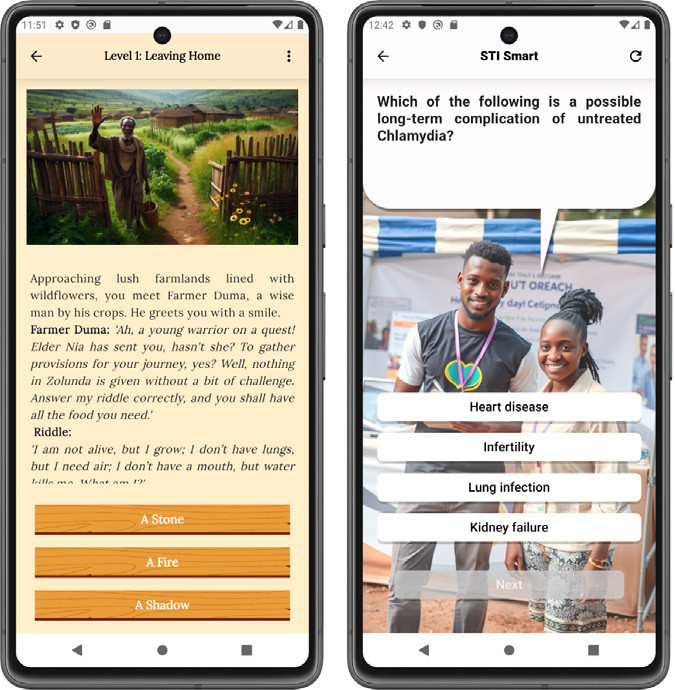
Figure 1 shows story and quiz interfaces, cropped from two different panels of the paper’s original screenshots. The former places learning content in an adventure seeking a health scroll; the latter has people answer questions to check understanding. They carry sequenced teaching tasks with a clear content scope — answers are not generated on the fly each time.
Open questions go to Safe Talk; the paper’s described version uses GPT-4o and the OpenAI Assistants API. It handles free questions on sexual health, relationships, and consent, allowing further explanation and follow-ups. Figure 2’s left side is rule-based assessment; the right is generative dialogue. The doctor figure in the interface is a bot persona — not a live clinician seeing patients.
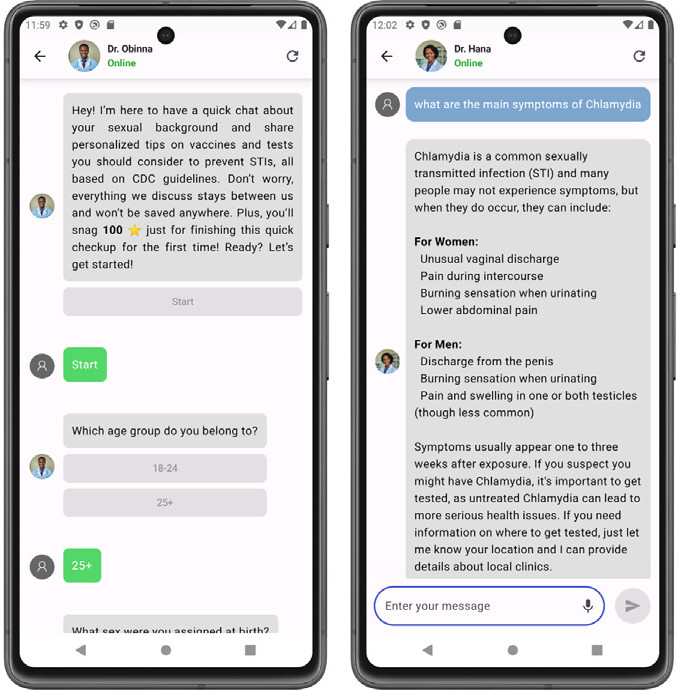
Lessons need to guarantee certain content will be covered; private questions are hard to enumerate in advance — so the authors use two kinds of bots. This evaluation did not compare against a single bot; it can show how the arrangement lands and how participants view it. Whether the hybrid architecture is more effective still needs comparative study.
02 To keep people learning, stories also need to know when to stop
The app uses the Health Belief Model to arrange content: whether people feel risk is relevant to them, understand consequences, see benefits of acting, and feel confident overcoming barriers. Along that learning path, disease knowledge and action confidence both need attention — making content interesting is only one step.
Following persuasive system design principles, the authors added stepwise guidance, rewards, reminders, and a leaderboard. Completing story levels and assessments earns points; nicknames appear on the leaderboard. These features aim to bring people back, but points record in-app activity — they are not evidence that protective behaviors already happened in real life.
A pilot exposed an interesting problem: the story module’s text was too long and participants felt fatigued. Researchers then rewrote plot and levels, cutting total module text by 40%, while adding dark mode, larger type, adjusted bright colors, and fixes for crashes on older devices and small-screen layout.
In later interviews, participants rated the game more positively, and some wanted more levels. We cannot attribute all improvement to shorter stories: multiple features changed between evaluations, and some scales differed too. The process better supports a plain design lesson: when learning is already effortful, narrative should not steal too much more attention.
03 Numbers rose after a week — behavior change still needs longer tracking
The main study included 62 participants who completed pre/post measures, aged 18–30; 20 were interviewed. They were asked to use the app for seven consecutive days, at least about ten minutes per day. Participants included people living in Africa and African-diaspora people living abroad for no more than fifteen years who still maintained some connection to African cultures.
Figure 3 shows three seven-point self-report indicators. Attitude toward changing risk behavior rose from 5.73 to 6.26; risk-avoidance intention from 5.61 to 6.24; self-efficacy from 5.57 to 6.23. Corresponding effect sizes d were 0.51, 0.63, and 0.71 — still statistically significant after multiple-comparison correction.
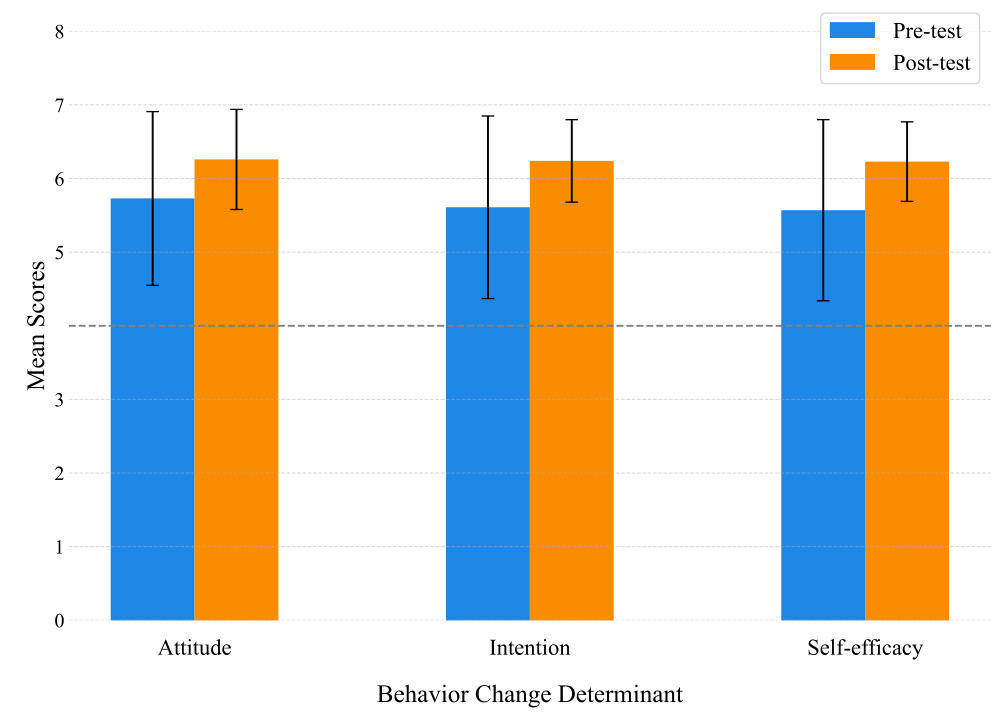
These indicators ask about intention and confidence — they have not yet directly measured real-world behavior. Baselines were already high, and post-scores clustered further at the high end; ceiling effects matter in interpretation. “Behavior change” in the paper’s title is a goal the app hopes to reach — it cannot be written as having already reduced high-risk behavior.
Knowledge quizzes offer another kind of evidence. As Figure 4 shows, easy in-app items rose from 77.10 to 93.55; hard items from 76.77 to 91.29 — both as percentages. Medium-difficulty items rose from 87.42 to 93.39, a smaller gain. Changes at all three difficulties remained significant after multiple-comparison correction.
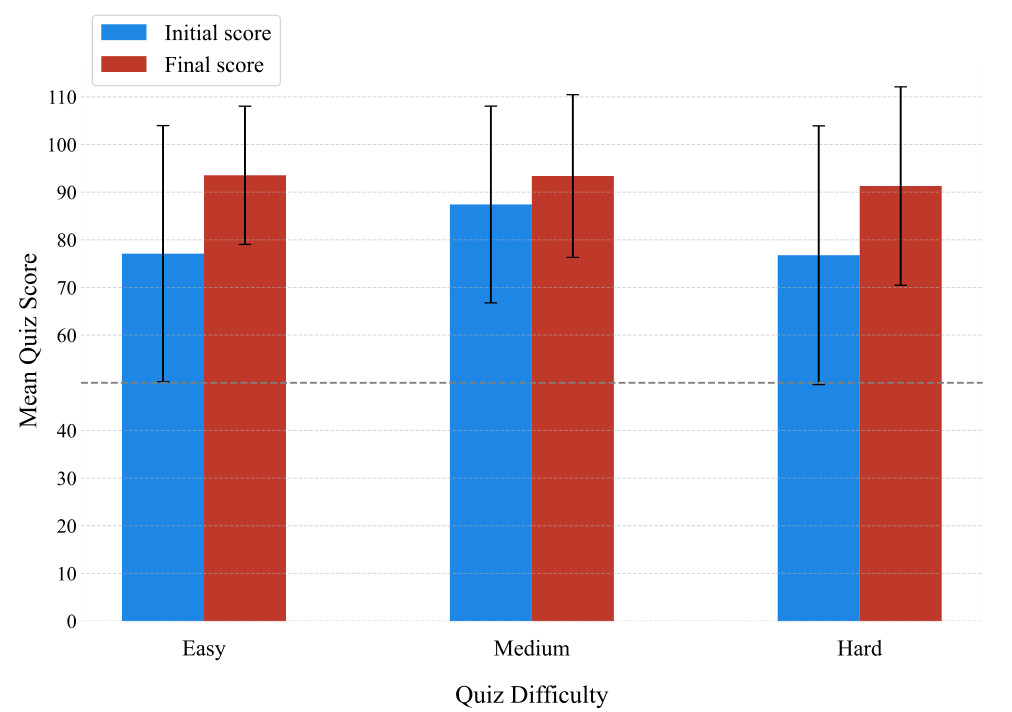
This is one group’s pre/post design — no control group. Retaking questions, participating in research itself, and using all modules together may all affect scores. Knowledge gains cannot be credited to Safe Talk alone; positive questionnaire change also cannot prove the app already lowered infection rates or remains effective months later.
04 Familiar faces make people willing to talk — one image does not cover everyone
Cultural adaptation was concrete in interviews. P17 felt the character imagery made them feel represented and more willing to chat with the bot; P5 felt the characters were less Western-centric than prior tools and easier to feel close to. The following is paraphrased interview content, not a Chinese transcript of participants’ original words.
Still, the study did not change character imagery alone and compare outcomes. Closeness may relate to names, stories, language, information content, and personal experience. From these interviews one cannot judge how much trust changing only avatars would bring — still less treat it as a universal fix.
Figure 5 gives four five-point acceptance dimensions: perceived trustworthiness 4.53, inclusiveness 4.61, cultural appropriateness 4.62, emotional impact 4.69. The last refers to emotional experience while using content — including safety, encouragement, and feeling informed — not a clinical measure of mental-health improvement.
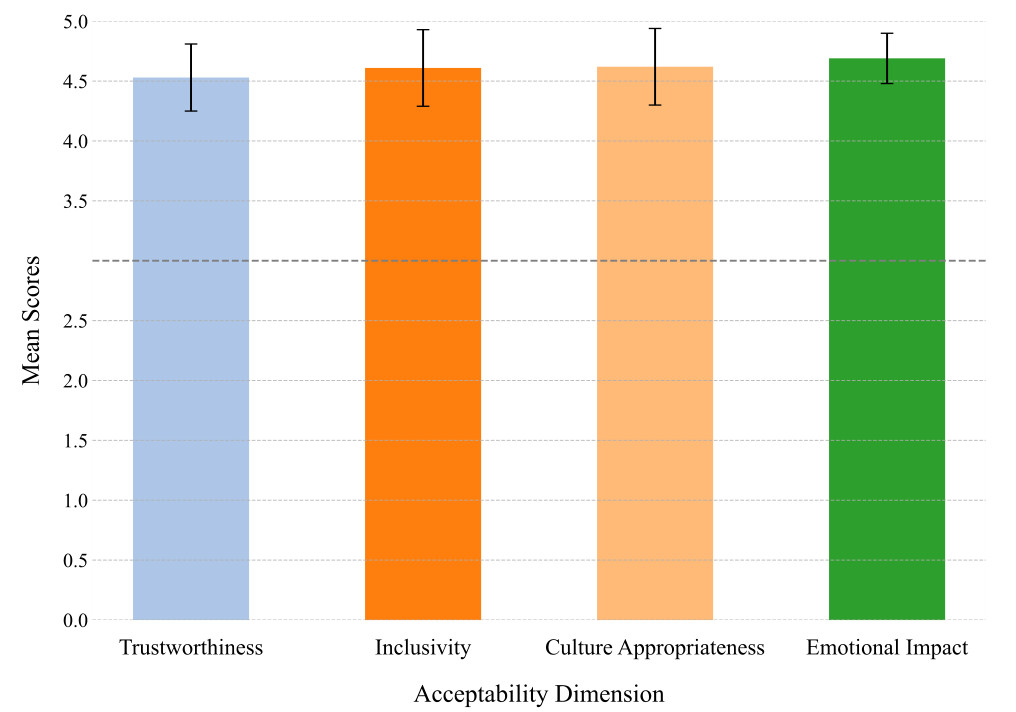
The sample is not the full picture of African young adults. Men were 62.9%; everyone had at least completed secondary education and needed sufficient English; Nigeria, Cameroon, and Ghana were main source countries. P6 also suggested adding characters from East Africa and elsewhere. “Culturally relevant” still needs the follow-up: relevant to whose culture?
Overall SUS usability reached 90.56 — this cohort found it usable. The study detected no score differences by age, gender, or education group, but that is not evidence of equivalence across populations, and it does not cover people unfamiliar with English, with less education, or not yet willing to discuss sexual health.
05 Trusting the knowledge source and feeling safe handing over chat logs are two different things
In interviews, some cross-checked information with external search; others trusted the app because of WHO, CDC, and similar sources. An interface without ads or subscription fees also felt more neutral. These clues explain how trust forms, but trustworthiness questionnaires measure users’ views — they did not verify whether every generated answer was accurate.
P10 separated the two: accepting the app’s information while doubting whether data were safe after disclosing personal details in Safe Talk, and whether they would be used otherwise. P12 also did not fully set aside doubt because of confidentiality statements. That reminds designers more than a high average score: information trust and data governance need separate handling.
Per the authors’ description of the research version, rule bots process on-device; points and nicknames use cloud services; Safe Talk chats are deleted after each session, researchers cannot view private dialogues, and content is not used for model training. Generative dialogue still goes through a third-party API, though — the authors acknowledge that differs from fully on-device processing.
Developers used prompts requiring the bot to cite reliable sources, stay on topic, and guide toward professional help when out of scope, then tested answers on preset scenarios and revised prompts. These are development measures the paper reports — they do not automatically equal large-scale clinical safety validation. Having answers carry links is still a distance from confirming those links actually support the claim.
06 From chat toward action — next steps need to connect to real services
Participants wanted features for communicating with clinicians, booking, and clinic referral. The paper lists these as later suggestions, not finished and validated services. The design question is direct: after learning or chatting, can people smoothly find next help — rather than only text that makes them feel more at ease?
Sustainable use also depends on ordinary conditions: whether older phones can run it, which features work on unstable networks, and who pays for generative services. Rule modules can work on-device; Safe Talk depends on an external API. Users wanting full offline support does not mean the current system is already fully offline-capable.
This week’s results are worth continued study, but longer follow-up, control conditions, and actual behavior measures are needed to know how far knowledge and intention travel. Adapted scales also have not been fully revalidated in this population. What I find most worthwhile is that the app seriously arranged both hard-to-ask questions and step-by-step learning needs; what remains to verify is how those arrangements change real life.
Paper informationOriginal title: Design, development, and evaluation of STI Shield: A multi-chatbot mobile application for sexual health education and behavior change in African young adults.
Authors: Hemad Fetrati, Gerry Chan, and Rita Orji, all from Dalhousie University, Canada; corresponding author Hemad Fetrati. This post is a third-party research reading, credited to X-Verse Lab.
Venue: International Journal of Human–Computer Studies, volume 218, article 103944, volume year 2027; published online 11 September 2026. The “2026” in the title refers to the online publication year. Paper link: https://doi.org/10.1016/j.ijhcs.2026.103944.
Key termsSTI: sexually transmitted infection — this paper discusses related knowledge education and support tools. Health Belief Model (HBM): folding perceived risk, benefits, barriers, and action confidence into design — applying the model does not guarantee behavior change.
Self-efficacy: confidence that one can accomplish something. SUS: System Usability Scale, score range 0–100; 90.56 is a scale score, not accuracy or a satisfaction percentage.
Holm–Bonferroni correction: used when comparing multiple related outcomes to control false claims of significant difference. It handles multiple testing; it cannot replace a missing control group.
ReferencesFetrati, H., Chan, G., & Orji, R. (2027). Design, development, and evaluation of STI Shield: A multi-chatbot mobile application for sexual health education and behavior change in African young adults. International Journal of Human–Computer Studies, 218, 103944. https://doi.org/10.1016/j.ijhcs.2026.103944