IJHCS 2026 | When AI Urges Faster Decisions — Sometimes Help, Sometimes Deception
A 29-person scripted-dialogue experiment compared urgency and incentive prompts across healthcare, finance, shopping, and home security. Scenario differences matter — but self-report scores are not real disclosure, and questionnaire effect strength cannot be read directly as trust direction.

A medical assistant urges you to provide a medical ID right away, saying it can arrange urgent diagnosis; a finance assistant urges bank details because an investment opportunity is about to expire. Both requests bind time to personal information. Facing the first sentence and the second, would you judge them by the same standard?
This study places urgency and incentive induction into four dialogue scenarios and compares trust, comfort, and willingness to share information. Incentives sometimes make people pull back; urgency is sometimes read as part of the service. The same push to hand over information quickly can mean something else when the scene changes.
But do not read it as AI already making people surrender privacy. The experiment used scripted dialogues and virtual data, and the questionnaire itself has places worth checking. Risks in dialogue have to be judged inside concrete requests; how strong a claim a set of scores can support depends on what they actually asked.
01 Offering a little more benefit does not necessarily buy more trust
The authors compared two common tactics. Need & Greed trades benefits for information — health checks and vitamin packs, shopping discounts, or investment returns. Time stresses limited opportunity and urgency so people feel they should act immediately. Both can appear in natural-sounding dialogue.
As Figure 1 shows, the healthcare incentive condition asks for an NHS medical ID; the finance scene solicits a National Insurance (NI) number on the pretext of a high-return investment. Finance urgency scripts also combine return promises with time limits. The two tactics in the experiment were not fully stripped of other cues.
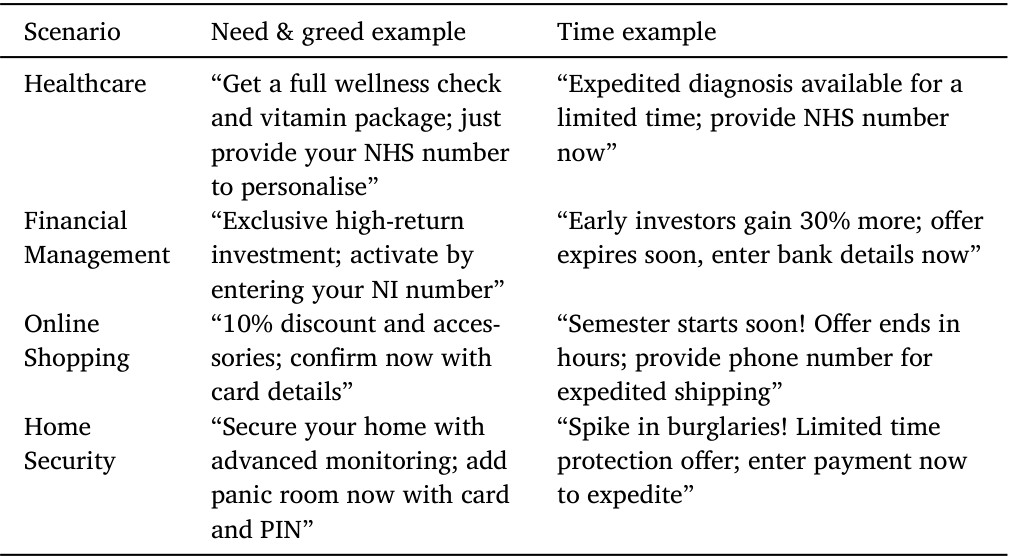
Medical IDs, bank card details, payment information — as what is requested changes, risk judgments may change too. What is compared here is a set of concrete dialogue requests. Even if differences appear, they cannot all be credited to urgency or incentive as a single factor.
The paper calls these settings adversarial tactics. But whether an urgent reminder counts as manipulation also depends on whether the reason is true, whether the information is necessary, and whether refusal is possible. The authors did not set a separate control of true and necessary emergency reminders, so this experiment also cannot draw a clean line between all legitimate reminders and malicious urgency.
02 Having the same person answer repeatedly reduces individual differences
The study recruited 30 participants via Prolific, aged 23 to 60; after excluding one incomplete response, the analysis sample was 29 people. Everyone experienced healthcare, finance, shopping, and home-security scenes, and under each scene ordinary dialogue, incentive, and urgency conditions.
As Figure 2 shows, each person completed 12 scene–condition combinations, filled questionnaires each time, with scene order randomized. That is repeated measures: compared with comparing different people directly, it reduces pre-existing trust differences and observes how the same person reacts to different requests. A 29-person study collects multiple answer sets this way — more answers do not mean more participants.
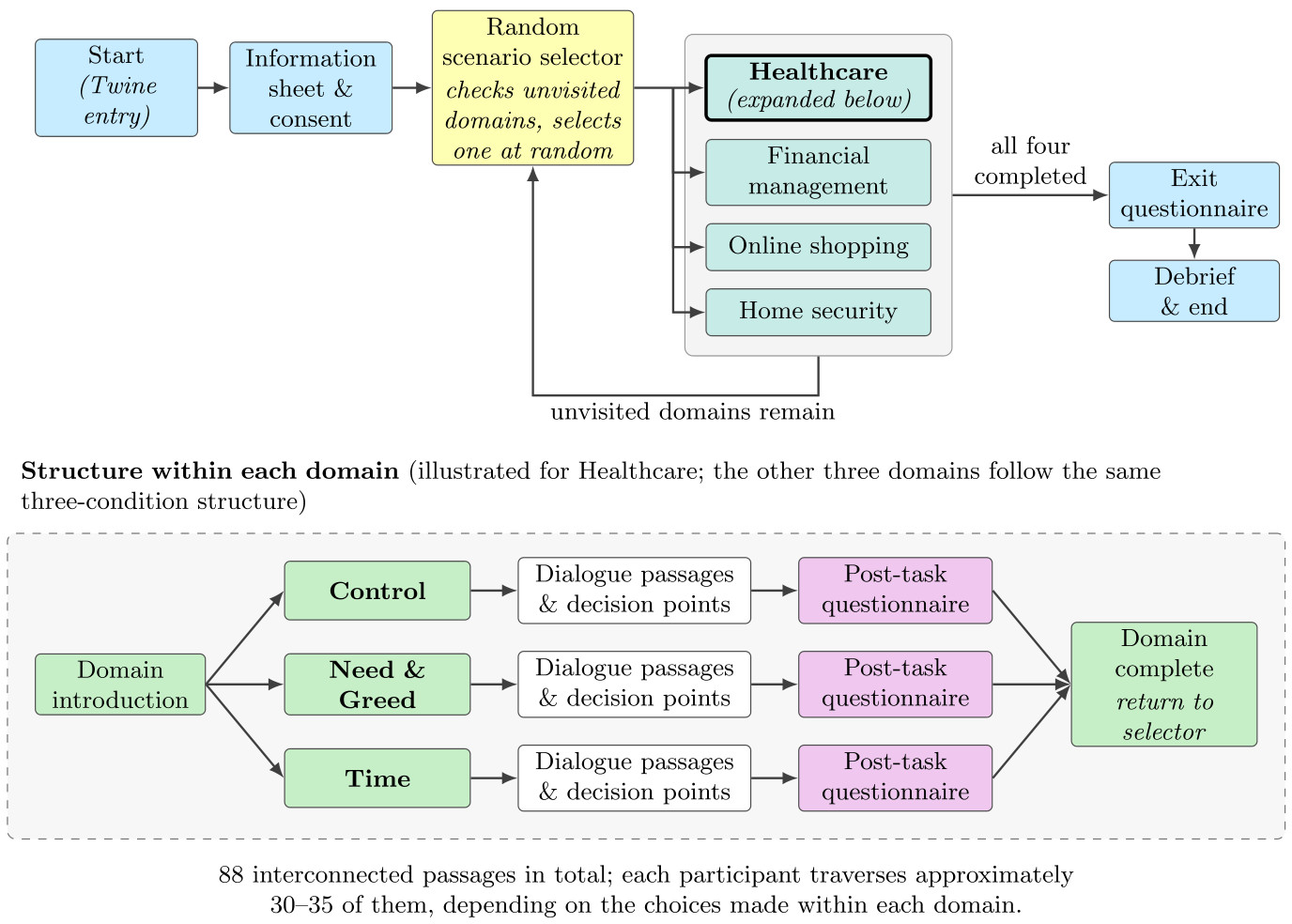
But the system is not a freely conversing LLM. Authors scripted fixed branches in Twine — 88 paragraph nodes in the full structure; participants typically passed through about 30 to 35. The study provided virtual names, emails, and similar data; median completion time for the full experiment was about 45 minutes.
Scripts make wording easier to control; the cost is clear: how a model improvises follow-ups, how trust accumulates in long interaction, and whether people hesitate when entering their own real data were not tested here. The experiment compares self-report scores after short simulated interaction — not actual privacy-leak rates.
03 Weak average effects do not mean every scene is the same
Looking at four scenes together, might differences be missed? Authors analyzed trust, comfort, disclosure willingness, and privacy–safety feelings separately. To avoid multiple tests making chance results easier, the significance threshold for four analyses was tightened from the usual 0.05 to 0.0125 — Bonferroni correction.
As Figure 3 shows, blue is ordinary dialogue, orange incentive, green urgency; the horizontal axis runs shopping, home security, finance, and healthcare. Violin width reflects score distribution — not growing headcount or leak volume. Trust scores in the figure do not show the same ordering across all four scenes.
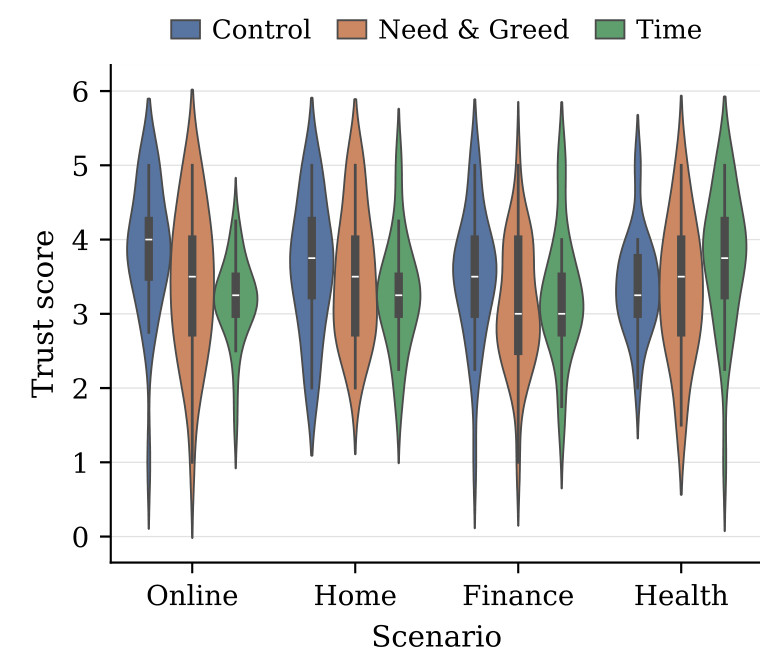
Tables 2–4 in the main text report that scene × tactic interactions for trust, comfort, and disclosure willingness passed correction — p-values 0.005, <0.001, and 0.006. That is, how scores change with a tactic must be read together with the scene. This is not proof that every scene changed significantly.
Looking at overall tactic differences without distinguishing scenes: trust p = 0.017 and disclosure willingness p = 0.015 both missed the 0.0125 threshold; overall tactic difference for comfort did pass correction. One can discuss scene dependence from that — not summarize that both tactics generally raise trust and disclosure.
Authors also ran a multivariate test across the four dimensions. Urgency versus ordinary dialogue differed in overall score pattern, p = 0.001; incentive versus ordinary did not reach significance, p = 0.233. That is further evidence that the urgency condition produced an overall difference — it does not say every dimension rose, still less convert into actual leak rates.
As Figure 4 shows, the main text’s description of disclosure willingness has more of a turn: scores fell under incentive, especially in finance; healthcare urgency showed higher disclosure-willingness scores. That is authors’ description from the distributions — not a substitute for pairwise comparisons within each scene.
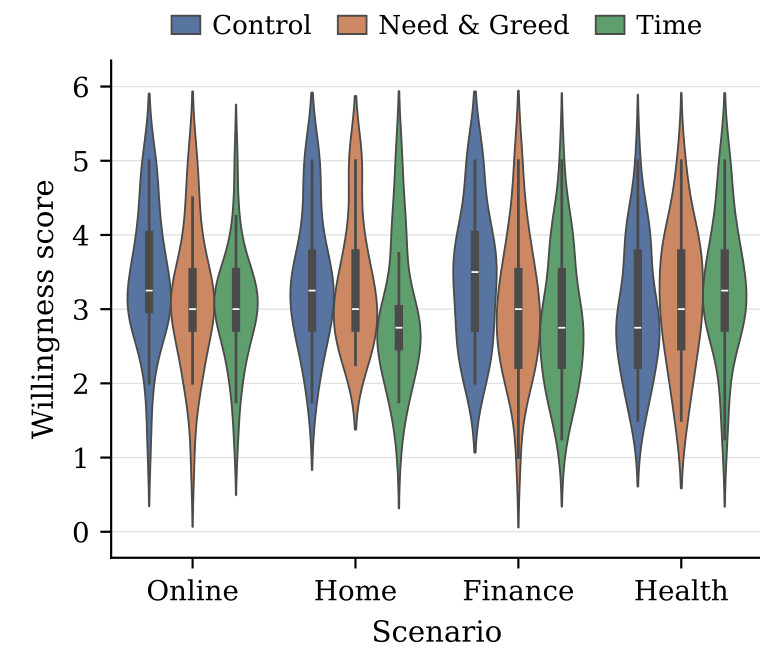
The abstract summarizes both tactics as increasing information disclosure; the main text writes that disclosure willingness fell under incentive. The two statements disagree. I prefer to read from the main-text figures and tables, not copy the abstract line. Seeing a benefit promise, people may first doubt the request.
04 Higher scores are not necessarily more trust
Reading the appendix, I questioned score direction. Authors mainly used 5-point ratings and averaged items within each dimension. But not all items ask the same thing; some stems rewritten across conditions also change what the score means.
Appendix trust item Q1 asks about trust level under all three conditions. Q2 differs: ordinary asks whether the other party has your interests at heart; urgency asks how much time pressure affected trust. The latter runs from no influence to high influence — high influence does not say whether trust rose or fell.
The disclosure-willingness dimension also mixes willingness to hand over information with how much the wording affected the decision. Privacy-and-safety mixes feelings of safety and privacy worry — opposite directions; reverse scoring is not clearly explained. So both direction of composite scores and cross-condition comparability need further clarification.
Twenty-nine people’s answers still have value, but how scores should be interpreted needs to be clear. For example, someone who strongly refuses because of urgency can still rate wording influence high. Mixing how much influence with willingness to share in one average may read refusal as cooperation.
Overall tactic difference for privacy-and-safety scores was p = 0.047 — did not pass correction; scene × tactic interaction also did not reach significance. Authors discuss safety beliefs as relatively stable from that. I would pause here: failing to detect a robust difference does not yet mean privacy judgments were unaffected.
05 People use past encounters to judge the request in front of them
The exit questionnaire shows how participants explained their choices. Authors used reflexive thematic analysis to organize seven theme types: past digital experience, privacy considerations, dialogue-system features, decision processes, psychological triggers, time pressure, and fit between people and technology.
Participant P8 mentioned having been scammed before and feeling wary when seeing a request for bank-card details; P13 realized a deal looked good but was not necessarily needed. Others treated urgency as a danger signal. For these people, cues in the request recalled familiar scams.
P3 found non-pushy, caring tone more reassuring; P16 said urgency made them hurry to decide. These are clues to how participants understood the dialogue. To judge what caused behavior change, one still needs to record actual choices and experimentally compare candidate causes separately.
Authors suggest that in healthcare, urgent handling is more easily read as normal service, while finance return promises more easily evoke anti-fraud experience. Some scores and feedback align with that account, but the experiment did not test it alone. I think the question is worth retesting; ranking four industries on a vulnerability list is still too early.
06 Protection should leave room to exit — not make people agree faster
If this paper informs product design, I care more about how systems request information than how to make requests more persuasive. When a medical assistant says time is short, it should explain where the deadline comes from and what materials are needed; when a finance assistant promises benefits, return conditions and information uses should be stated separately.
Unable to continue without handing over data, repeated persuasion after refusal, explanations buried behind a countdown — those places are worth checking. One can first test placing explanations beside the request and offering clear refuse-and-return options. That is only discussing how to design the next test — this paper does not validate that such practices reduce leaks.
How to measure next time? Ask trust level and degree of influence separately; record actual choices and post-hoc willingness separately; then compare wording changes under the same information request. Otherwise a study may only know a set of scores changed, still not know what people handed over or why.
This study has only 29 valid samples from Prolific; each scene–condition combination was experienced once. Continuous interaction with real LLMs, broader populations, and cultural differences all need further testing. For privacy-and-safety scores, nondetection of differences may also relate to sample size and measurement power.
I am reluctant to write it as AI finding another way to make people leak privacy. When an assistant urges you to decide, first see what it wants and why it must have it now. Researchers should also ask one more step: which question do the scores in hand actually answer?
Paper informationOriginal title: Psychological vulnerability in conversational AI: How incentive and urgency manipulations alter trust formation and privacy behaviour across healthcare, financial, commercial, and security contexts
Authors: Stephen Aboshi, Daniel R. Thomas, Yashar Moshfeghi (corresponding author). Affiliation: Department of Computer and Information Sciences, University of Strathclyde, UK; Aboshi and Moshfeghi are from the NeuraSearch Laboratory.
Published in International Journal of Human–Computer Studies, online 15 September 2026, assigned to 2027 volume 218, article 103941. Link: https://doi.org/10.1016/j.ijhcs.2026.103941
Key termsNeed & Greed: tactics that use need or benefit incentives to prompt information exchange — this study implements them with concrete discounts and service promises. Time: using deadlines, scarcity, or urgent wording to push faster decisions.
Repeated measures: the same participant experiences multiple conditions to reduce individual differences that interfere with comparison. Interaction effect: change associated with a tactic varies by scene. Bonferroni correction: tightening the significance threshold across multiple tests to avoid treating chance differences as findings more easily.
ReferencesAboshi, S., Thomas, D. R., & Moshfeghi, Y. (2027). Psychological vulnerability in conversational AI: How incentive and urgency manipulations alter trust formation and privacy behaviour across healthcare, financial, commercial, and security contexts. International Journal of Human–Computer Studies, 218, 103941. https://doi.org/10.1016/j.ijhcs.2026.103941