IJHCI 2026 | Wearing VR May Not Deepen Learning — AI Relational Scaffolds Matter More
A within-subjects study with 16 participants found the VR browsing condition weakest; turning concepts, relations, and reflection into callable AI scaffolds produced more complete, higher-quality concept maps.
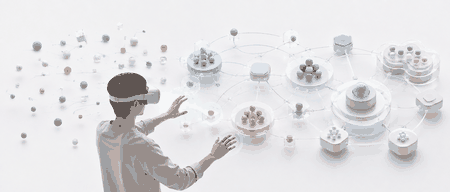
Suppose you have a short time to learn eight unfamiliar concepts. A browser can give you definitions, ChatGPT can answer questions, and VR can even lay knowledge nodes out in front of you. What still traps people is the same hard problem: knowing what each concept means is not the same as knowing why they relate to one another.
That is exactly where concept mapping is most cognitively demanding. Even if you write many nodes, if the links are only side-by-side lists, learners still get a bag of facts — not a knowledge structure they can explain, compare, and infer from.
I would rather place this paper’s value somewhere else: it is not merely that VR and large models were put together again, but that the authors remade AI from an answering tool into a relational scaffold. The results also leave a clear reminder: immersion does not automatically buy deeper learning; what matters is whether the interface presses on the step that is actually hard for learners.
01 The hard part of learning is not collecting concepts, but stating relations clearly
The study focuses on relational knowledge construction: whether learners can organize scattered concepts into an explainable structure. Concept maps are well suited to observing that process, because every node, proposition, and cross-branch link leaves a trace. The problem also surfaces: novices can often find concept definitions, yet struggle to judge which two concepts should be linked, how to write the linking words, and — harder still — how to build meaningful cross-links across different branches.
The authors therefore did not only count nodes in the map. They jointly evaluated proposition quantity, crosslink quantity, and the quality of both kinds of connection. That distinction matters. Drawing one more line does not necessarily mean deeper understanding; only when relation direction, linking words, and concept combination all make sense does that line count as part of the knowledge structure.
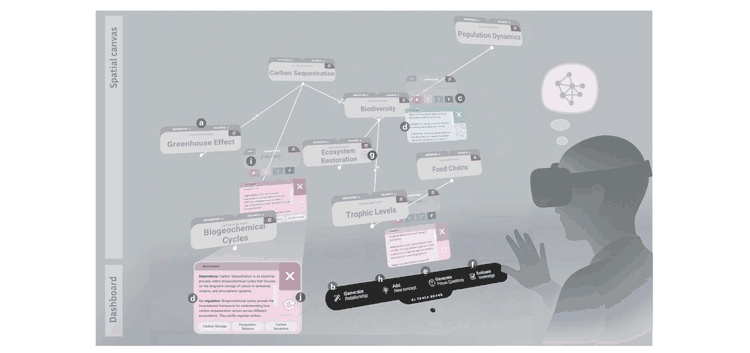
Figure 1 shows CmapVR’s core interface. Concept nodes sit in three-dimensional space; learners can move and connect them directly. AI features are embedded beside the mapping actions, not opened as a separate chat window.
So the research question shifts with it: can AI help at the right point while learners organize relations? The evaluation standard is no longer whether replies look good, but whether the final concept map actually changes.
02 AI scaffolds are not one chat box, but three kinds of executable action
CmapVR splits support into three layers. Concept scaffolds handle definitions and examples; relation scaffolds can auto-suggest links and also probe the relation between two concepts along comparison, integration, inference, and other directions; metacognitive scaffolds prompt learners to check their current focus and look back at their knowledge structure.
This is not only an interface arrangement — it directly changes how AI enters learning. Ordinary chat requires learners to first notice what they lack, then organize the problem into a prompt. For beginners, those two steps are themselves a threshold. Embedded scaffolds turn “what you might think next” into buttons, so help appears beside concepts and links.
Relation scaffolds matter especially. They do not vaguely ask the model to explain a topic; they compress the task onto a concrete relation: what do these two concepts share, can they be integrated, what can be inferred, and how should that be written as a proposition. AI’s role thus moves from filling in facts toward helping learners build structure.
03 Comparing four conditions is about more than VR versus desktop
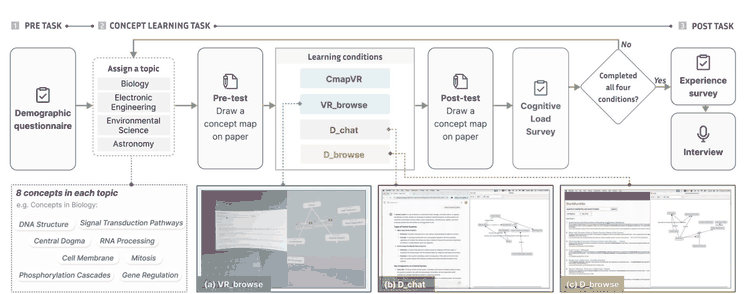
The study recruited 16 university students, ages 22 to 31, in a within-subjects design. Everyone experienced all four conditions, with order balanced by Latin square; the four learning topics all came from science domains, each fixed at eight concepts. Before and after learning, participants independently drew concept maps on paper.
The four conditions were: CmapVR with embedded LLM scaffolds; VR_browse, relying on web browsing in the same VR environment; D_chat, a desktop concept-mapping tool with ChatGPT-4o; and D_browse, a desktop concept-mapping tool with a browser. Figure 2 shows the full flow from pre-test, learning task, and post-test through questionnaires and interviews.
Putting the four groups together has a clear strength: the study compared several workflows learners might actually use, rather than pitting a new system only against a weak baseline. But it is not a strict two-by-two factorial experiment. VR, information source, access mode, and scaffold structure all changed together, so the results cannot separately answer “whether immersion, the LLM, or embedded interaction produced the effect.”
In other words, what this study can support is how the full CmapVR workflow performed on a controlled task — not attributing every point of gain to VR or the large model itself.
04 What increased was not only links — relation quality rose with them
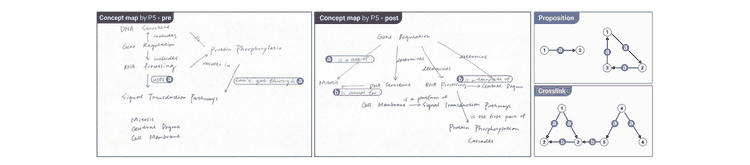
Figure 3 shows one participant’s pre- and post-test example. Concepts in the pre-test were relatively scattered; the post-test not only added propositions but also connections spanning different branches. The schematic on the right further distinguishes ordinary propositions from crosslinks, showing how the authors turned “richer structure” into scorable metrics.
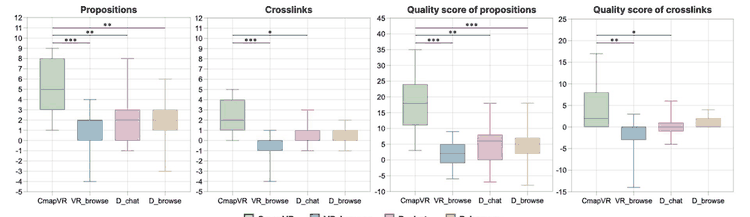
The quantitative results are more direct. Under CmapVR, proposition count rose by an average of 5.40; VR_browse was 1.00, D_chat 1.80, and D_browse 1.93. Proposition quality gains were 17.40, 1.87, 4.33, and 4.40 respectively; CmapVR differed significantly from the other three conditions.
On crosslink quantity, CmapVR rose by 2.13 on average; VR_browse instead fell by 0.47; D_chat and D_browse rose by 0.33 and 0.53. CmapVR was significantly higher than VR_browse and D_chat; the comparison with D_browse was p=.053, not crossing the usual significance threshold. Crosslink quality showed a similar direction, but the significant differences listed in the paper mainly came from CmapVR versus VR_browse and D_chat.
Figure 4 places the four metrics together. The safest reading is not “VR beats desktop,” because the weaker performers include VR_browse. A judgment closer to the evidence is: when relational support aligns tightly with concept-mapping operations, learners more readily write new information as explainable connections.
05 Scaffolds reduce useless friction — they do not make the task thought-free
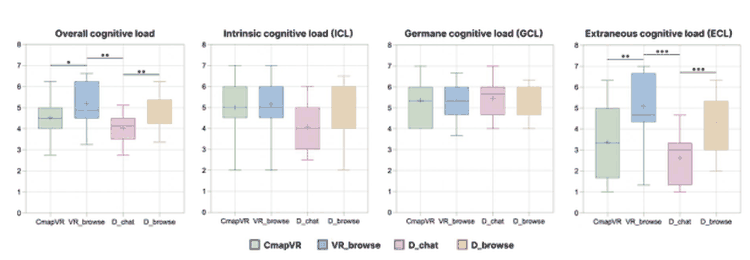
Cognitive-load results fill in the other half of the story. VR_browse’s overall cognitive-load mean was 5.20, higher than CmapVR’s 4.53 and also higher than D_chat’s 4.04. The clearest difference fell on extraneous cognitive load: VR_browse 4.76, CmapVR 3.58, D_chat 2.62.
In Figure 5, the four conditions showed an overall difference in intrinsic load, but pairwise post-hoc comparisons were not significant; germane load related to actively constructing knowledge also showed no difference, p=.80. That is, CmapVR did not make the content that needs understanding simpler, nor did it prove that learners invested more effective mental effort. It more likely reduced attention spent browsing, switching, searching, and reorienting concepts.
For education products, this step cannot be vague. Lowering cognitive load is not the same as flattening every difficulty. The parts of the content that should be hard still have to be handled by learners; what design should really remove is cost unrelated to learning goals — finding entry points, moving information, remembering context.
06 Better learning performance does not mean the interface is already more usable
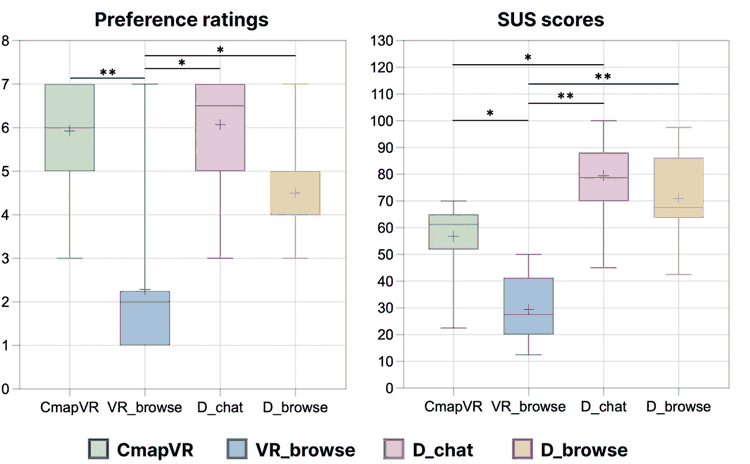
If you look only at learning outcomes, it is easy to write CmapVR as a full victory. Subjective experience was not so neat. Participants’ preference mean for CmapVR was 5.93, significantly higher than VR_browse’s 2.29; D_chat’s preference was 6.07, also higher than VR_browse. The paper did not show CmapVR beating D_chat on preference.
The usability gap is clearer. On the System Usability Scale, D_chat scored 79.5, significantly higher than CmapVR’s 56.8; CmapVR in turn was higher than VR_browse’s 29.5. After Figure 6 places preference and usability side by side, a fact averages can hide comes out: a learning tool can win on task outcomes and still feel hard to operate.
Interviews explain where the friction came from. Of 16 people, 6 complained about the virtual keyboard, 5 had difficulty with gestures or moving objects, and 3 had physical discomfort. VR’s spatial layout made it easier for some participants to form an overall mental map, but input, selection, and manipulation still charged an extra cost.
The paper also found no significant correlation between usability scores and several learning-performance measures. That does not imply experience does not matter — only that in this small sample, feeling smooth and drawing better concept maps did not form a stable relationship. For real classrooms, low usability may still affect long-term adoption, practice frequency, and dropout — none of which sits inside one short experiment.
07 Relation prompts were used most; reflection was touched least
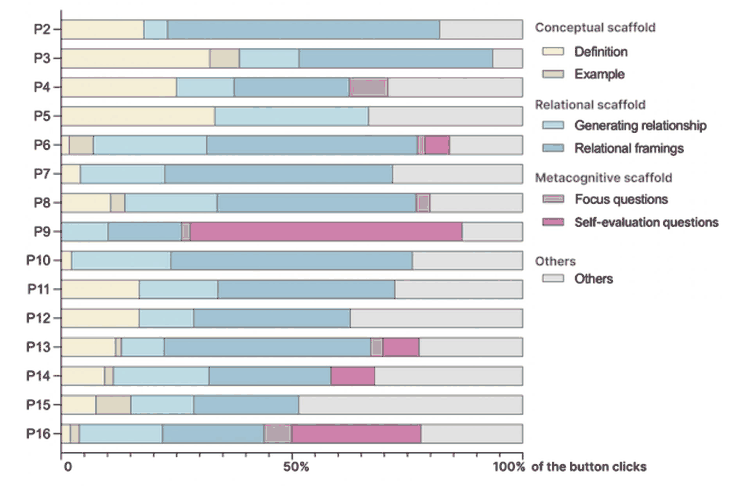
After one participant’s log was lost, the authors analyzed feature use for 15 people. Relation scaffolds accounted for 51.3% of all interactions, of which relation framing was 34.7% and auto-generated relations 16.6%; concept scaffolds were 14.7%, and metacognitive scaffolds only 8.9%. More specifically, 8 of 15 people never used a metacognitive feature even once.
Figure 7 shows that difference. Most people’s clicks concentrated on generating relations and relation framing; only a few frequently called focus questions or self-assessment. Learners were willing to click features that immediately complete a link, but not necessarily to choose features that make them pause and check understanding.
The truly tricky place is also here: if reflection is forever only an optional button, it will likely lose to instant answers. The authors also remind that structured interfaces can make model output look more credible, so learners may reduce critical checking. The next step cannot only optimize accuracy of recommended relations — it must also study how to put verification, source comparison, and self-explanation into required pathways.
Still, do not push this result too far. The sample is only 16 people; topics are STEM knowledge with clear structure; the experiment measured only immediate post-tests. Gains may partly come from short-term memory of AI content; whether they persist long-term or transfer to new problems, the paper does not answer. Multiple hypotheses also did not uniformly control family-wise error across the whole experiment. The authors therefore position the results as exploratory findings, not general conclusions.
What is most valuable about this study is not proving that VR plus AI is always effective, but shifting the design focus from “how much information to provide” toward “how to help learners build relations.” For the next generation of learning tools, what may be truly scarce is not answers, but making it possible for people to organize answers into their own knowledge structure.
Paper informationOriginal title: Supporting Relational Knowledge Construction Through LLM-Assisted Concept Mapping in Virtual Reality
Authors: Fangyuan Cheng, Bingyi Su, Karen B. Chen
Affiliation: North Carolina State University, Edward P. Fitts Department of Industrial and Systems Engineering
Paper link: https://doi.org/10.1080/10447318.2026.2719119
Key termsRelational knowledge construction: Not only remembering isolated facts, but also being able to state causal, comparative, hierarchical, or inferential relations among concepts. This paper observes that structure through propositions and crosslinks in concept maps.
Concept map: Nodes represent concepts; lines with linking words represent relations. It is both a learning tool and assessment material that externalizes knowledge structure.
Extraneous cognitive load: Mental cost caused by how information is presented and how interaction works, yet not directly serving learning goals — for example, frequent window switching or difficult input in VR.
ReferencesCheng, F., Su, B., & Chen, K. B. (2026). Supporting relational knowledge construction through LLM-assisted concept mapping in virtual reality. International Journal of Human–Computer Interaction. Advance online publication. https://doi.org/10.1080/10447318.2026.2719119