Computers & Education 2026 | AI Teachers Should Ask First — Let Students Speak Their Thinking
This framework paper proposes five constructivist principles: AI pedagogical agents should ask first and support collaboration and artifact iteration — not finish thinking for students.

A student has just dragged a parameter in a physics simulation. AI already sees the error and knows the standard answer. It now has two choices: point out what is wrong directly, or ask first and let the student say their own judgment.
For a general assistant, solving faster is usually better. For a pedagogical agent, that standard may be exactly reversed: if the answer arrives too soon, students need not explain, compare, try, fail, and revise. The task is finished; cognitive work may have been taken over by AI.
This Computers & Education paper does not compare which model teaches better. The authors first press a more basic design question: when generative AI can do almost anything, which thinking must still be kept for students themselves? Their answer is to re-constrain the pedagogical agent’s role with constructivism.
01 The goal of a pedagogical agent is not to end the task faster
The paper starts from a very practical tension. Generative AI sharply lowers the barrier to building pedagogical agents, yet also makes instructional systems easier to turn into answer machines. Students can outsource planning, reasoning, evaluation, and self-monitoring to AI, then mistake smooth output for mastery. The authors cite the phrase “mirage of false mastery.”
Constructivism treats learning as an active process of building meaning. Students need to explain phenomena in authentic tasks, surface prior conceptions, negotiate with peers, and turn ideas into testable artifacts. So this paper does not list features by AI capability; it proposes five pedagogical principles: engagement in authentic contexts, explanation construction and cognitive conflict, collaboration and community, artifact construction, and cognitive apprenticeship.
That shift changes product metrics. If the goal is only finishing problems, giving steps directly is efficient; if the goal is transferable understanding, the system also needs to record which judgments students made, which ideas they revised, and whether they can say why.
02 Good guidance must see what the student is doing
The first principle is offering help that is usable in the moment within authentic, open tasks. The paper gives a convex-lens imaging experiment: an AR system senses light-source and lens positions via object detection; an LLM then asks questions based on the current optical layout. When the light source is moved to 207 mm from the lens — past the 200 mm mark — the agent does not announce the imaging conclusion; it asks students to observe what changed in the image.
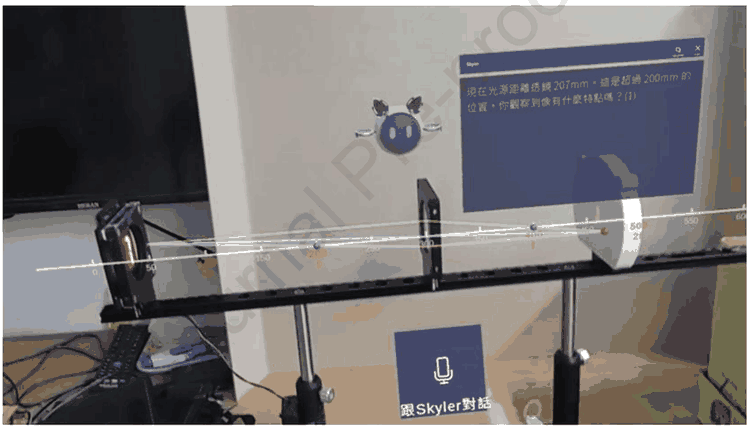
What Figure 1 is truly worth noticing is that feedback is bound to the operation the student just performed — not merely stacking a chat bubble on the experiment view. A general LLM only knows what the student asked; a contextualized agent also needs to know where objects are, how parameters changed, and what the student already tried. That information decides whether it should remind procedure, point to phenomena, or press for explanation.
But “feedback in the moment” is not better the more frequent it is. An oversensitive system may jump in on every student probe and turn open exploration into a linear, prompt-following task. So this principle must be read with intervention timing later: sensing more finely does not mean prompting more often.
03 Asking before answering is how useful confusion is preserved
Building understanding often is not filling a missing fact, but discovering that an existing explanation no longer fits a new phenomenon. The paper illustrates with a momentum simulation after fireworks explode. Students wrongly think a speed change means mass also changed. The agent first asks how gravity affects vertical velocity and momentum; only when students still do not revise does it further clarify that mass is unchanged, then ask them to reconsider the role of speed.
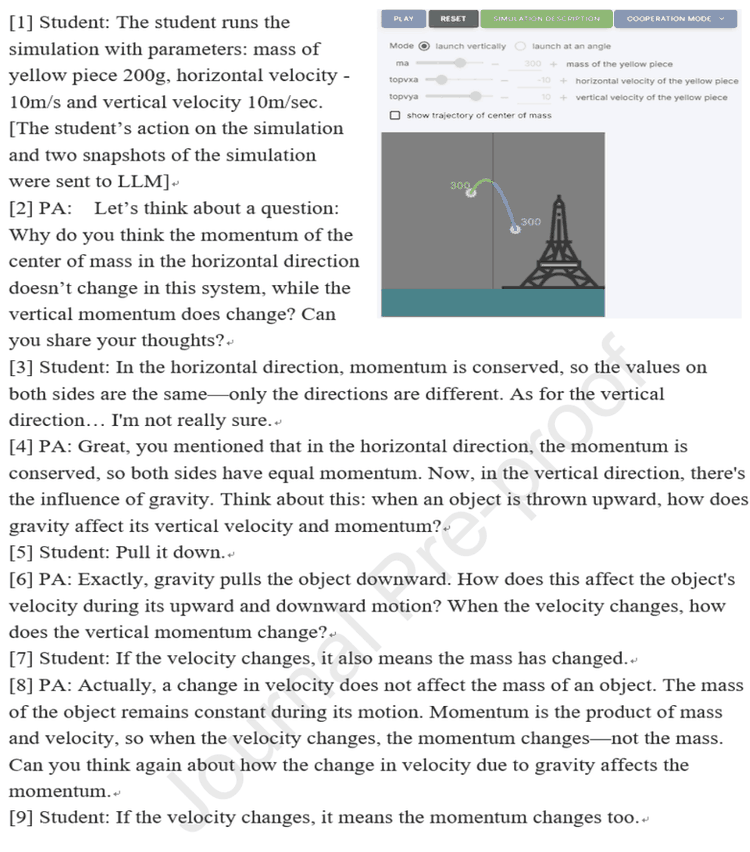
The dialogue in Figure 2 is imperfect, yet closer to real learning than giving the correct answer once. The student’s misconception is spoken aloud, so the system has something to target. The authors therefore propose a practical rule: first use questions to elicit analysis, evaluation, and idea generation; then escalate hints by need; only last give a direct solution.
The value of that rule is preserving “productive struggle,” not deliberate delay. The system must judge whether students are forming an explanation or already stuck for lack of prerequisite knowledge. The paper offers a design direction, but when to escalate from question to hint to answer still needs empirical calibration by subject, age, and task difficulty.
04 AI need not always be the teacher — sometimes it fits better as the student
In this framework, AI can be a tool, tutor, learner, or teammate. Those roles correspond to different allocations of cognitive responsibility — not merely a costume change. When AI acts as a teachable agent, students must explain to it, correct it, and monitor whether it truly learned; when AI acts as a collaboration facilitator, it should invite peers to add and connect different contributions, rather than turn group discussion into students taking turns asking AI.
The paper cites three goals of academically productive talk: building a learning community, constructing accurate knowledge, and promoting rigorous thinking. That constrains the agent’s collaborative interventions: it can ask for reasons, invite comparison, and surface disagreement, but should not automatically become the center of every turn just because it holds content knowledge.
This also reminds product designers not to evaluate only how long students chat with AI. More important is whether, after AI appears, explanation, challenge, and negotiation among students increase — or get replaced by one-to-one Q&A.
05 The artifact is only the result — revision history shows whether learning happened
The framework’s fourth principle places AI inside modeling, programming, and creation tools — but as co-constructor and formative assessor, not a finished-product contractor. The paper uses computational scientific modeling as an example: students encode phenomena as graphical objects, variables, mathematical relations, and behavior rules, then run the model and check whether results match physical expectations.
Figure 3’s task is modeling a drone dropping an object. After students omit gravitational acceleration, the object travels in a straight line instead of forming a parabola. The GPT-4o agent in the text locates that gap by reading the model’s internal equations, then suggests introducing gravitational acceleration in the vertical direction.
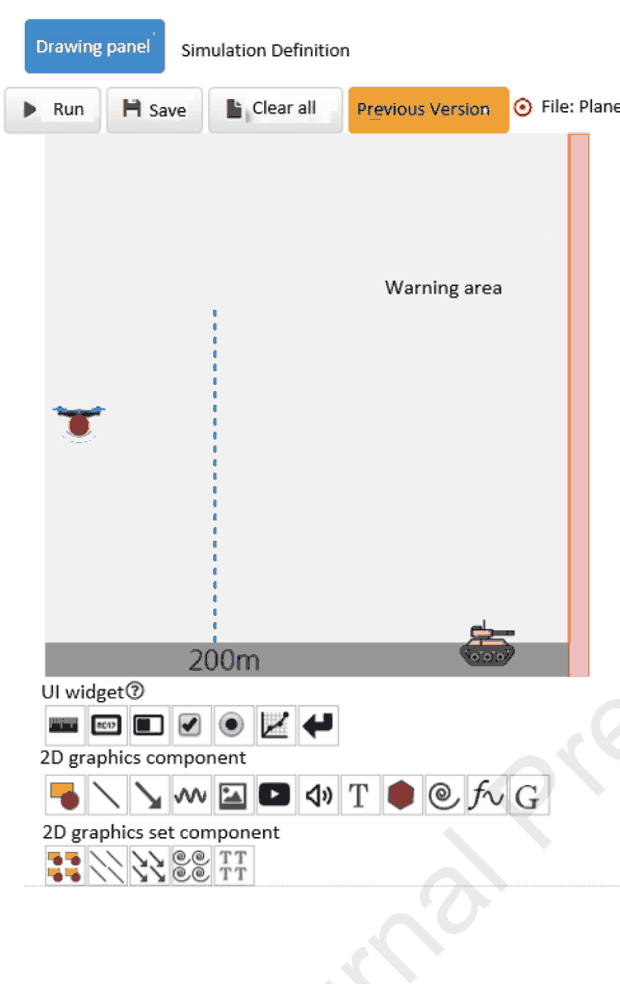
Figure 4 shows C2STEM placing visual blocks, a physics scene, and challenge tasks in one environment. For the agent, the value of such a tool is not only seeing whether the final animation is right, but also reading program structure and revision trajectories — so feedback can point at students’ model assumptions.
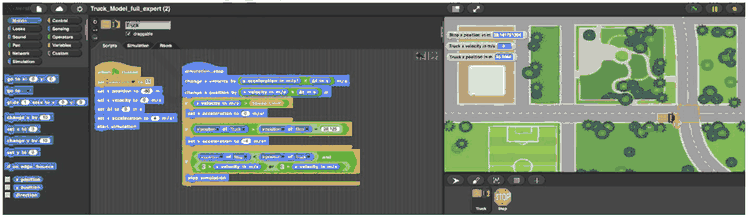
Here the paper offers an evaluation stance worth keeping: once generative AI enters artifact construction, assessment cannot look only at the finished product; it must also look at revision history, how prompts changed, and which schemes were debugged. Only that process evidence can distinguish whether students are building knowledge or merely moving generated results into the artifact.
06 Intervention timing cannot be left entirely to the model — teachers must retain control
The fifth principle comes from cognitive apprenticeship. The agent can demonstrate how experts handle complex tasks, and also ask questions, give cues, and require reason-giving while students operate. How many feedback templates a system has is not the hard part. The hard part is whether this moment calls for demonstration, follow-up questioning, or silence.
The authors distinguish reflection-in-action from reflection-on-action. The former requires the agent to adjust scaffolds in the moment from current dialogue, operations, and task state; the latter, at milestones or after the task, has students look back at their own thinking path. Both need data, but data triggers cannot equal pedagogical judgment.
Therefore the paper explicitly lists teacher-in-the-loop as a cross-domain safeguard. Teachers are not only called in when AI errs; they should be able to set instructional goals, choose agent roles, monitor interaction, and in class adjust intervention frequency, scaffolding fade-out speed, and role persona in real time. That means a usable pedagogical-agent product cannot have only a student-side chat box; it also needs teacher-side orchestration and review interfaces.
07 This is a design map — not an effectiveness verdict
The paper’s evidence strength needs to be stated clearly. It is a theory-driven design framework that shows how five principles can be realized through AR experiments, science simulations, collaborative dialogue, and computational-modeling cases, while synthesizing existing literature. It does not use a new unified experiment to compare these five designs against ordinary chat-style AI on learning outcomes, nor give a causal ranking of which principle works best for which learners.
The authors themselves list ten tensions still needing work: authenticity versus artificial generation, AI authority versus student agency, cognitive conflict versus task relevance, shared context versus privacy, over-scaffolding versus exploration, hallucination versus misdirection, plural viewpoints versus answer homogenization, data-driven versus human interpretation, creation versus recombination, and speed versus depth. These are not risks a system prompt can erase.
The paper’s ending also acknowledges that effects of different intervention timings and guidance modes still need systematic evaluation; how teachers and agents form mutually beneficial relations remains open; and diffusion of no-code development tools will raise teacher professional development and digital-divide issues. The safer use is treating this framework as a design review checklist — not packaging it as an already-proven universal solution.
For a team building an AI education product, five questions can check a proposal first: Is the task tied to an authentic situation? Does the system let students express and revise explanations? Is AI promoting peer dialogue or replacing it? Does assessment see the construction process of artifacts? Can teachers understand and change the agent’s intervention timing? Those five questions decide more than “which model was plugged in” whether the product helps students learn — or does the work for them.
Paper informationOriginal title: The Design Framework for Pedagogical Agents Supporting Constructivist Learning with Generative AI
Authors: Chen-Chung Liu, Chin-Chung Tsai, Ramazan Yilmaz, Jiun-Yu Wu, Maria Ranieri, Di Zou, Leanna Archambault, Johan van Braak, and Gautam Biswas. Main affiliations include National Central University (Taiwan), National Taiwan Normal University, Vanderbilt University, The Hong Kong Polytechnic University, and others. Corresponding author: Gautam Biswas.
Journal: Computers & Education, 2026, Journal Pre-proof, 105744.
Paper link: https://doi.org/10.1016/j.compedu.2026.105744
Key termsPedagogical agent: An AI role that provides guidance, feedback, or collaboration for specific learning goals — not the same as a general chat assistant without instructional boundaries.
Constructivism: Emphasizes that learners actively form understanding through situation, dialogue, conflict, and artifact construction, rather than treating knowledge as conclusions that can be directly transmitted.
Cognitive apprenticeship: Places expert modeling, coaching, scaffolding, and reflection inside authentic tasks, and gradually fades help as learner competence rises.
ReferencesLiu, C.-C., Tsai, C.-C., Yilmaz, R., Wu, J.-Y., Ranieri, M., Zou, D., Archambault, L., van Braak, J., & Biswas, G. (2026). The Design Framework for Pedagogical Agents Supporting Constructivist Learning with Generative AI. Computers & Education, 105744. https://doi.org/10.1016/j.compedu.2026.105744