Computers & Education 2027 | After AI Enters Class, The Fight Is Who Gets to Be the Teacher
An analysis of 28,137 Chinese social-media comments finds that the public is rewriting the meanings of teacher roles, ways of learning, and educational equity along multiple pathways.

“Will AI replace teachers?” sounds like a question about technical capability, but behind it sit harder problems: who will explain knowledge, who will judge whether homework was done by the student, and who decides whether a new way of learning counts as fair?
When similar debates scatter across comment sections on Douyin, Weibo, and Bilibili, they are easily sorted into optimistic versus pessimistic camps. But once 28,137 comments sit together, what appears is not simple opposition. Some see AI as a tool that lowers information barriers; some worry about teacher authority and career prospects; others already discuss how to reorganize curriculum, questioning, and assessment.
This Computers & Education paper pushes the question one step further: public understanding of AI in education is shifting from “should we use a tool” toward “how roles, rules, and capabilities in education will be rearranged.” That change has no single entry point, and it is not a straight line from technology investment to educational reform.
01 Comment sections are not classrooms — but they can expose conflicts classrooms will meet
Researchers collected public comments related to AI education on Douyin, Weibo, and Bilibili from February 2024 to October 2025. The raw corpus exceeded 35,000 items; after manual screening, removal of ads and anomalous text, exact deduplication, and spot-checks of bot accounts, 28,137 anonymized comments remained.
The three platforms offer different discourse environments: Weibo sits closer to public issues and policy talk; Douyin comments often attach to concrete classroom and short-video scenes; Bilibili gathers more young users’ technical and learning discussion. Together, they show how the public instantly expresses hopes, anxiety, and normative judgments.
But comment sections cannot stand in for educational reality. They are shaped by recommendation algorithms, post topics, user structure, and expression motives; they record how people talk about educational change, not what teachers and students actually do. The “structural shifts” mentioned later should all be read as perceptions and imaginaries in discourse.
02 The authors wanted more than what people talk about — they wanted which topics appear together
The study follows a four-stage analysis route. First, LDA extracts latent topics from massive short comments; then Jaccard coefficients map topic keywords onto theoretical constructs such as “technological capital penetration” and “micro-level pedagogical resilience”; topic probabilities and sentiment scores are next calibrated into fuzzy sets; finally fsQCA seeks condition combinations that co-occur with pedagogical structural-shift discourse.
Figure 1 shows this route. LDA answers “which semantic clusters recur in comments”; Jaccard answers “how those clusters map onto theoretical concepts”; fsQCA no longer asks which single variable matters most, but seeks different pathways that form when multiple conditions appear together.
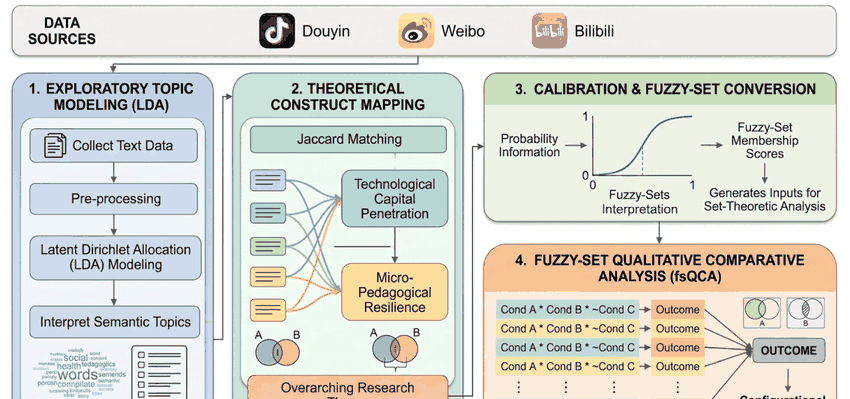
Once the methods are joined, analysis no longer stops at word clouds and topic rankings. Researchers can move from “what people said” to “which worry, adaptation, and innovation narratives point, in different combinations, toward reconstructing teacher roles and teaching practices.” The cost is also clear: mapping from topics to theoretical constructs, and calibration thresholds for fuzzy sets, all help shape the final pathways.
03 Eight themes show that AI-education debate has already reached roles and institutions
Researchers repeatedly trained models between 3 and 12 candidate topics; eight themes achieved the highest coherence score in 7 of 8 trials and were finally selected. Two coders then checked representative comments for each theme; Cohen’s Kappa was 0.769, indicating a fairly solid basis for consistent theme labeling.
The eight themes are: cognitive oscillation, career anxiety, disciplinary restructuring, pedagogical structural shift, role adaptation, coupled innovation, multimodal tension, and technological divide. They do not sit on one level. Some discuss how individuals understand and use AI; some discuss teacher careers and disciplinary boundaries; some point directly at instructional functions and institutional arrangements.
Figure 2 presents their semantic relations via topic distance. Role adaptation and coupled innovation sit close and partly overlap, showing that “how people adjust roles” and “how humans and machines co-innovate” often appear together in comments; career anxiety, disciplinary restructuring, and pedagogical structural shift each occupy relatively independent positions.
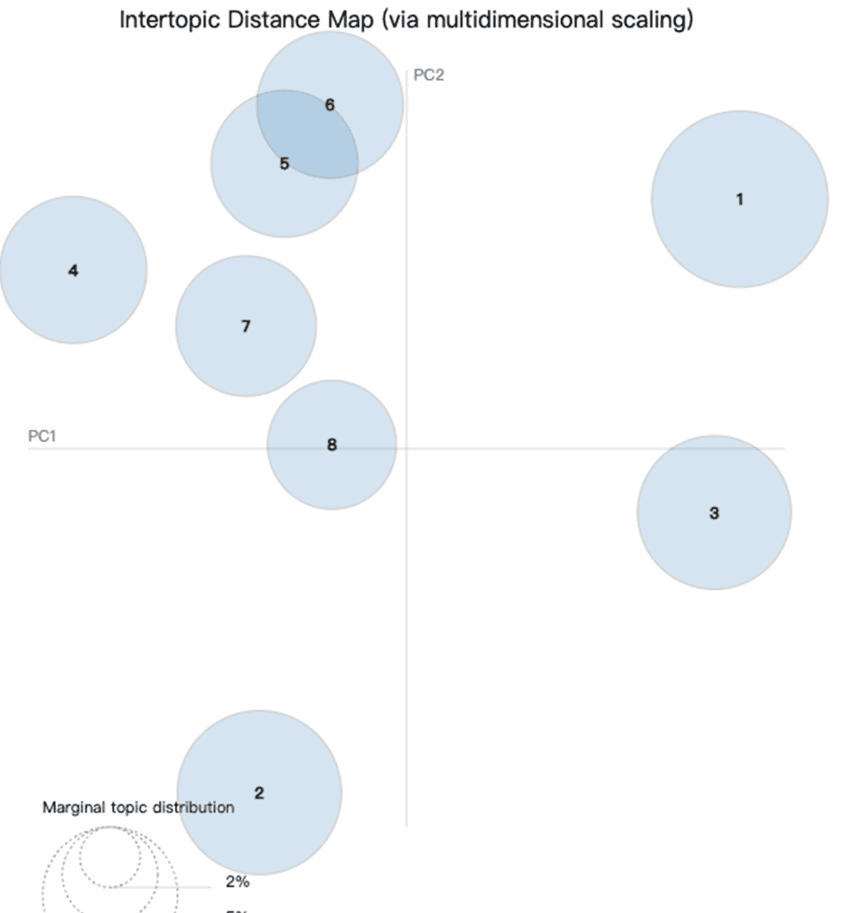
Circle size is not the point. The real change is that public discourse has moved past “can AI help me with homework.” People begin discussing which work teachers will keep, whether questioning ability becomes a new threshold, whether urban and rural schools will pull farther apart, and what place traditional listening and reading still hold in an AI era.
04 No single factor is a necessary condition for pedagogical structural-shift discourse
The study set “pedagogical structural shift” as the outcome set, with the other seven themes plus sentiment score as conditions. In necessity analysis, no single condition’s consistency reached the 0.90 necessary-condition standard. Technological divide is not necessary; positive or negative emotion is not either.
The public need not first form strong anxiety before talking about teacher-role change; sitting in an obvious technology gap is also not a premise for imagining pedagogical rearrangement. Career worry, cognitive adjustment, innovative practice, and multimodal adaptation can enter the same discussion endpoint through different combinations.
fsQCA then found 5 sufficient configurations associated with high-level pedagogical structural-shift discourse. Overall solution consistency was 0.926, coverage 0.702. Figure 3 lists core and peripheral conditions for each path; the first path’s raw coverage was 0.675, clearly higher than the others; the remaining paths offer alternative explanations rather than five mainstream modes of equal scale.
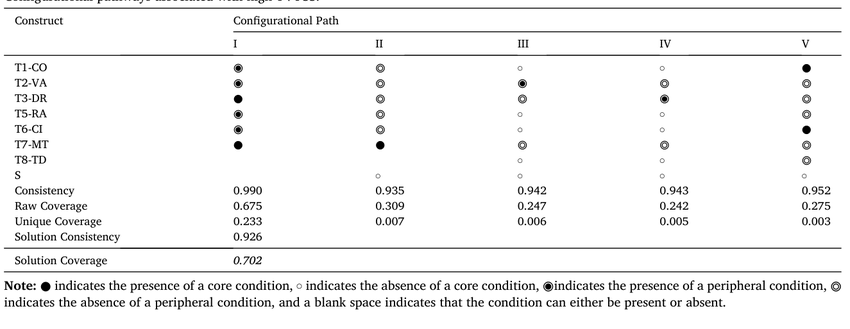
“Sufficient configuration” also cannot be read as a causal recipe. It means that in this set of calibrated comment data, a condition combination is highly consistent with the outcome set; it does not mean that moving the same conditions into schools will necessarily trigger instructional reform.
05 Five configurations were grouped into four change pathways — but they are not four types of schools
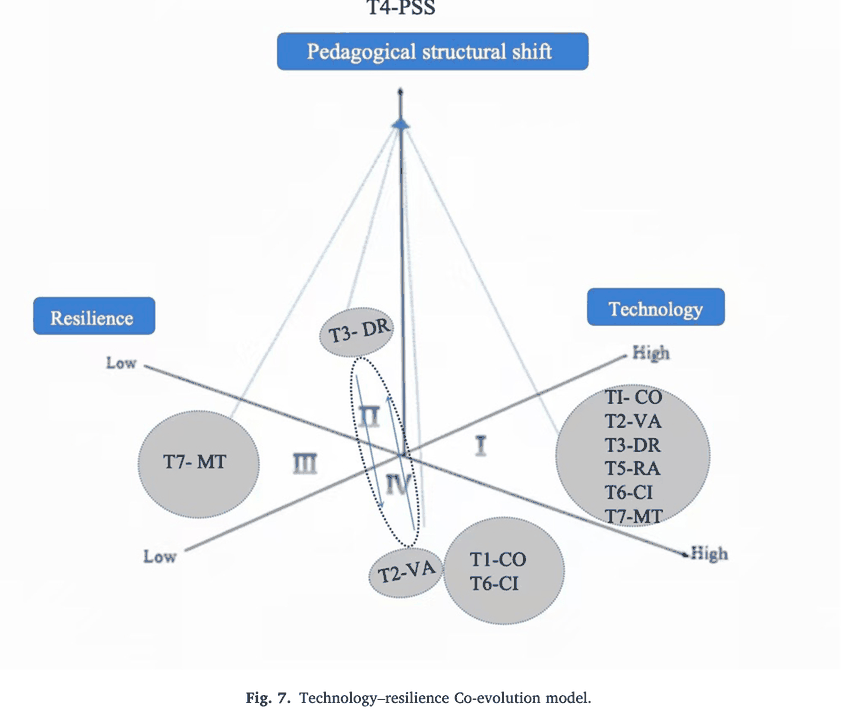
In discussion, the authors merged two mutually substitutable configurations and obtained four conceptual pathways. The first is the comprehensive pressure pathway: both technological penetration and pedagogical resilience are high, multiple peripheral conditions stack, and the public adapts actively while sensing broader institutional pressure. Resilience here is not only a buffer; it may also let change diffuse faster and deeper.
The second is the substitutive restructuring pathway. Career anxiety and disciplinary restructuring can substitute for each other across configurations: sometimes people reopen discussion of teaching functions because they fear job replacement; sometimes they start from changes in knowledge organization and disciplinary boundaries — and both land on rearranging teacher roles and practice.
The third is the multimodal adaptation pathway. Even when technological penetration and overall resilience are not strong, around local media changes in speech, image, and cross-language expression, the public may still form imaginaries of instructional-function change. Reform discourse need not always start from large platforms or heavy investment; it can begin from one concrete interaction mode.
The fourth is the double-loop cognitive pathway. When technical conditions are limited, cognitive oscillation and coupled innovation become core: people doubt, probe, and revise their understanding of AI while seeking ways to embed new tools in teaching. Anxiety and exploration coexist and do not prevent new educational expectations from forming.
Figure 4 places the four pathways on axes of technological penetration and pedagogical resilience. It is a theoretical explanation diagram, not a measured classification of real schools. A given school cannot be accurately shoved into a quadrant from a few indicators alone, and the four names cannot replace local evidence.
06 The counterintuitive finding is that emotion and the technological divide both retreat to the periphery
AI-education discussion is often written as two main lines: one of anxiety, fear, and resistance; another of uneven resources and digital divide. But in this configurational analysis, sentiment score and technological divide did not become core necessary conditions. The core more often landed on cognitive adjustment, disciplinary restructuring, role adaptation, innovation coupling, and multimodal tension.
That does not mean emotion and equity issues are unimportant. SnowNLP’s sentiment classification accuracy on 500 human-annotated comments was 81.20%, Macro-F1 0.8119, but sarcasm, internet slang, and contextual reversal may still be misread. That technological divide sits at the periphery in the model may also relate to theme definition, platform-user structure, and sample period.
Tightening the claim a bit: the public’s structural imaginary of AI education need not be driven by a single fear or resource gap. When people begin rewriting the value of abilities such as “can ask questions,” “can teach others,” and “can verify AI,” role change has already happened at the discourse level — even if commenters show no strong emotion.
07 This paper offers diagnostic language — not a reform prescription
Researchers also swapped several parameter sets to check whether these pathways vanish easily. They used probability-ratio transforms to ease dependence from eight topic probabilities summing to one; changed calibration anchors, consistency thresholds, and frequency cutoffs; and re-ran analysis keeping only comments whose dominant-topic probability exceeded 0.50. Core pathways largely held, suggesting results are not wholly dependent on a single parameter.
Boundaries remain clear. Individual comments may come from the same user or thread and cannot be treated as fully independent; early 2024 comments clearly outnumber late 2025 ones, which may suppress emerging issues; bot audits rely only on public information and cannot rule out residual automation or coordinated behavior.
LDA topics from short comments carry noise; only 59.34% of comments had a dominant-topic probability above 0.5. Jaccard depends on vocabulary overlap; although the authors also used BERT semantic similarity to check mappings, moving from “what the public said” to “which theoretical construct it belongs to” still includes researcher judgment. fsQCA pathways are set associations, not longitudinal change, and not classroom effects.
If a school, because it looks like the “comprehensive pressure pathway,” directly configures psychological support or curriculum-restructuring plans from the table, it has already crossed the evidence boundary. A more reasonable use is treating the four pathways as interview and survey question frames: what do our teachers worry about, which roles are changing, do students treat questioning and verification as new abilities, and are technology investment and human adaptation moving in sync.
True verification still needs classroom observation, teacher interviews, time-slice analysis, and cross-cultural comparison. Only when that evidence connects can we judge whether structural imaginaries in comment sections truly turn into changes in curriculum, assessment, and power relations.
After AI enters education, the deepest change may not appear first on model capability charts. It may appear first in how people re-answer three questions: who teaches, what is learned, and what counts as knowing how to learn. Paper informationOriginal title: Unpacking AI–education discourse: Topic modeling and fsQCA of Technology–Resilience dynamics in pedagogical perceptions
Authors: Hongfeng Zhang, Liwei Ding, Jinqiao Zhou
Affiliation: Macao Polytechnic University
Journal: Computers & Education, Volume 256, Article 105738
Paper link: https://doi.org/10.1016/j.compedu.2026.105738
Key termsLDA topic model: Estimates latent topics from word co-occurrence in large text corpora, and each comment’s probabilistic belonging to different topics.
fsQCA: Uses set relations to find pathways where multiple condition combinations co-occur with an outcome, emphasizing equifinality and causal asymmetry; it is not the same as regression and does not automatically prove causation.
Pedagogical resilience: Used in the paper to describe how educational participants such as teachers and students adapt and reorganize cognitively, emotionally, and in role practice under technological shock.
ReferencesZhang, H., Ding, L., & Zhou, J. (2027). Unpacking AI–education discourse: Topic modeling and fsQCA of Technology–Resilience dynamics in pedagogical perceptions. Computers & Education, 256, 105738. https://doi.org/10.1016/j.compedu.2026.105738