Computers & Education 2026 | Kids Teach More When AI Sounds Sad — But Cheerful Voices Raise Scores
A three-week randomized experiment finds that sad, gender-mismatched voices more readily spark immediate teaching behaviors, while cheerful, gender-matched voices correspond to higher standardized math assessment gains.
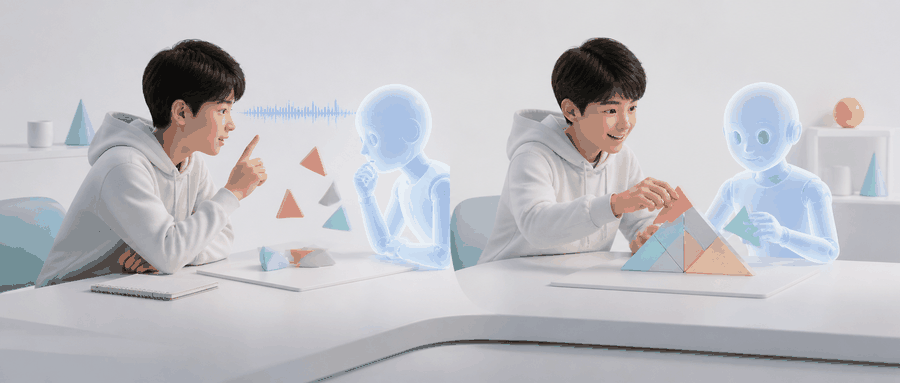
If an AI student says in a somewhat low voice, “I still don’t get this problem,” will a child teach it more carefully? Intuitively, that design seems to manufacture vulnerability on purpose. Yet in learning-by-teaching settings, precisely that sense of “it needs me” may push students from answerers into explainers.
The catch is that being more willing to talk in the moment is not the same as scoring better three weeks later. A randomized experiment covering 386 sixth- and seventh-graders found that sad, gender-mismatched voices more readily sparked answering, explaining, and tutoring; what truly corresponded to higher standardized math assessment gains was the gender-matched, cheerful combination.
This Computers & Education paper does not rush to pick one “best voice” for AI teachers. It first separates two goals often collapsed together: voice can ignite learning behavior, but the conditions that sustain that behavior and settle into scores may be a different set.
01 This time AI does not teach the child — the child teaches AI
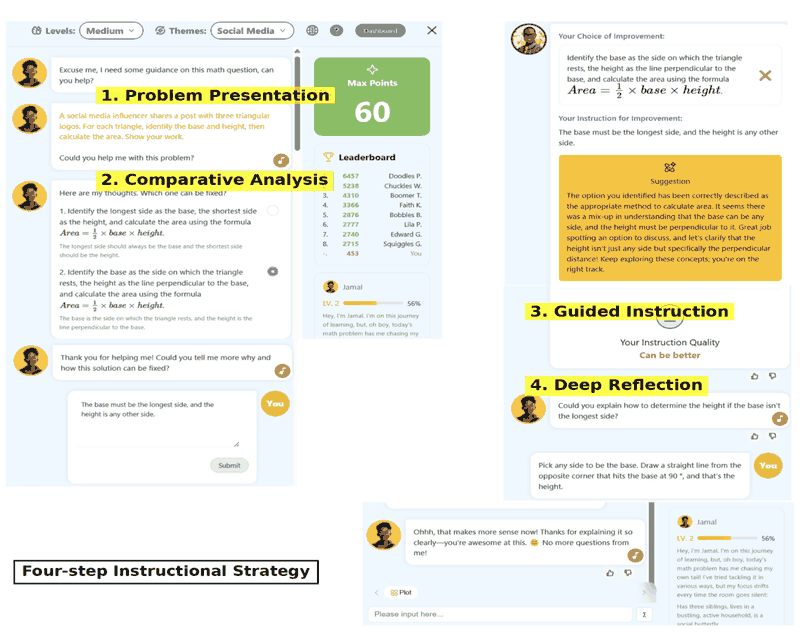
The system in the study is a teachable agent. It does not play the all-knowing teacher; it places itself in the position of “not yet learned,” so students take teaching responsibility. Facing a math problem, AI first offers two solution approaches, one containing a common error; students must compare, judge, then explain what is wrong and how to fix it.
Figure 1 shows the full four-step flow: problem presentation, solution comparison, guided teaching, and deep reflection. The system also asks why a given approach does not hold, forcing students to say aloud judgments that previously existed only in their heads. Learning here does not come from listening to AI lecture, but from organizing knowledge, correcting errors, and explaining to someone else.
Once the roles reverse, the job of voice changes too. In traditional intelligent tutoring systems, speech mainly carries explanation and feedback; design goals often emphasize clarity, credibility, and comfort. A teachable agent’s goal is different: it needs students to feel responsible for helping the other. So a less confident voice is not necessarily a defect — it may be a cue that starts teaching motivation.
02 Researchers split voice into 12 combinations, not only male vs. female
The system used six middle-school-looking cartoon avatars — three male and three female — covering different racial appearances. Avatars themselves stayed consistent; the experiment manipulated whether voice gender matched the avatar, whether the voice sounded adolescent or adult, and whether the tone was sad, calm, or cheerful.
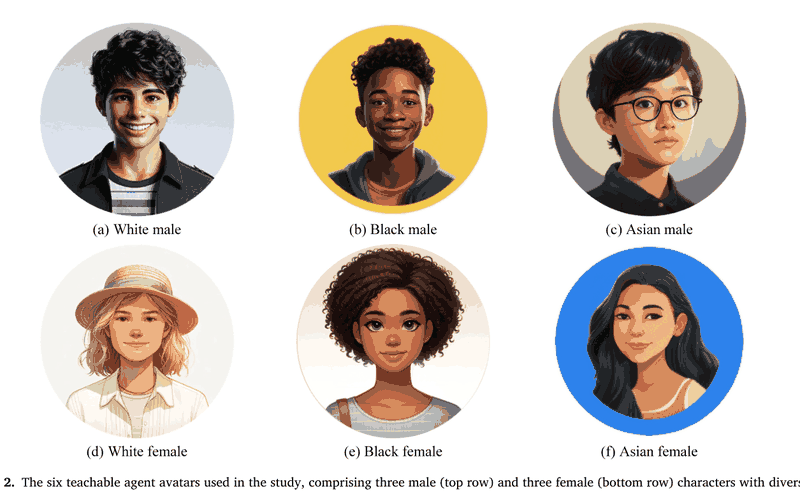
The three dimensions formed a full 2×2×3 factorial experiment with 12 voice configurations. Each student was randomly assigned one fixed configuration; over three weeks, whichever avatar they met, voice attributes stayed the same. Researchers could therefore estimate effects of single acoustic cues and check whether combining cues produced more than simple addition.
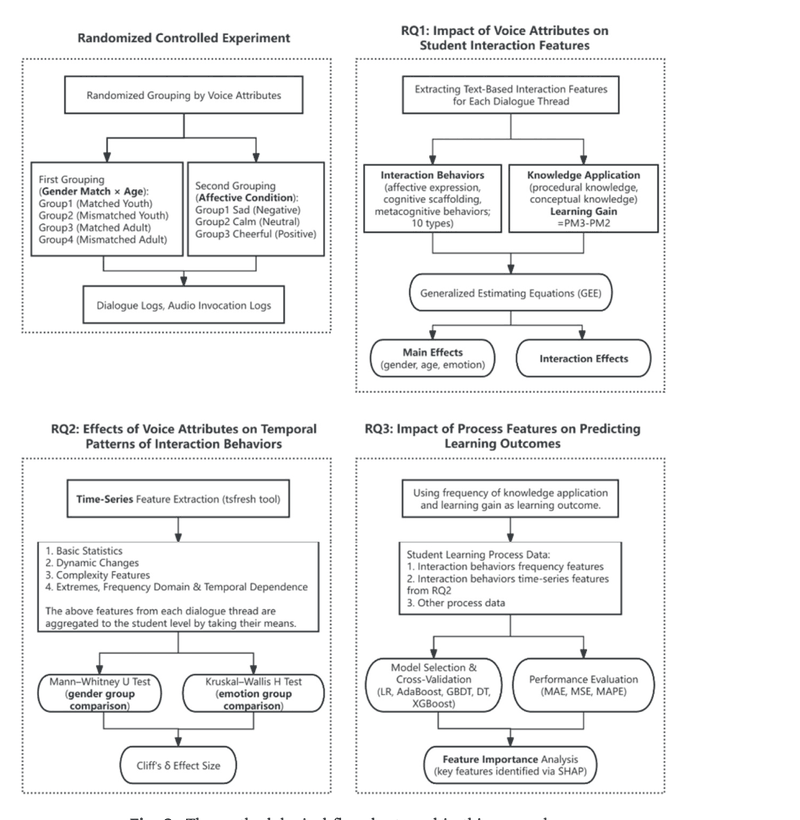
Figure 2 summarizes three analysis chains. Researchers first used generalized estimating equations to test voice effects on 10 interaction behaviors, two knowledge-performance measures, and learning gains; then converted dialogue into time series to observe how behavior changed across turns; finally used machine learning and SHAP analysis to find process features that truly predict learning outcomes.
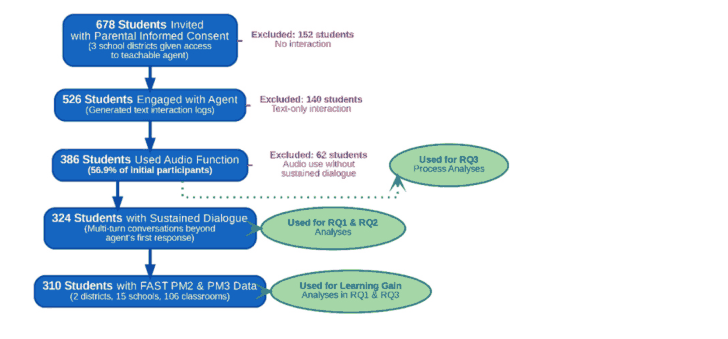
The experiment ran on the real Math Nation math platform, not a lab session of a few dozen minutes. 386 students who invoked voice formed the voice-analysis sample; 324 of them continued multi-turn text dialogue; 310 had complete FAST state math assessment pre–post data.
Figure 3 lays out sample screening: initially 678 people received system access, 526 actually interacted with the agent, 386 used voice, 324 sustained dialogue, and finally 310 entered learning-gain analysis. The numbers keep shrinking, reminding us that later conclusions mainly apply to students willing to use voice and actually take part in interaction.
03 The more AI sounds like it needs help, the more easily students enter the teacher role
In immediate interaction, the surprise was the combination of sad tone and gender mismatch. “Mismatch” here does not mean matching the student’s own gender; it means the avatar’s presented gender differs from the voice’s perceived gender, weakening a clear, familiar gender image.
Relative to the gender-matched, sad-tone reference condition, gender-mismatched + sad tone was associated with more conceptual knowledge expression, β = 0.776; answering behavior β = 1.773; explaining behavior β = 0.693. The sad group had the highest frequency on 9 of 12 interaction features; time-series analysis also showed it more readily sustained higher peaks and overall levels of tutoring behavior.
Figure 4 aggregates significant main effects after multiple-comparison correction. Gender mismatch was positively related to conceptual expression, politeness, answering, explaining, tutoring, and learning gains; calm and cheerful tones increased explaining but reduced encouragement and error correction. Voice does not simply make interaction “more” — it changes which teaching moves students choose.
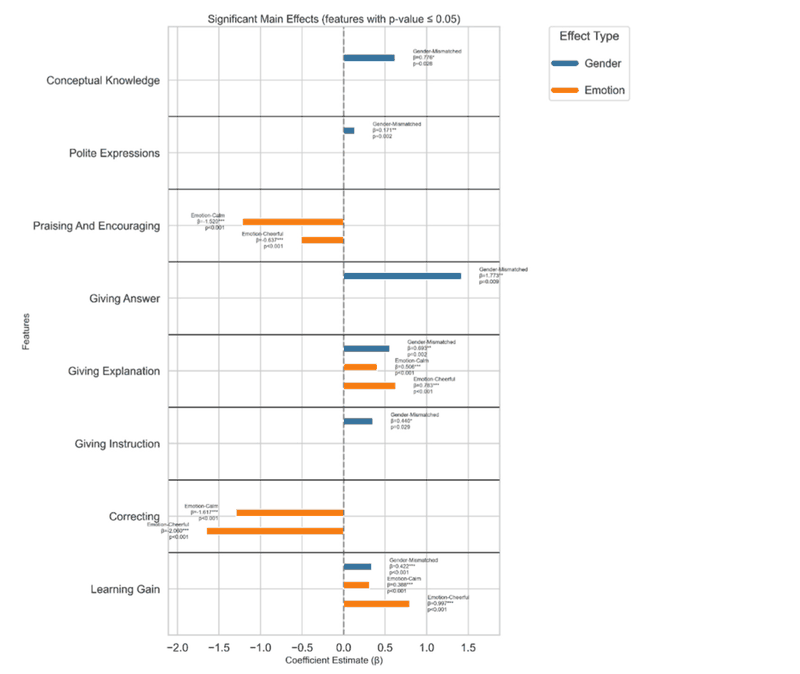
The authors read this as a responsibility-driven motivational path: sadness may make the agent seem more in need of help; gender mismatch may lower prior social-identity expectations, so students become more willing to explain and correct. That is a reasonable interpretation, but still only a theoretical inference. The study did not directly measure empathy, sense of responsibility, or how students perceived these voices, so the mechanism cannot be treated as a proven psychological process.
04 Talking more in the moment does not mean learning more in the end
Looking at assessments three weeks later, the story changes. Process and outcome did not stand on the same side. Gender-mismatched + sad tone sparked many immediate teaching behaviors, but its association with standardized assessment gains was only a positive trend, β = 0.422, with a confidence interval crossing zero — not significant.
By contrast, gender-matched + cheerful tone was associated with the highest FAST math assessment gains, β = 0.997, 95% CI 0.420 to 1.573; it also raised conceptual knowledge expression, β = 0.722, and explaining behavior, β = 0.783. In other words, the voice that gets children into helper mode immediately is not the same configuration as the voice that lets them stably express and gain assessment progress over a longer stretch.
The authors therefore propose a two-stage motivational model: early on, use voices that more strongly evoke responsibility to start teaching behavior; once knowledge consolidation begins, shift toward more familiar, positive voices to maintain psychological safety and sustained participation. That dynamic design direction is suggestive, but the paper only compared fixed configurations and never actually switched voice across learning stages. So for now it is a design hypothesis awaiting tests, not a finished scheme.
05 Adolescent vs. adult voice made no difference in this experiment
Researchers originally expected peer-age voices to make AI feel more like a peer needing help, and adult voices to evoke teacher or authority schemas. But on interaction behavior and learning outcomes, voice age had no significant effect.
This null result should not be read simply as age meaning nothing. All avatars were drawn as middle-school students, so adult voices paired with young faces create cross-modal inconsistency; although the study confirmed with acoustic parameters that adult and adolescent voices truly differed, it did not ask students to rate the age they heard. Students may have heard acoustic differences without stably mapping them onto social age.
Voice design is never a single-channel problem. The face users see, the timbre they hear, the wording they read, and the actions the system takes jointly form a character. Optimizing voice alone without checking its relation to avatar, role, and task easily mistakes a complex social cue for an independent dial.
06 What truly predicts learning is not how many turns were chatty, but how teaching happened
The randomized experiment answers “what differences voice configurations caused”; the machine-learning analysis asks “which process features best predict learning outcomes.” The two cannot be mixed as causal evidence, but together they help judge through what learning behaviors voice actually works.
The three most important predictors of procedural knowledge were total tutoring, total error correction, and dynamics of tutoring behavior; conceptual knowledge depended most on total explaining. For standardized learning gains, what ranked highest was not dialogue turns or usage counts, but how students managed frustration, how they adjusted confirmatory feedback, and whether they kept politeness, tutoring, and encouragement going.
In Figure 5, frustration-management features ranked first, followed by dynamics of confirmatory feedback and the median and floor of polite expression. Gender match ranked 29th; calm, cheerful, and sad tones ranked only 28th, 43rd, and 54th; total dialogue turns fell as low as 84th.
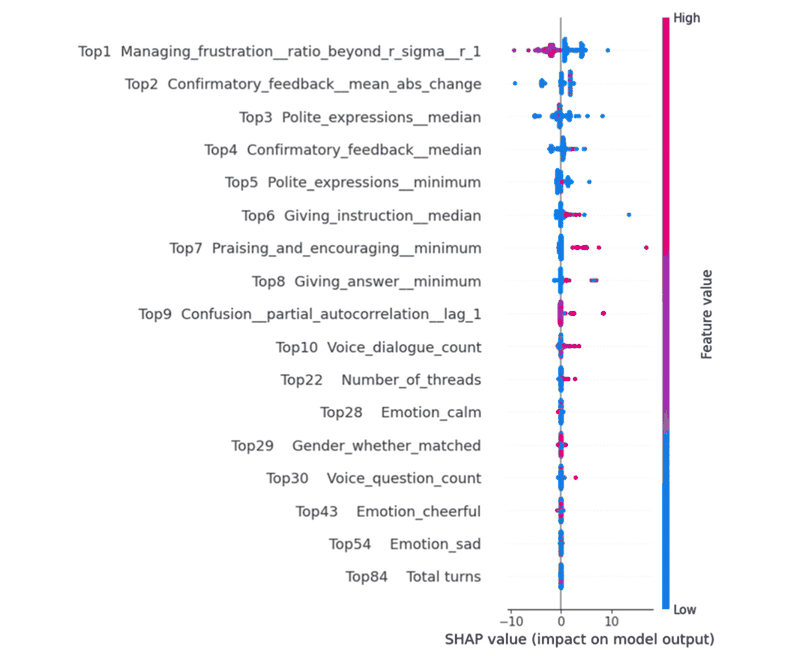
That ranking finally brings the question back to teaching itself. Voice is more like an entry point: it can attract attention and change the behaviors students adopt when they speak, but whether learning happens mainly depends on whether students explain, correct, tutor, and regulate emotion when dialogue stalls. Surface persona design can start interaction; what carries learning remains the quality of cognitive and socio-emotional processes.
07 This randomized experiment is stronger than correlational work — but generalization still needs tightening
Students were randomly assigned to 12 voice configurations, and pretest scores did not differ significantly across groups, so within the experimental sample, voice conditions and observed behavior differences have a fairly strong causal footing. Three weeks of real platform use, state standardized assessment, and fine-grained dialogue logs also sit closer to classroom practice than satisfaction ratings or one-shot tasks alone.
Still, of 678 students granted access, only 386 ever used voice. Sustained-dialogue analysis shrank further to 324, and learning-gain analysis to 310. Researchers checked differences between voice and non-voice users and found no significant bias on core metrics, but students willing to enable voice and keep chatting may still represent a more active group.
The sample came from two school districts in the southeastern United States; researchers could not report participant-level gender and racial composition; the intervention lasted only three weeks and focused on sixth- and seventh-grade math. The social meaning of voice emotion also changes with culture, age, subject, and task, and cannot be generalized directly to all K-12 AI teachers.
The paper also did not directly measure empathy, responsibility, or psychological safety; the two-stage mechanism still needs interviews, scales, or physiological indicators. Machine-learning SHAP rankings show which features help the model predict; they do not mean frustration management itself was randomly manipulated and proven to raise scores.
If product teams remember only “sad voice” or “happy voice,” they read the study too narrowly. A better approach treats voice as an adaptive instructional cue: at task start, watch whether students take explanation responsibility; when stuck, adjust emotion and prompts; in consolidation, prioritize safe, coherent exchange. Evaluation systems likewise cannot look only at session counts and dwell time — they must also ask whether explaining, correcting, tutoring, and frustration regulation truly occurred.
A voice can make a child willing to speak, but it cannot complete learning for them. What AI education design should truly optimize is not “who it sounds like,” but “what cognitive moves it gets students to make.” Paper informationOriginal title: I hear you: Enhancing middle school mathematics engagement and learning outcomes through teachable agent voice design
Authors: Hai Li, Wanli Xing, Chenglu Li, Bailing Lyu
Main affiliations: University of Florida, University of Miami, University of Utah, Auburn University
Journal: Computers & Education, 2026, Volume 254, Article 105725
Paper link: https://doi.org/10.1016/j.compedu.2026.105725
Key termsTeachable agent: A virtual learning partner that deliberately plays the role of knowing less, so students learn by explaining, tutoring, and correcting — rather than receiving answers directly.
Gender match: Whether the avatar’s presented gender aligns with the voice’s perceived gender; this paper manipulates match between avatar and voice, not match between student and agent.
SHAP: An analysis method that explains each feature’s contribution in a predictive model. It can show which features matter more for model prediction, but cannot alone prove causation.
ReferencesLi, H., Xing, W., Li, C., & Lyu, B. (2026). I hear you: Enhancing middle school mathematics engagement and learning outcomes through teachable agent voice design. Computers & Education, 254, 105725. https://doi.org/10.1016/j.compedu.2026.105725