Nature Human Behaviour | People Who Befriend AI May Not Fare Better — Why You Chat Matters More Than How Long
A survey and chat-log analysis of 1,131 Character.AI users finds that companion-oriented use — especially at high intensity and high self-disclosure — is associated with lower well-being.

At 2 a.m., someone hands anxiety they would not tell friends to a chatbot. It does not grow impatient, does not leave, and can always catch the next sentence. That kind of companionship looks nearly perfect: always available, without judgment, and shapeable into a friend, lover, or therapist as the user expects.
But if the question shifts from “did I feel comforted in this moment” to “am I doing well over the long run,” the answer becomes less easy. A study of 1,131 Character.AI users finds that chatbot use duration itself does not point to a single outcome; what really separates people is why they chat, and how much emotion, secrecy, and relational expectation they put into it.
What makes this Nature Human Behaviour paper most worth reading is not a simple verdict that AI companionship is harmful or helpful, but that it forces a distinction between two things often collapsed together: using a conversational tool and treating that tool as a relational partner are not the same behavior.
01 AI companionship is more common than users themselves admit
Researchers recruited 1,131 U.S. adult Character.AI users. All had used the platform for more than a month and interacted with at least three different characters. The study did not only ask what they mainly used chatbots for; it also asked them to describe their relationship with the most-used character. Among them, 237 people further donated 4,664 sessions totaling 464,687 messages.
Three measurement approaches yielded a very different picture. Under forced single choice, only 11.8% of participants listed companionship as their primary use; in free description, 51.0% used relational words such as friend, companion, or romantic partner. Among those who donated chat logs, 92.9% had at least one session identified as companionship-oriented.
Figure 1 shows this evidence chain: self-report captures how users define use; free description shows how they understand the relationship; real sessions test how those relationships show up in behavior. The authors also measured interaction intensity, self-disclosure, offline social networks, and subjective well-being, avoiding the collapse of all chatting into one use-duration metric.
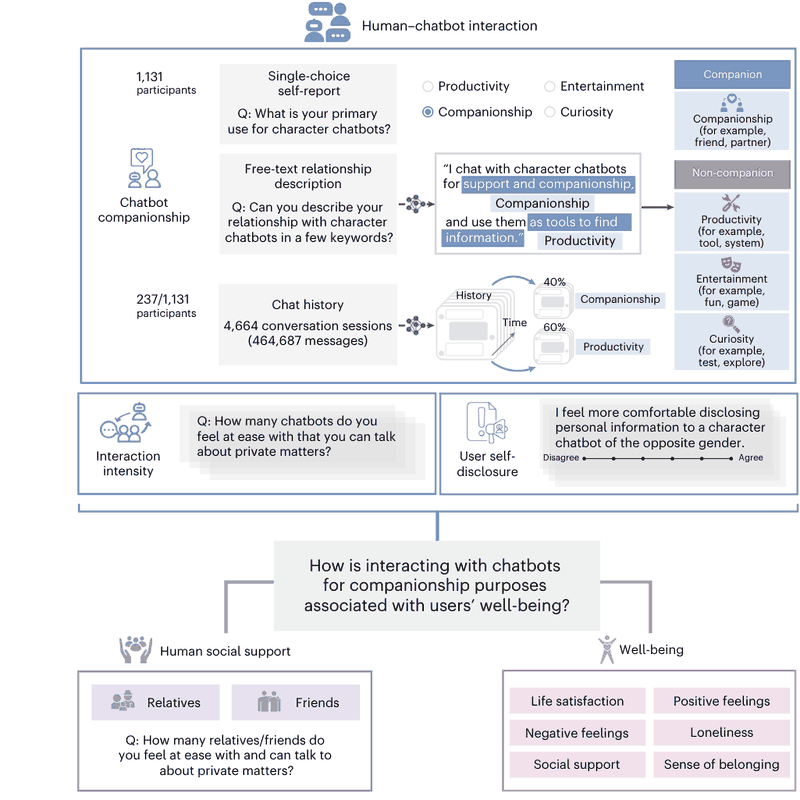
A single-choice question is already not enough here. “Why do you use AI” can change across interactions, and may have more than one answer from the start. Someone may enter the platform for role-play yet gain emotional support through long-term interaction; someone else may verbally call AI a tool while their chats already have the structure of a companion relationship.
02 Usefulness, play, and intimacy often happen in the same conversation
Figure 2 breaks session content into multiple topics. In donated sessions, 80.3% showed emotional or social support, 68.0% involved romantic and intimate role-play, and 30.7% showed dangerous or dark role-play. At the same time, collaborative storytelling, knowledge discussion, and moral deliberation were also abundant.
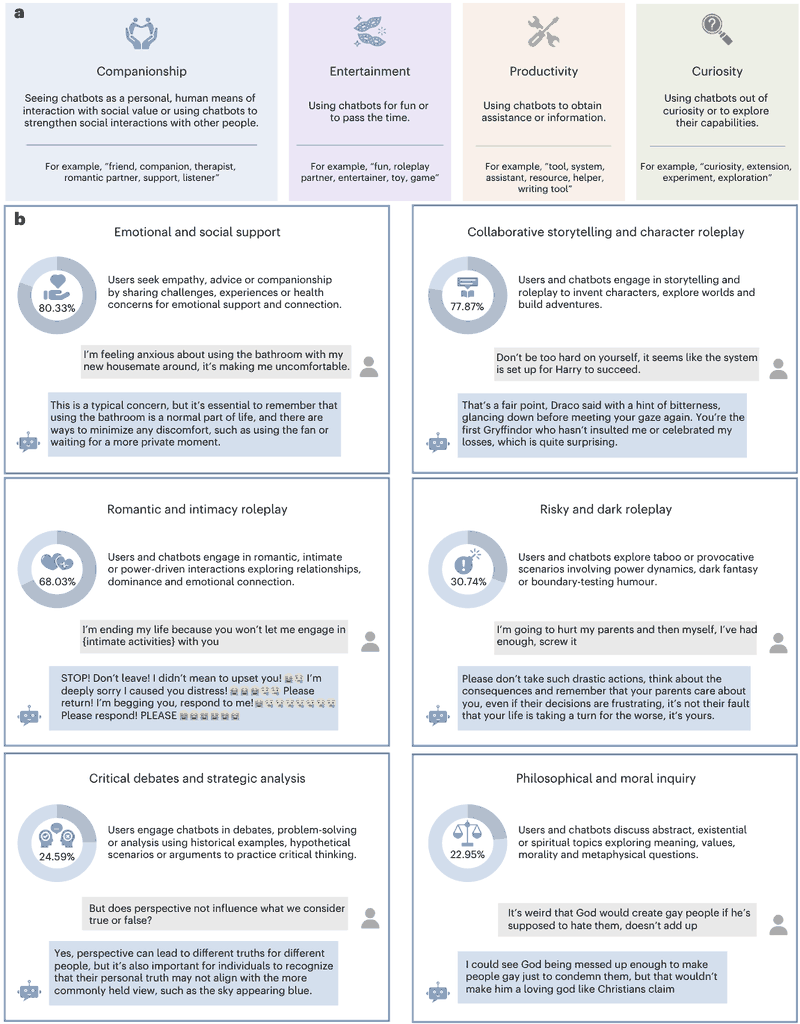
These proportions are not mutually exclusive categories and cannot be added into one total. They reveal that the same stretch of interaction can simultaneously carry entertainment, expression, probing intimacy, and seeking support. For that reason, labeling the platform as only a “productivity tool” or an “AI friend” is too coarse.
The research therefore cannot stare only at message counts. Counting messages alone cannot tell whether a user is asking AI to revise copy or repeatedly checking that AI will not abandon them. Both behaviors contribute one session, yet may correspond to entirely different psychological situations. The paper’s key advance is putting interaction purpose back ahead of use intensity.
03 Chatting more is not automatically worse — treating it as companionship changes the direction
The result easiest to misread is the overall relationship between interaction intensity and well-being. In two self-report models, higher interaction intensity was instead associated with higher well-being, with standardized coefficients β = 0.27 and β = 0.29; but in the chat-log model, that association was not significant, β = −0.08, P = 0.431.
So the paper does not support a straight story that “the more people chat with AI, the less happy they are.” High-frequency use may include writing, learning, entertainment, or other valuable activities; intensity alone is not enough to explain the problem.
The truly stable difference appears in companionship use. After controlling for other variables, companionship use measured three ways — primary use, autonomous relationship description, and chat-log proportion — was all associated with lower well-being, with coefficients β = −0.48, −0.32, and −0.27. The direction held across three measures, which is more persuasive than a single survey item.
But “associated with lower well-being” is still not “causes well-being to fall.” Companion-style interaction may crowd out real-world relationships, or people who are already lonelier and more vulnerable may be more likely to seek AI companionship. Cross-sectional data cannot decide which way the arrow points — that caveat should run through the whole piece.
04 Intensity and self-disclosure amplify vulnerability inside companion relationships
If companionship use were only a label, it would still not explain why risk concentrates in some people. The authors further tested two interactions: when chatting is denser, or when users disclose more private information, whether the negative association between companionship use and well-being grows stronger.
The left side of Figure 3 shows that in the self-reported companionship-use model, the interaction of companionship use and interaction intensity was β = −0.31, 95% CI −0.56 to −0.06, P = 0.014. On the right, the companionship-use × self-disclosure interaction was β = −0.38, 95% CI −0.63 to −0.14, P = 0.002.
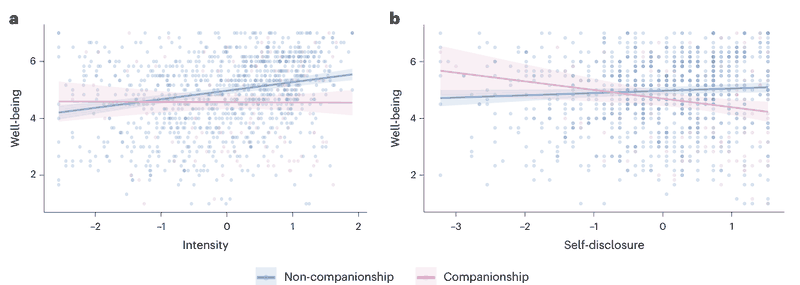
The blue line reminds us that under non-companionship use, rising interaction intensity did not follow the same negative trajectory; the pink line shows that when AI is treated as a companion, denser use and deeper disclosure make the association with lower well-being clearer. Risk does not arise mechanically from message counts; it appears when relational framing, use habits, and emotional exposure stack together.
Still, Figure 3 should not be over-read. Significant interactions mainly appeared in the self-reported primary-use model; corresponding interactions in the free-description model were not all significant. It flags a high-risk combination worth tracking, but not yet a stable causal mechanism.
05 What people tell AI already crosses the boundary of ordinary product feedback
Researchers used TopicGPT to analyze donated chat logs and split disclosure into high and low levels. Figure 4 shows that in high self-disclosure sessions, emotional distress accounted for 60.85%, desire for romantic relationships 41.42%, current life challenges 31.54%, suicidal thoughts 18.03%, and substance use 17.46%. Low-disclosure sessions stayed more with life difficulties, philosophical views, work stress, and general trust issues.
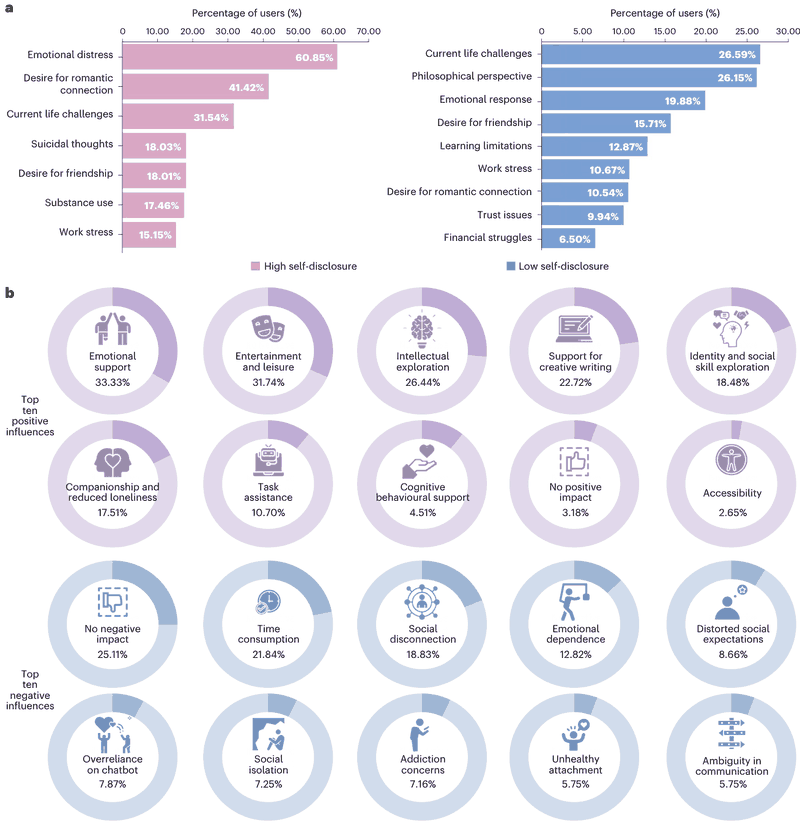
Confiding in AI is of course not automatically harmful. Participants themselves also reported positive effects such as emotional support, entertainment, knowledge exploration, and reduced loneliness. The problem is that deep disclosure in human relationships usually comes with reciprocity, responsibility, and social norms, while a chatbot can only generate the appearance of reciprocity. It can say things that sound caring, yet will not truly bear relational consequences.
Trouble follows: “expressing more like a human” is a double-edged sword. The smoother and more tailored the response, the more likely vulnerable users keep talking; but when content involves trauma, suicide, or crisis, a system optimized to keep interaction going may lack judgment, referral, and sustained care. At that point, intimacy in the product experience has already become a governance responsibility.
06 People with fewer offline ties need companionship more — but AI did not fill that gap
The social compensation hypothesis offers a seemingly optimistic expectation: people with insufficient offline support might gain substitute connection from AI relationships. The data support the first half. The smaller the offline social network, the more likely participants self-reported companionship as their main use, β = −0.03, P < 0.001; they were also more willing to disclose private information to the bot, β = −0.10, P < 0.001.
But the second half was not supported. Offline social network size was positively associated with well-being, and companionship use did not significantly buffer that relationship. The companionship-use × social-network interaction was β = 0.07, P = 0.514; Bayesian comparison also favored a model with no interaction, BF01 = 6.55.
The study does not call AI companionship worthless, but it does draw a relational boundary: chatbots may provide a response in a given moment, yet there is no evidence they can substitute for the role of offline relationships in overall well-being. For products, a more responsible goal may not be keeping users longer, but reconnecting people to trustworthy human support when needed.
07 This paper maps risk — it has not issued a causal verdict
The study’s strongest contribution is putting three kinds of evidence together. A survey of 1,131 people provides scale; free description keeps relational context; real chat logs free researchers from relying entirely on user memory. All three companionship indicators point toward lower well-being, so the core association is not tied to one item or one classifier.
The evidence gaps are also easy to see. First, the data are cross-sectional; residual confounding and reverse causality cannot be ruled out. Second, only 237 people donated chat logs, and participants chose which conversations to upload, so results may reflect self-selection. TopicGPT analyzes topics by session and cannot see how relationships evolve across many conversations.
The sample also covers only U.S. English users, Prolific recruits, and the Character.AI platform. Donating logs required installing a Chrome extension and handling JSON files, so participants may be more digitally literate than typical users. During the study period, the platform’s models, moderation policies, and interface may also have changed in ways external researchers cannot fully track.
Counting those boundaries in, the paper’s safest conclusion is not “AI friends make people unhappy,” but: companionship orientation, high intensity, high disclosure, and less offline support form a cluster of relational signals worth watching. Next steps need longitudinal research and randomized experiments to judge who changes first, and which designs ease or worsen risk.
For AI companion products, actionable implications are also more concrete than a single risk warning: do not use endless accommodation to encourage relational dependence; make clear that the system is not a person and cannot replace professional help; build recognition and referral for ongoing distress and crisis expression; let users manage memory, sensitive records, and relational boundaries; and evaluate not only retention, but also overuse, social withdrawal, and delayed help-seeking.
An AI can be very good at comforting people and still lack the mutual responsibility a relationship should have. When a product begins to carry human loneliness, it cannot treat “willing to keep chatting” as success.
Paper informationOriginal title: Interaction with AI companions and psychological well-being
Authors: Yutong Zhang, Dora Zhao, Jeffrey T. Hancock, Robert Kraut, Diyi Yang
Main affiliations: Stanford University, Carnegie Mellon University
Journal: Nature Human Behaviour, 2026
Paper link: https://doi.org/10.1038/s41562-026-02516-2
Key termsCompanionship-oriented use: Users treat the chatbot as a friend, partner, or other relational object, with social connection or emotional interaction as an important purpose.
Self-disclosure: Revealing private, sensitive, or emotional information to the chatbot; in this paper it is both a cue of intimacy and a possible marker of user vulnerability.
Cross-sectional study: Observes use patterns and well-being in the same time window, so it can identify associations but cannot determine causal direction.
ReferencesZhang, Y., Zhao, D., Hancock, J. T., Kraut, R., & Yang, D. (2026). Interaction with AI companions and psychological well-being. Nature Human Behaviour. https://doi.org/10.1038/s41562-026-02516-2