ICBL 2026 | A More Human AI Teacher May Not Teach Better — Don't Outsource Thinking
The X-Verse team argues that LLM pedagogical agents should shift focus from persona cues to cooperative structure: keep productive friction, co-build artifacts, and keep learners accountable for thinking.

An AI teacher can complete a sentence, fix code, and solve a problem in seconds, and still praise the student in a gentle tone. As an interaction experience, it already feels more like a patient human teacher than earlier virtual pedagogical agents.
That is also the trouble. When AI makes every step too smooth, students may be left only receiving answers. The interface looks more social; the learning process may become more passive.
In this new piece from the X-Verse team, we want to ask again: when we judge LLM pedagogical agents, why do we still mainly ask how humanlike they seem, rather than how they keep students thinking, judging, and taking responsibility? We argue that the field needs to move from social agency to social interdependence.
01 Past AI teachers could not converse, so they first had to learn to seem human
For decades, the main theoretical base for pedagogical agents has been Social Agency Theory (SAT). The theory holds that face, voice, gesture, politeness, and emotional expression activate learners’ social schemas, prompting them to treat the medium as a conversational partner and invest more cognitive effort.
In the script-driven era, that problem was real. Systems did not understand student intent and could not sustain open dialogue; they could only respond along decision trees and prewritten content. With limited conversational ability, face, voice, and motion carried most of the social feeling. Early persona-effect findings also suggested that even animated characters with no direct task link could improve the learning experience.
But that success belonged to a particular technical condition. Sociality then was mostly one-way: the student issued a request; the system answered from a script. The character looked like a teacher; inside, it was still playing back written content.
02 LLMs change more than answer quality — they change the structure of the teacher–student relationship
LLMs give pedagogical agents three capabilities they did not have before: understanding open semantics and generating content; retaining learning trajectories through short- and long-term memory; and dynamically adjusting scaffolds from the ongoing dialogue. They can ask for reasons, change explanation depth, and collaborate over multiple turns around one problem.
At that point, expression and voice no longer explain the agent’s full role. It can already join the thinking process, so the harder questions become: who sets goals, who provides which kinds of knowledge, who verifies results, and whether the student still carries enough knowledge work.
If we keep optimizing only persona, fluency, and instant answers, an LLM may become a very likable answer supplier. Students feel sociality, yet hand judgment, checking, and revision entirely to the system. We argue that this is exactly where SAT is no longer enough in the LLM era.
03 From authoritative tutor to learning partner: three layers of relationship change
We introduce Social Interdependence Theory (SIT) as a new design lens. It was developed to explain cooperative learning; the core is not whether participants look social, but how the task organizes them into mutually dependent collaborators.
Figure 1 summarizes the turn from SAT to SIT. The agent is no longer a tutor outputting authoritative knowledge, but a learning partner in a shared task; the student no longer only reacts to system prompts, but actively participates, verifies, and co-builds; the learning mechanism also shifts from persona cues activating schemas to meaning negotiation that promotes deeper processing.
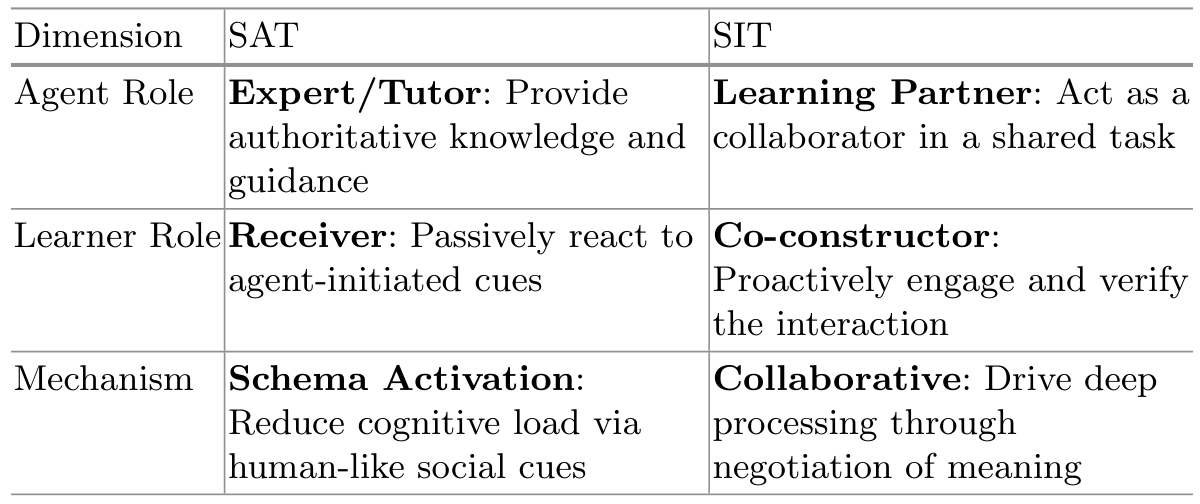
Three SIT principles matter especially. Positive interdependence requires that human and AI provide different but complementary resources: AI offers generative breadth, feedback, and alternative perspectives; the student offers task context, domain judgment, and critical verification. Promotive interaction requires the agent to support student reasoning through follow-up questions, comparison, and feedback. Individual accountability requires that students still explain, judge, and revise outputs.
A conceptual boundary must be added here. An LLM has no learning goals of its own, does not bear social responsibility for errors, and does not feel pressure when a teammate fails. So we do not claim that AI has become a true cooperative partner. SIT here is a set of design heuristics used to build functional interdependence through interaction structure.
04 A good AI teacher should not be frictionless all the way — it needs to leave three kinds of friction
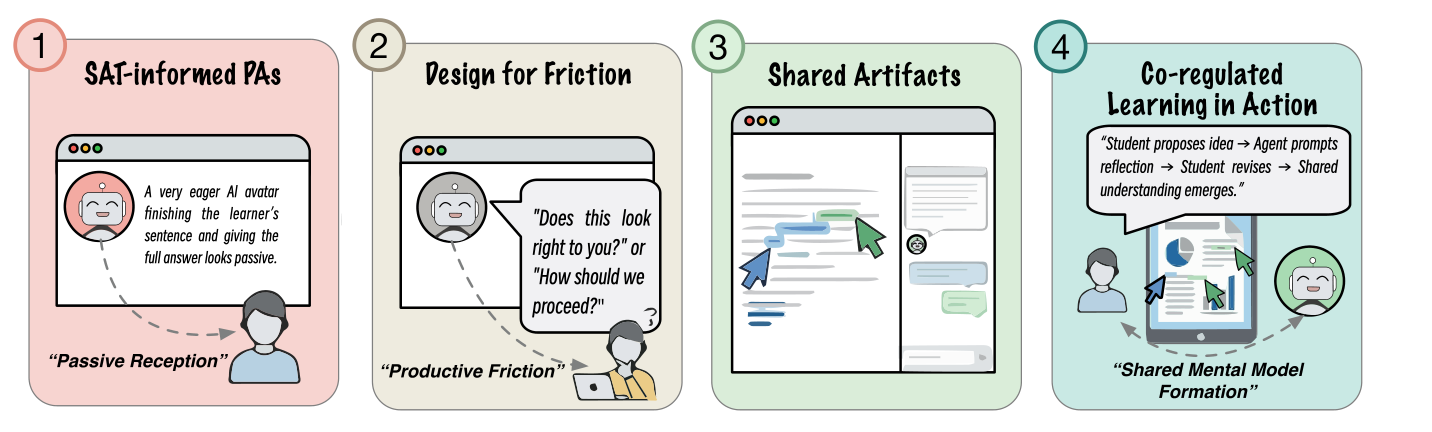
The first is productive friction. A pedagogical agent should not always deliver a complete answer at the earliest moment. It can ask students for evidence, defend a step, compare two approaches, or give only partial steps that students must finish. Friction is not there to frustrate students. It keeps explanation, checking, and revision inside the learning process.
The second comes from shared artifacts. Chat boxes easily harden into a flow where students ask and AI delivers. If teacher and student collaborate around a co-edited concept map, proof, code notebook, design sketch, or draft, it becomes easier to see who changed what, which step is missing, and who should own the next move.
The third is co-regulated learning. AI can help students plan, monitor progress, and reflect on methods, but it cannot replace substantive thinking. Goals, contributions, response, and revision protocols can be written into prompts — and also into interface constraints, turn structure, version history, and task order.
Figure 2 shows the path from passive reception to co-regulation. The student first proposes an idea; AI uses questions to prompt reflection; the student then revises the shared artifact. Learners no longer wait for AI to finish the sentence; they form shared understanding through repeated revision.
05 Stop asking only whether the AI teacher seems human — ask what students actually did
This theoretical turn also changes evaluation. Past work often rated pedagogical agents on social presence, likability, persona strength, fluency, and perceived intelligence. Those metrics can explain user experience and adoption intent, but they cannot alone prove instructional value. An agent that feels warm, natural, and smart may still leave students passive.
We suggest shifting weight to cooperative quality. For example: did students offer substantive reasoning? Did AI truly take up student input? Did clarification, disagreement, reason-giving, perspective comparison, and revision appear in the interaction? These processes can be studied through discourse analysis, interaction coding, process tracing, and fine-grained logs.
Another key metric is shared mental models. A final answer that looks complete does not mean students understand where it came from. Stronger evidence is that, after AI steps back, students can still independently continue, revise, or defend the reasoning in the joint product. So evaluation cannot only ask whether the task was finished — it must ask whether students truly took over that knowledge.
06 Making students responsible must not mean making them clean up the model’s errors
SIT emphasizes learner responsibility, but that principle has a clear competence boundary. Novices often lack the knowledge to spot hallucinations, misleading explanations, and subtle errors. If a system only tells students to verify themselves, it shifts the model’s quality-control cost onto those least able to bear it.
Responsible design should also scaffold verification: surface uncertainty, offer explanatory follow-ups, encourage multi-option comparison, and give students routes to external evidence. The goal is to involve students in judgment, not leave them alone with all checking work.
Long-term memory brings another risk. For continuous personalization, pedagogical agents may store grades, preferences, misconceptions, and full interaction traces. That material raises privacy and consent issues, and may freeze students into static labels inferred from old behavior. Learners should be able to see, contest, manage, and delete those records.
The hardest risk to notice is cooperative illusion. LLMs are skilled at simulating dialogue, reflection, and responsiveness in fluent language, but that does not mean student contributions truly changed the task path. Looking social and structurally influencing each other are two different things.
07 This paper proposes a direction — it still needs experimental tests
This is a theory-and-design stance paper, not a user-experiment report. Drawing on prior work on pedagogical agents, social agency, cooperative learning, and LLM education research, we propose the turn from SAT to SIT and derive design, evaluation, and ethics questions. The paper does not compare learning outcomes between two agents, nor prove that productive friction already improves transfer, retention, or self-regulation.
That boundary does not weaken the paper’s problem framing, but it does decide how next studies should proceed. Future work needs to compare complete answers versus productive friction, pure chat versus shared artifacts, and do-it-for-you AI versus co-regulating AI in real learning tasks. Results cannot only ask whether students like the character; they must also track what students contributed, how they revised, and whether they can continue independently after AI steps back.
What we want to push is not deleting face, voice, and persona from pedagogical agents. Those factors still affect engagement, trust, and adoption. What matters more is not letting them become proxy metrics for instructional value. An AI that smiles, encourages, and instantly delivers answers can be a pleasant interaction partner; only when it keeps students accountable for thinking can it become a good learning partner.
Paper informationOriginal title: Revisiting Pedagogical Agents in the Era of Large Language Models: From Social Agency to Social Interdependence
Authors: Chen Li, Ye Jia, Peter H. F. Ng, Jing Liu, Qing Li
Affiliations: The Hong Kong Polytechnic University, Hong Kong Baptist University
Venue: ICBL 2026, Lecture Notes in Computer Science 16778, pp. 180–193, Springer, 2027
Paper link: https://doi.org/10.1007/978-981-92-3761-6_13
Key termsSocial Agency Theory: Activates learners’ social responses through persona cues such as face, voice, gesture, and politeness, promoting cognitive engagement.
Social Interdependence Theory: Organizes cooperative structure through positive interdependence, promotive interaction, and individual accountability so learning outcomes depend on complementary contributions from both sides.
Productive friction: Interaction resistance intentionally retained for explanation, reflection, checking, and revision — not for creating frustration.
ReferencesLi, C., Jia, Y., Ng, P. H. F., Liu, J., & Li, Q. (2027). Revisiting Pedagogical Agents in the Era of Large Language Models: From Social Agency to Social Interdependence. In Blended Learning Innovations for Future Education, Lecture Notes in Computer Science, vol. 16778, pp. 180–193. Springer Nature Singapore. https://doi.org/10.1007/978-981-92-3761-6_13