IUI 2026 | Median Hazards Fell from 93 to 63 — When AI Becomes a Coach, Not an Alarm
A simulator study with 15 licensed drivers shows real-time assistance can cut hazards, and after personalized training improvement remains on a new map with assistance removed. Fixed order, small sample, and short tests still limit the conclusions.
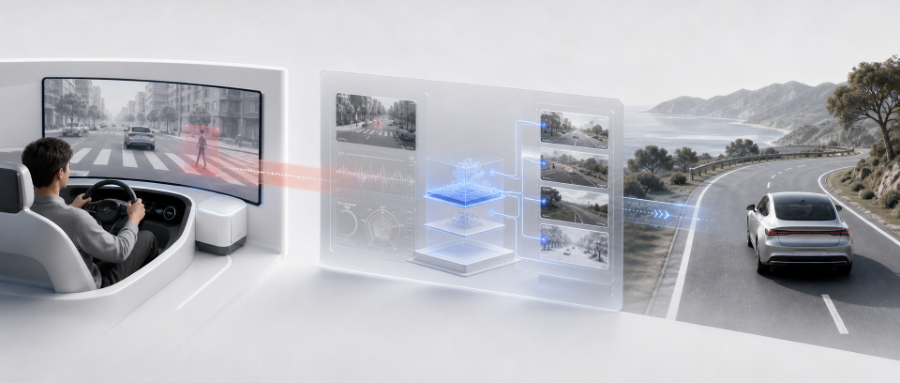
In the CARLA driving simulator, 15 licensed drivers first completed 10 minutes of unaided driving. The median hazard count was 93. After turning on real-time alerts and driving advice, that number fell to 76.
What really opened the gap was not the alarm. Drivers received 15 minutes of personalized training, then drove independently on a new map they had not seen before, with the system no longer prompting; median hazards fell further to 63, and median collisions fell from 2 to 1.
What I care about more is after the alarm is off. Good driving AI should not only catch people when danger appears — it should also help them drive more stably when AI is gone. DriveCoach’s focus is therefore not denser reminders, but a teaching loop from diagnosis and assistance to targeted practice.
01 Alarms can avoid immediate risk — but may not teach what to do next time
Traditional advanced driver-assistance systems are good at detecting lane departure, lead-vehicle distance, and collision risk. The problem is they usually handle only “what to do right now,” rarely explain why a driver repeatedly falls into the same risk class, and still less arrange follow-up practice for weak skills.
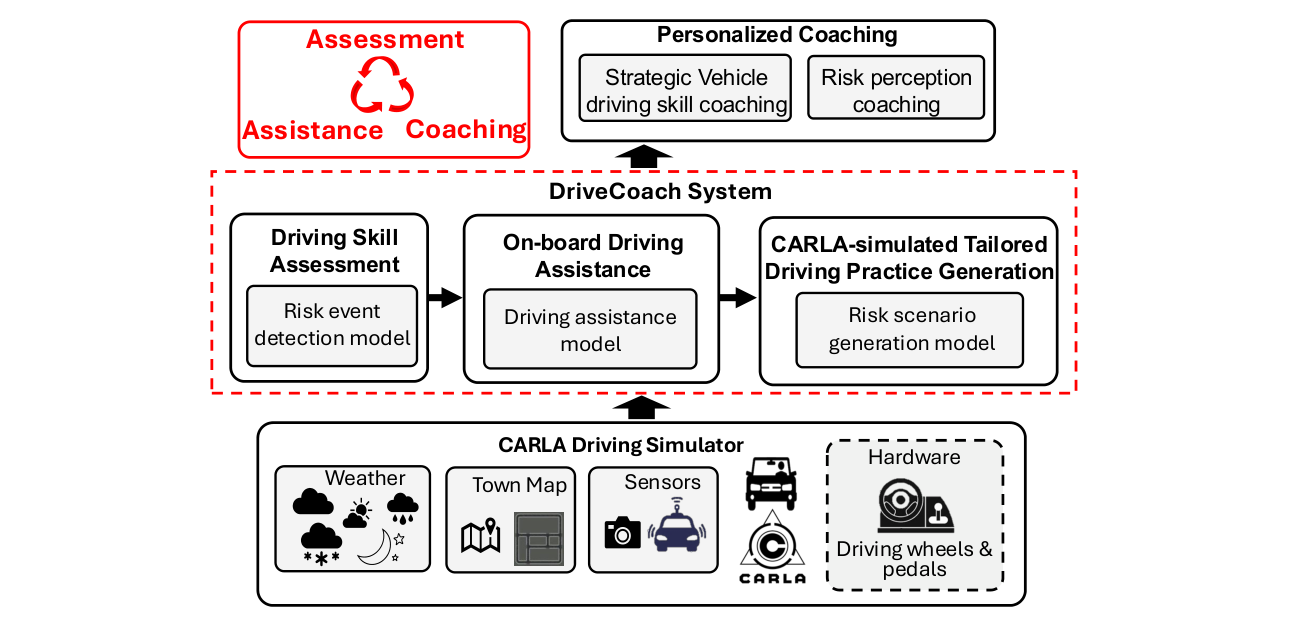
DriveCoach splits the task into three continuous stages. An assessment module diagnoses skill gaps from collisions and hazards; an assistance module gives risk alerts and avoidance actions while driving; a training module then generates new practice scenarios from personal weak points. Figure 1 shows this assess–assist–train chain.
Success criteria change with it. Short-term assistance only asks whether immediate accidents fall; a teaching system also asks: after assistance is removed, can the driver recognize risk, plan ahead, and carry the practice into unfamiliar environments?
02 The system first translates hazards into trainable skills
DriveCoach does not hand drivers a vague safety score. It first uses simulator sensors to identify collisions, then a two-stage model to detect hazards: first whether the current state is dangerous, then which risk type, using the 30 seconds of video and vehicle data before the trigger. The model reached F1 0.985 on collected data, and a domain expert continually verified detection events during the experiment.
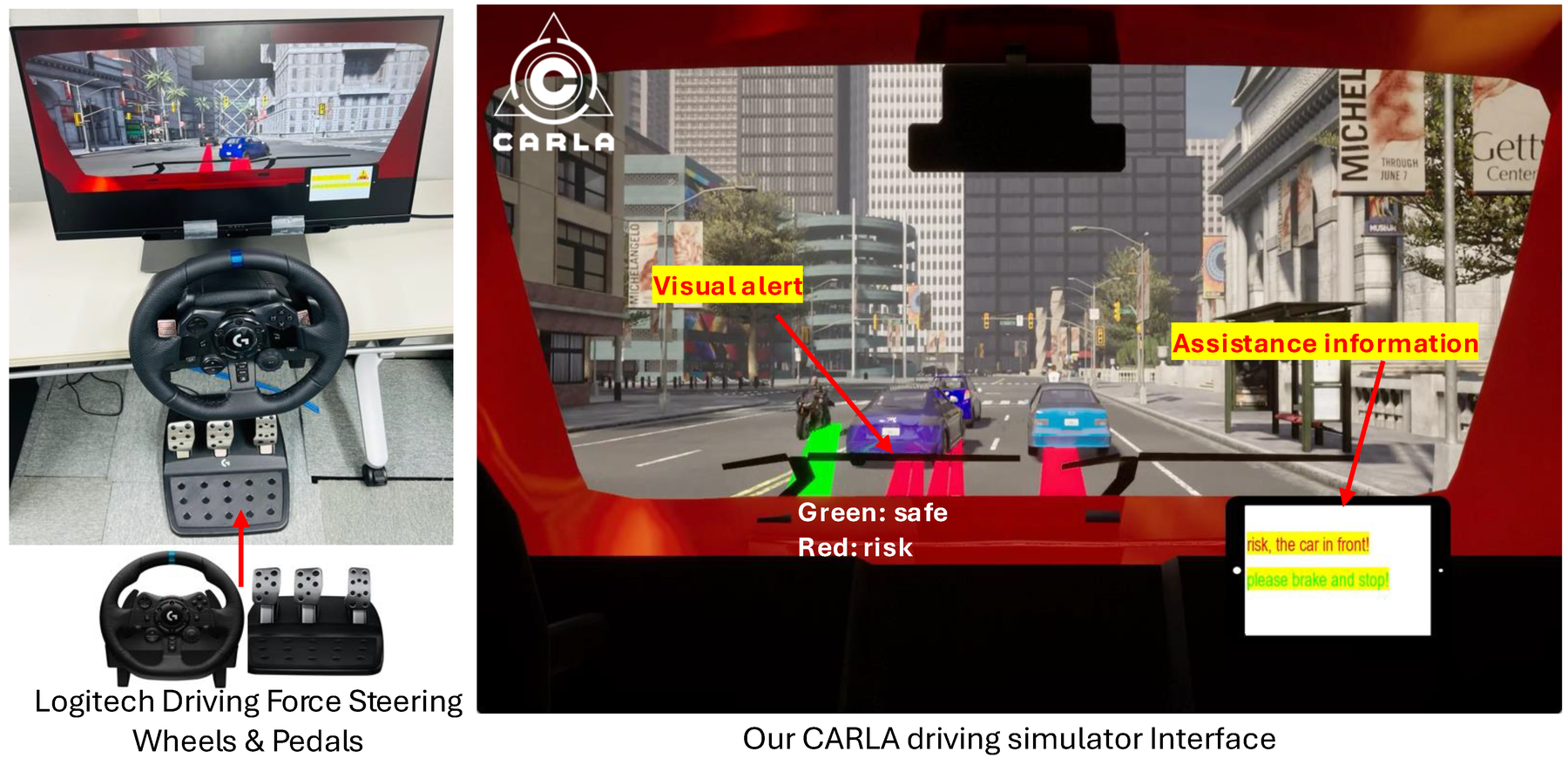
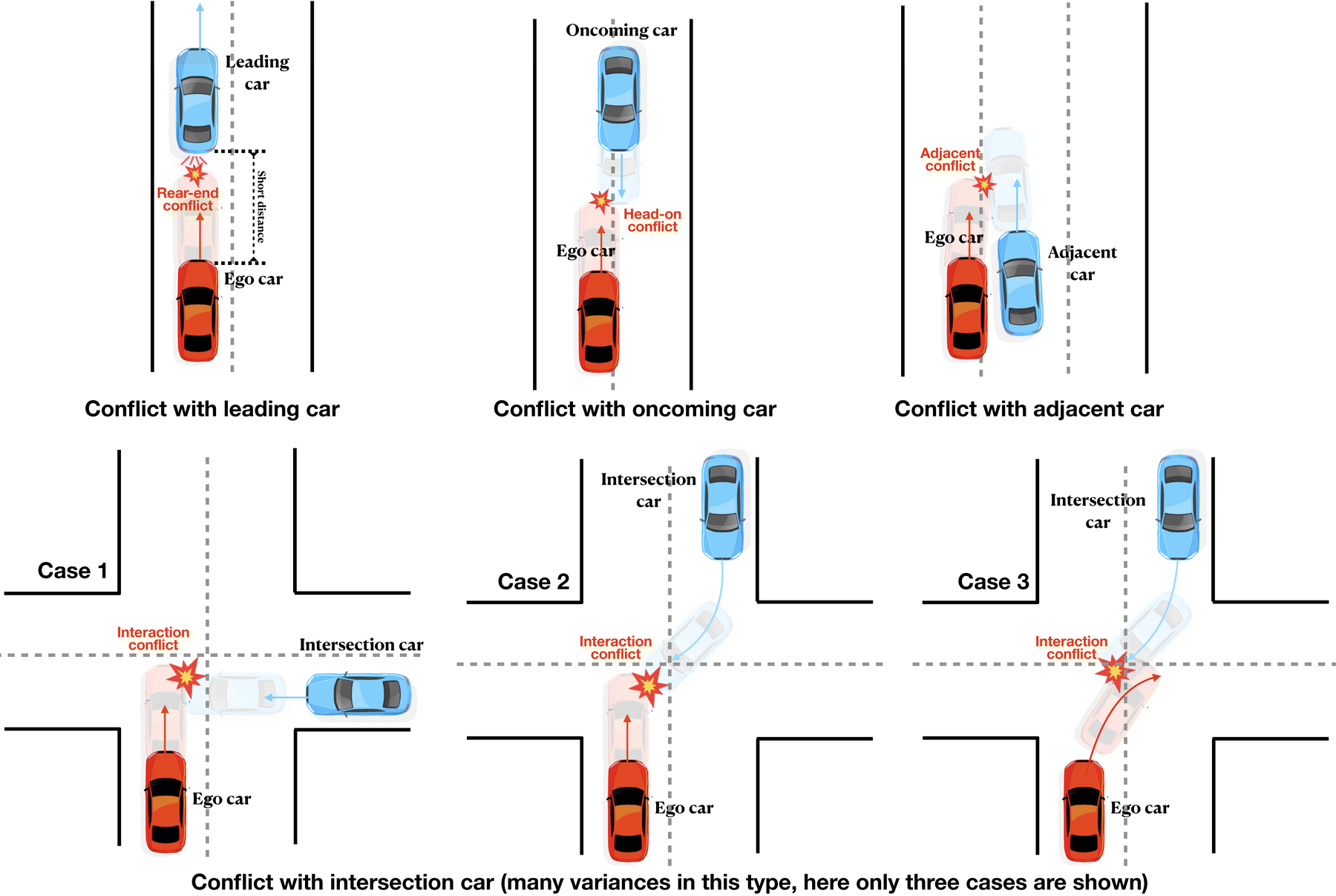
The study merges seven risk classes into four strategic driving skills: keeping safe following distance, handling oncoming traffic, dealing with adjacent vehicles, and negotiating intersections. Figure 2 shows the steering wheel, pedals, and simulator interface in the experiment. Risk regions, alerts, and advice overlay directly on the driving view.
What is assessed here is not whether steering and braking are practiced, but whether drivers can notice risk early and keep a safety margin. Figure 3 draws the spatial relations among the four risk types clearly, and also shows why later training must be designed separately by skill gap.
03 Personalization is not swapping one prompt — it is rebuilding a risk scenario
Once the system finds a driver weak at handling merging vehicles, it does not only generate “watch for side traffic.” DriveCoach calls scenario templates, configures road, weather, vehicle positions, traffic density, and adversarial vehicle behavior, and generates a CARLA scenario that can be practiced repeatedly.
Figure 4 shows this process. The system first retrieves feasible vehicle spawn positions, then plans each vehicle’s route, speed, and trigger conditions, and finally compiles an executable CARLA script. Drivers practice correct actions under similar but not identical conditions.
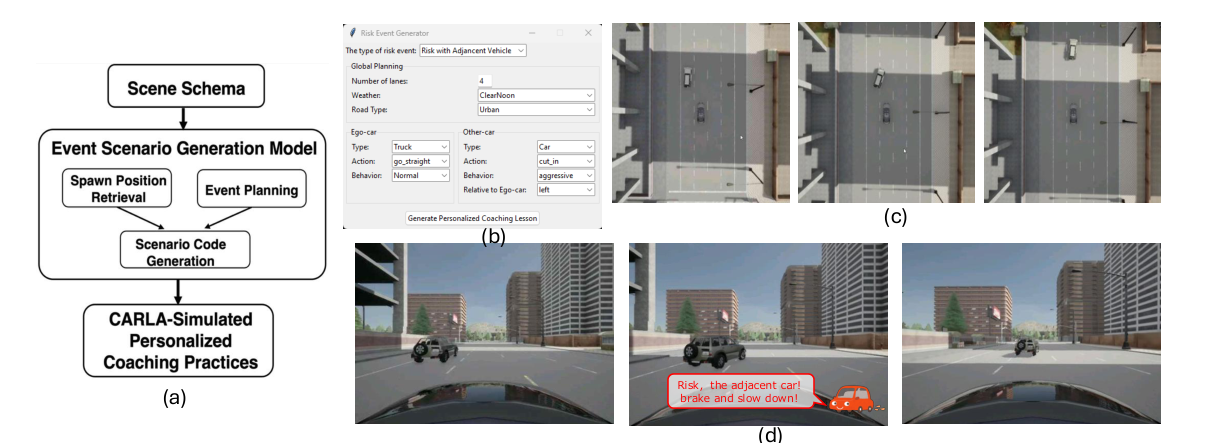
Scenarios are not freely generated by an end-to-end model, but controlled by explicit templates and finite-state behavior. Researchers can adjust difficulty and inspect why risk occurred. Driving training is not drawing concept art; controllability and reproducibility matter more than looking “realistic.”
04 The experiment compared assistance now versus after assistance was removed
The user study included 15 participants with valid licenses and 1 domain expert. Driving experience ranged from under 3 months to over 8 years; 12 had played racing or other simulation games. Each session was about 100 minutes, with about 80 minutes of effective task time.
As Figure 5 shows, formal experiment order was fixed. Test 1 was 10 minutes of unaided driving; Test 2 turned on real-time assistance under the same map, traffic, and weather; then came 15 minutes of personalized training; Test 3 moved to a comparably difficult but unseen map and turned assistance off.
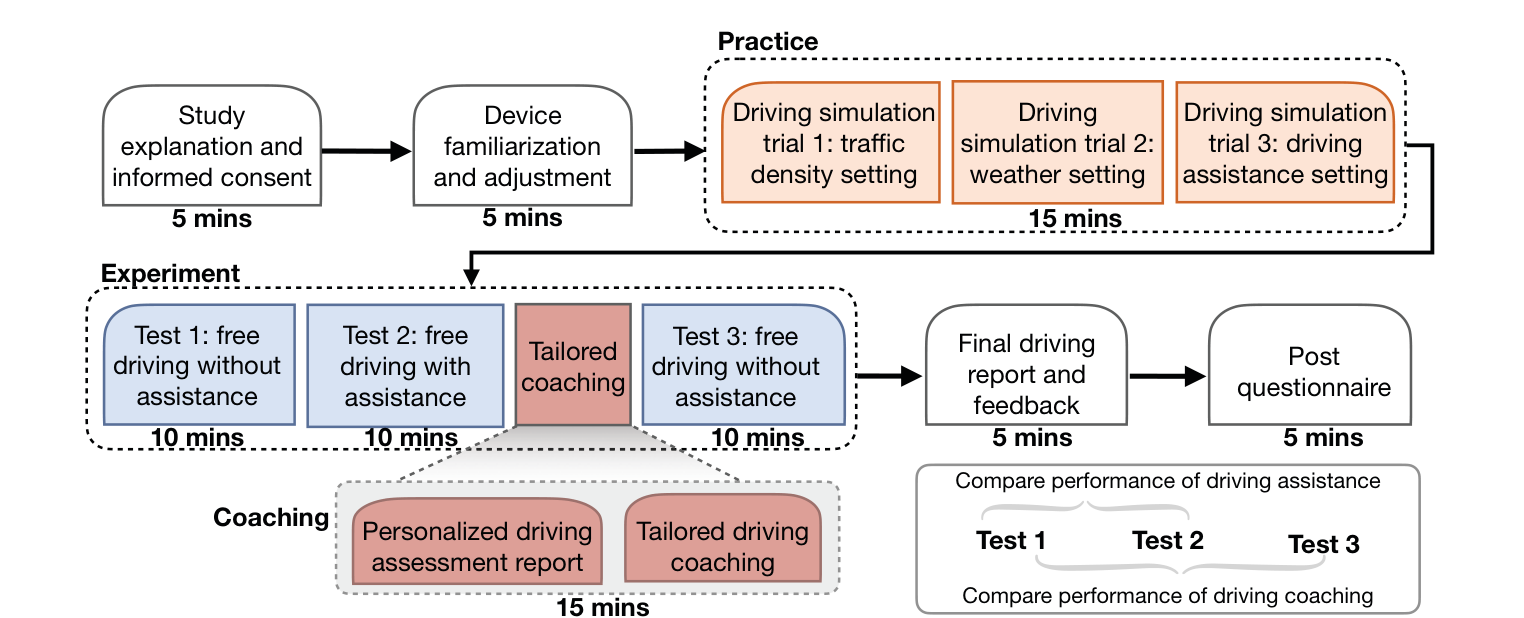
Tests 1 and 2 share the same environment, suited to observing whether real-time assistance can lower risk. Test 3 changes environment and stops prompting, so one can check whether trained behavior appears across scenes.
But that fixed order also leaves a gap: Test 3 improvement may come jointly from personalized training, more driving practice, and further familiarity with the simulator — the three were not fully separated.
05 Real-time prompts work — but only for some risks
Real-time assistance cut median hazards from 93 to 76; the difference reached statistical significance with a large effect size. Median collisions stayed at 2 with no significant change. The paper argues collisions were already few (a floor effect) and the sample was too small to detect differences stably.
Split by the four risk types, effects were uneven. Oncoming risk fell significantly; adjacent-vehicle and intersection risks only showed declining trends; continuously keeping following distance did not improve significantly. Figures 6 and 7 give overall and per-risk results.
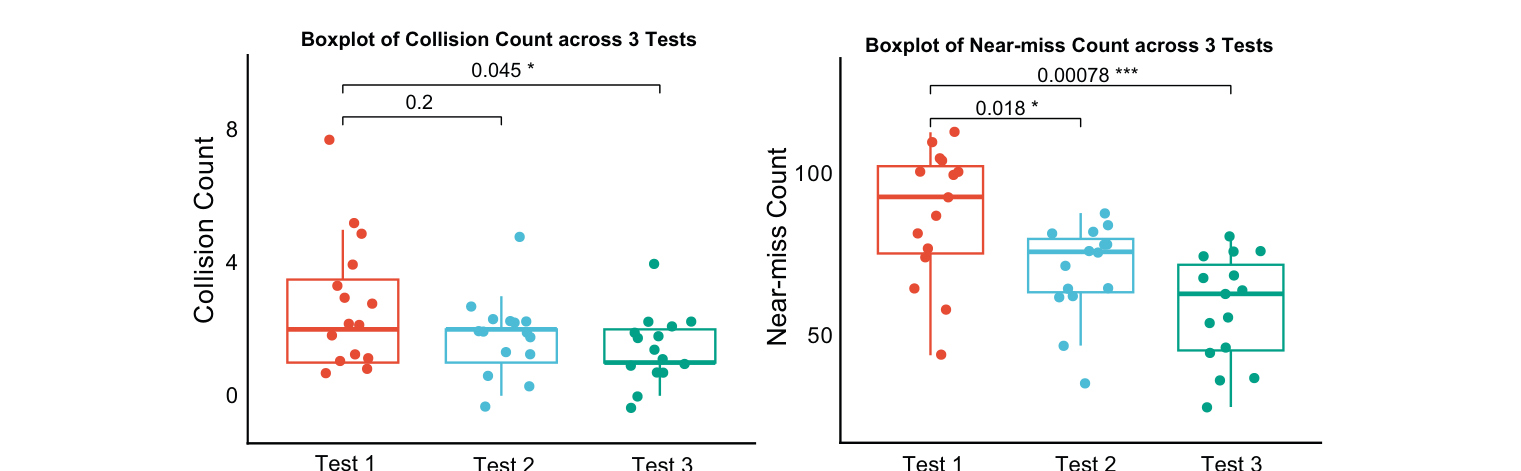
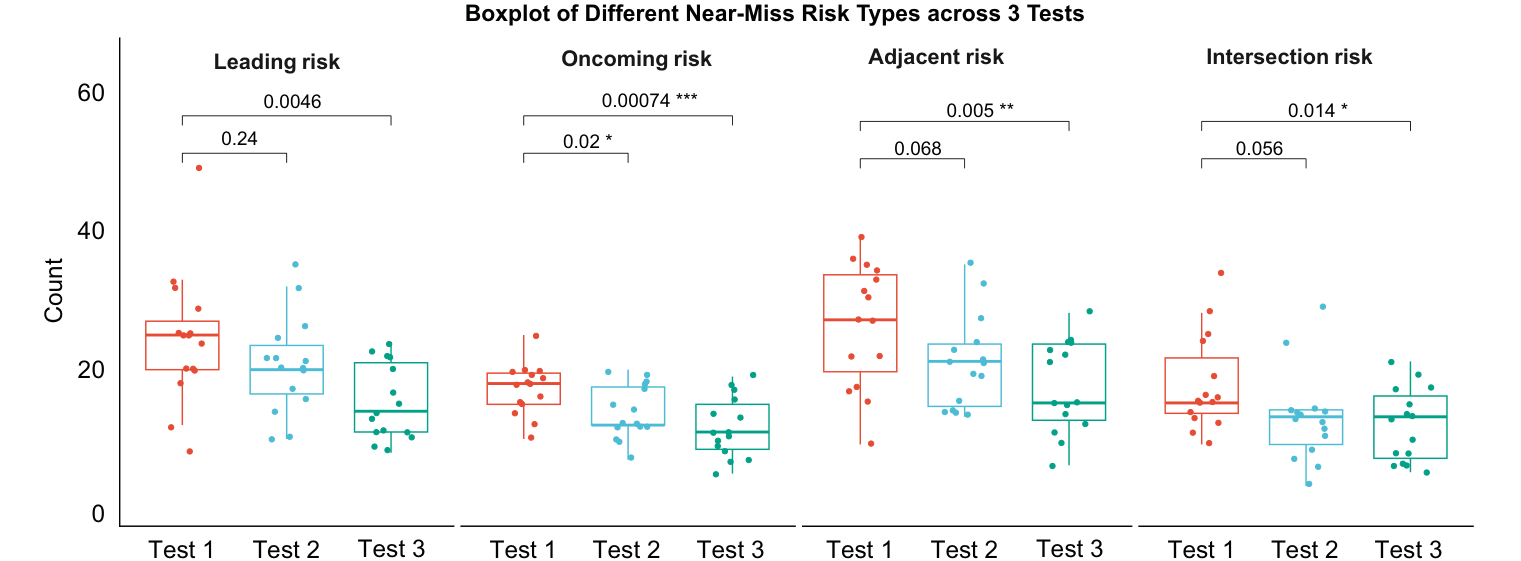
The alarm’s boundary is also clear. Oncoming risk often has a clear moment and action; timely prompts may work immediately. Following distance needs continuous control. Drivers may even wait for the system alarm before adjusting, no longer actively keeping a safety margin. More timely assistance does not automatically mean better learning.
06 Post-training results are broader — but still not long-term retention
After personalized training, Test 3 median collisions fell from a baseline of 2 to 1, and median hazards from 93 to 63. All four hazard types fell significantly: effect sizes for following, oncoming, adjacent, and intersection were 0.73, 0.87, 0.71, and 0.63.
More importantly, Test 3 used a new map and had no real-time assistance. Results at least show participants were not simply remembering the previous stretch of road, nor relying on alarms to avoid risk. Practices formed in training still appeared in unfamiliar simulated scenes.
But the paper’s “retention” must be given a time scale: Test 3 immediately followed 15 minutes of training. The study did not track performance a week or a month later, nor test on real roads. Fixed experimental order and a sample of only 15 further limit causal strength. This is short-term simulator transfer evidence, not proof of long-term driving skill or real-road safety.
07 Drivers prefer a coach — but still question some prompts
The 7-point scale ran from −3 to 3. Personalized training received the most consistent ratings: 13 people agreed with skill-assessment results, personalization of training, and performance improvement, each with mean 1.67. Practical quality of the system received 100% positive ratings; intention to use had mean 1.53.
Ratings of real-time assistance were subtler. Eleven people found risk alerts easy to understand, and participants generally felt prompts were safe and not very intrusive; but on “I agree with the driving-assistance information,” only 9 gave positive ratings, mean 0.67, and not significantly above neutral. Figure 8’s distributions make that difference clear.
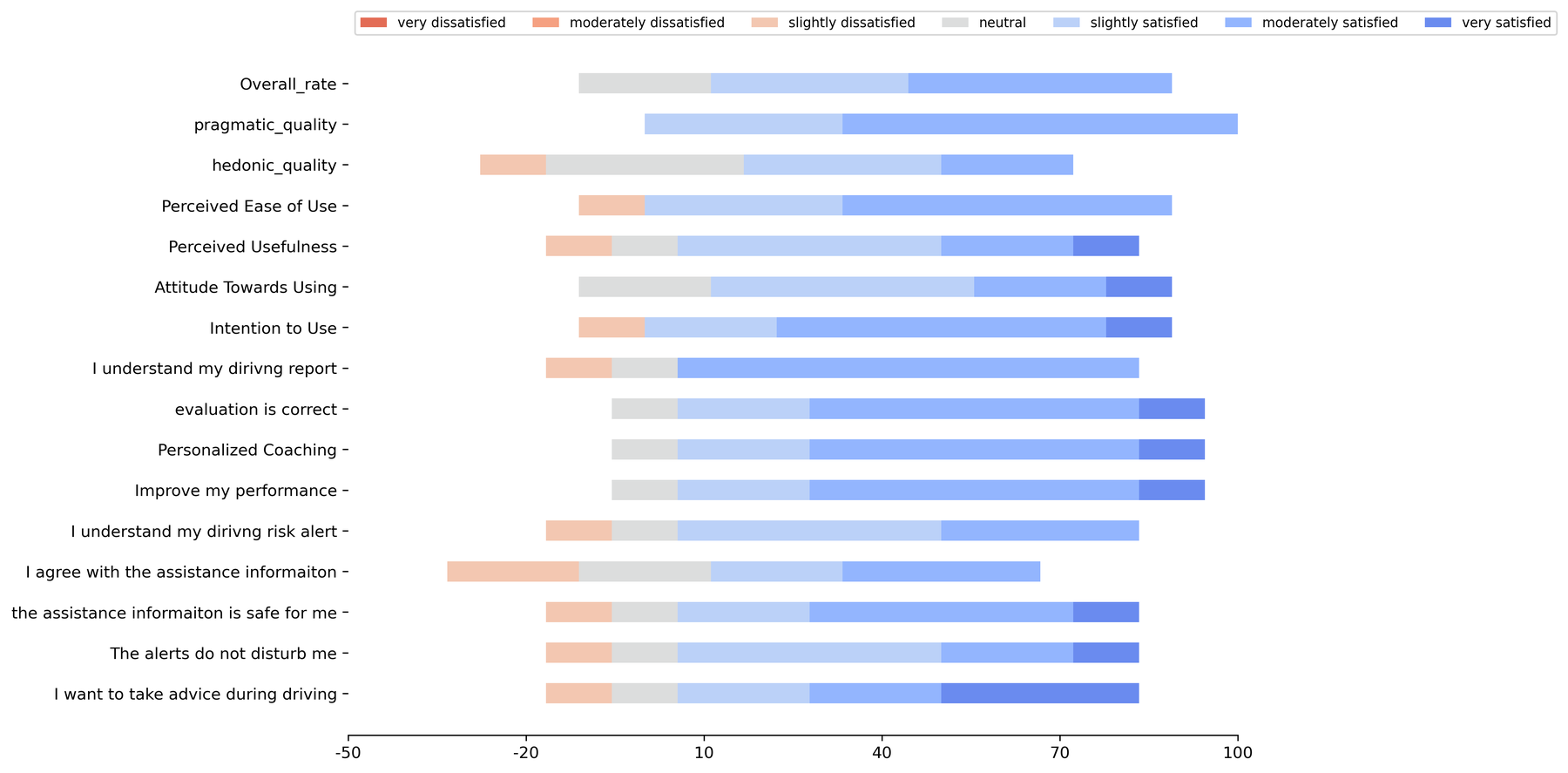
That matches the behavioral data: alarms are generally useful, yet do not guarantee every prompt matches drivers’ judgment of timing and severity. Driving AI cannot only chase detecting more risks; it must also calibrate prompt frequency, explain trigger reasons, and gradually reduce intervention as skill improves, to avoid dependence and numbness.
DriveCoach’s most transferable lesson is not only about cars. Any AI assistance aimed at complex skills can ask three questions: can the system diagnose specific weak points, arrange targeted practice, and keep ability after help is removed? The end of assistance should not be making people unable to leave the system — it should be letting the system gradually step back.
Paper informationOriginal title: Intelligent Tutoring in a Driving Simulator: Enhancing Driving Proficiency With AI-Driven Skill Assessment and Personalized Coaching Generation
Authors: Wenbin Gan, Minh-son Dao, Do-Van Nguyen, Ito Sadanori, Koji Zettsu
Affiliations: National Institute of Information and Communications Technology; Nagoya University
Paper link: https://doi.org/10.1145/3742413.3789060
Key termsHazard: An event that has not yet collided, but where the vehicle has already crossed a safety boundary and timely action is needed to avoid an accident.
Strategic driving skill: Risk-judgment ability one layer above steering and braking — for example maintaining safe distance, anticipating oncoming traffic, and handling complex intersections.
CARLA: An open-source autonomous-driving simulator that can configure maps, weather, traffic participants, and vehicle behavior, often used for controllable driving research.
ReferencesGan, W., Dao, M., Nguyen, D.-V., Sadanori, I., & Zettsu, K. (2026). Intelligent Tutoring in a Driving Simulator: Enhancing Driving Proficiency With AI-Driven Skill Assessment and Personalized Coaching Generation. In Proceedings of the 31st International Conference on Intelligent User Interfaces (IUI ’26). ACM. https://doi.org/10.1145/3742413.3789060