DIS 2026 | AI Science Editing Should Show Tradeoffs, Not Only Versions
Spatial Balancing maps scientific rigor and narrative appeal onto a spatial canvas, helping authors keep their bearings across rounds of AI revision.

When you ask AI to revise a science-communication draft, the easiest thing to get is more versions — a bit more rigorous, a bit more vivid, a bit more like a video script, a bit more accessible to a general audience. The trouble arrives quickly: which version is closer to my goal? Did this edit strengthen scientific accuracy, or did it trade away readability?
This DIS 2026 paper focuses on that gap. It does not turn the AI writing tool into a chat box that merely offers better suggestions. Instead, it places one of the hardest tensions in science communication — scientific exposition versus narrative engagement — onto a two-dimensional space, so authors can see where they are heading as they revise.
What is most interesting about Spatial Balancing is not novelty for its own sake. It turns AI generation from a sequence of text replacements into a revision trajectory that can be reviewed, compared, branched, and merged. In practical terms, the question is less “can AI help you revise better?” and more “can authors still know what they are changing while AI helps?”
01 The hard part of science writing is not being popular — it is continually balancing two goals
The paper opens by noting that science-communication writing differs from academic writing. It must accurately convey concepts, mechanisms, and evidence, and it must also keep non-expert readers willing to continue. Narrative, metaphor, suspense, and everyday examples raise engagement, but they can also oversimplify and weaken credibility; overly technical explanation, in turn, can shut readers out.
This is not a one-time style choice. It is a process of repeated adjustment. Every paragraph an author revises may shift scientific exposition and narrative engagement at once. Conventional LLM writing tools usually package suggestions as local text replacements, leaving authors to track in their heads how those replacements affect overall goals.
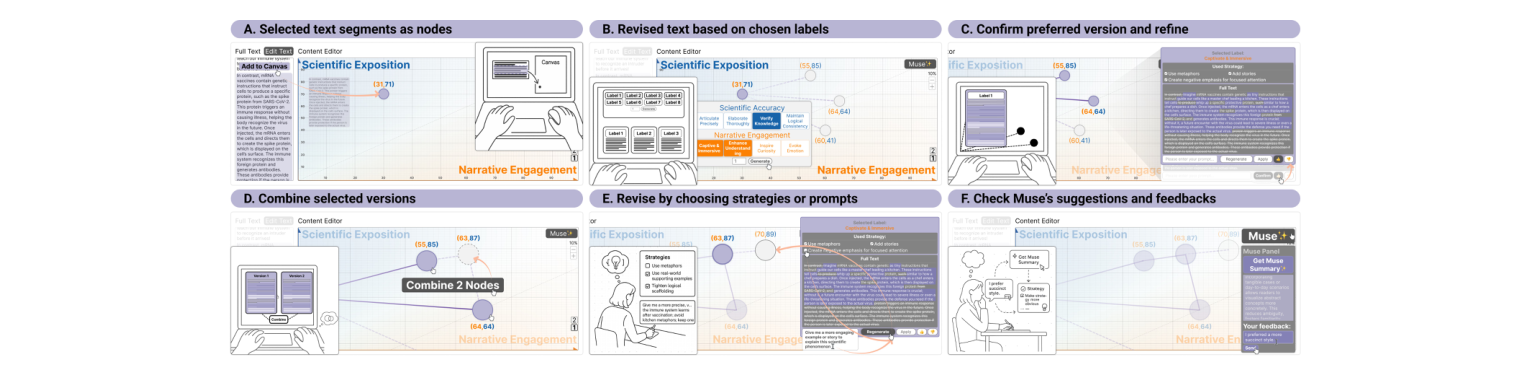
As Figure 1 shows, Spatial Balancing places a draft on a two-dimensional canvas: the vertical axis is Scientific Exposition, the horizontal axis Narrative Engagement. Each AI generation, confirmation, merge, and further revision becomes a node and a trajectory on the canvas.
02 The system first unpacks “how to revise” into 25 strategies, then compresses them into 8 operable labels
To keep AI from offering only vague advice, the authors first built a strategy space for science-communication writing. They retrieved literature from communication studies, education, psychology, linguistics and writing, and HCI, ultimately selecting 35 relevant papers. Two authors coded the material, then revised it through a focus group with four science-communication experts.
The paper arrives at 25 strategies: 10 that primarily strengthen narrative engagement, 7 that primarily strengthen scientific exposition, and 8 that act on both. To make the interface usable, the system further organizes these strategies into 8 labels — 4 oriented toward scientific exposition and 4 toward narrative engagement.
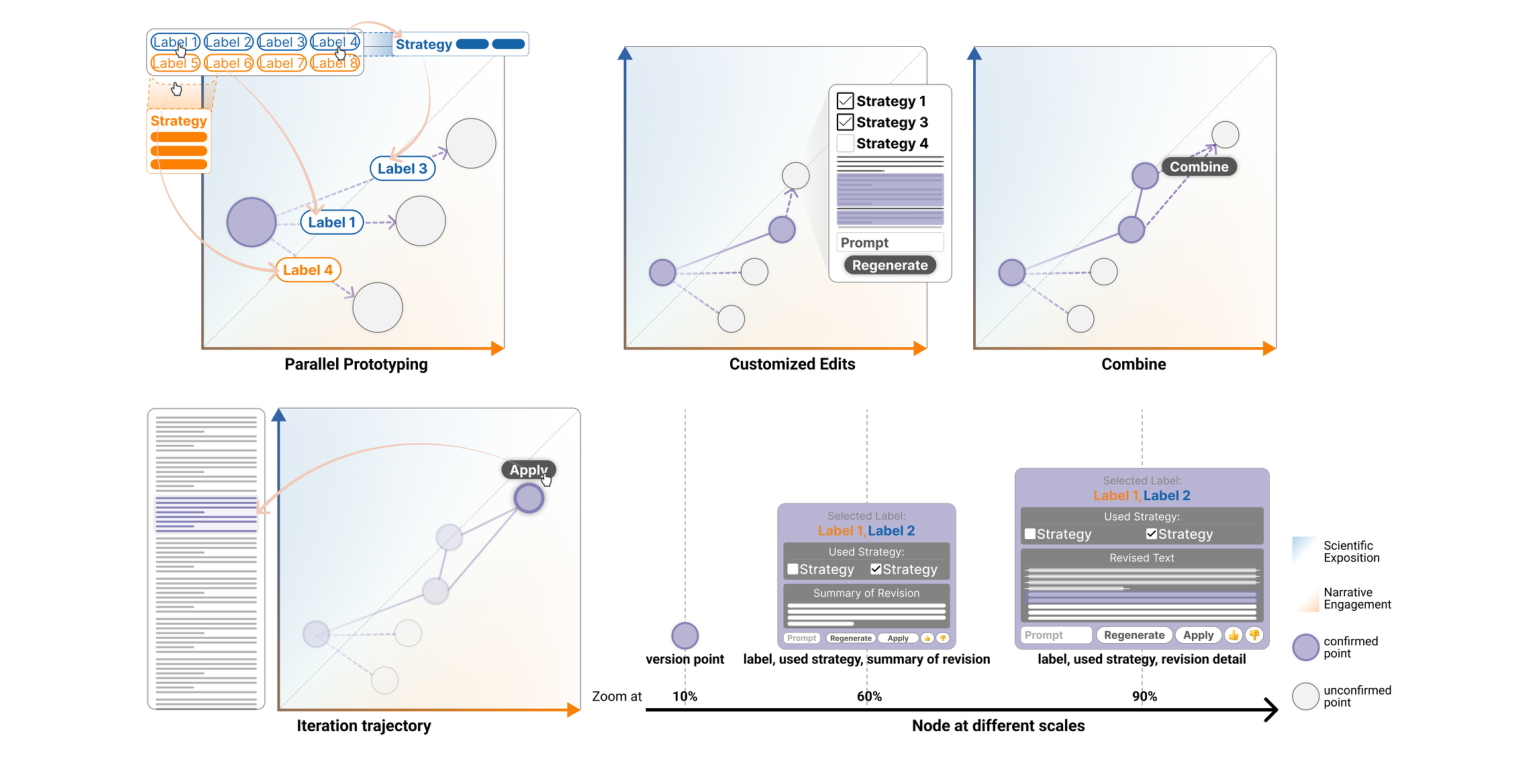
Figure 2 shows how this design enters interaction. Authors can generate versions in different directions in parallel, switch strategies, merge versions, and adjust prompts. What matters is that LLM output is no longer only a new block of text; it is placed back into a space with direction, labels, and history.
03 The value of the 2D canvas is turning revision from a chat log into a roadmap
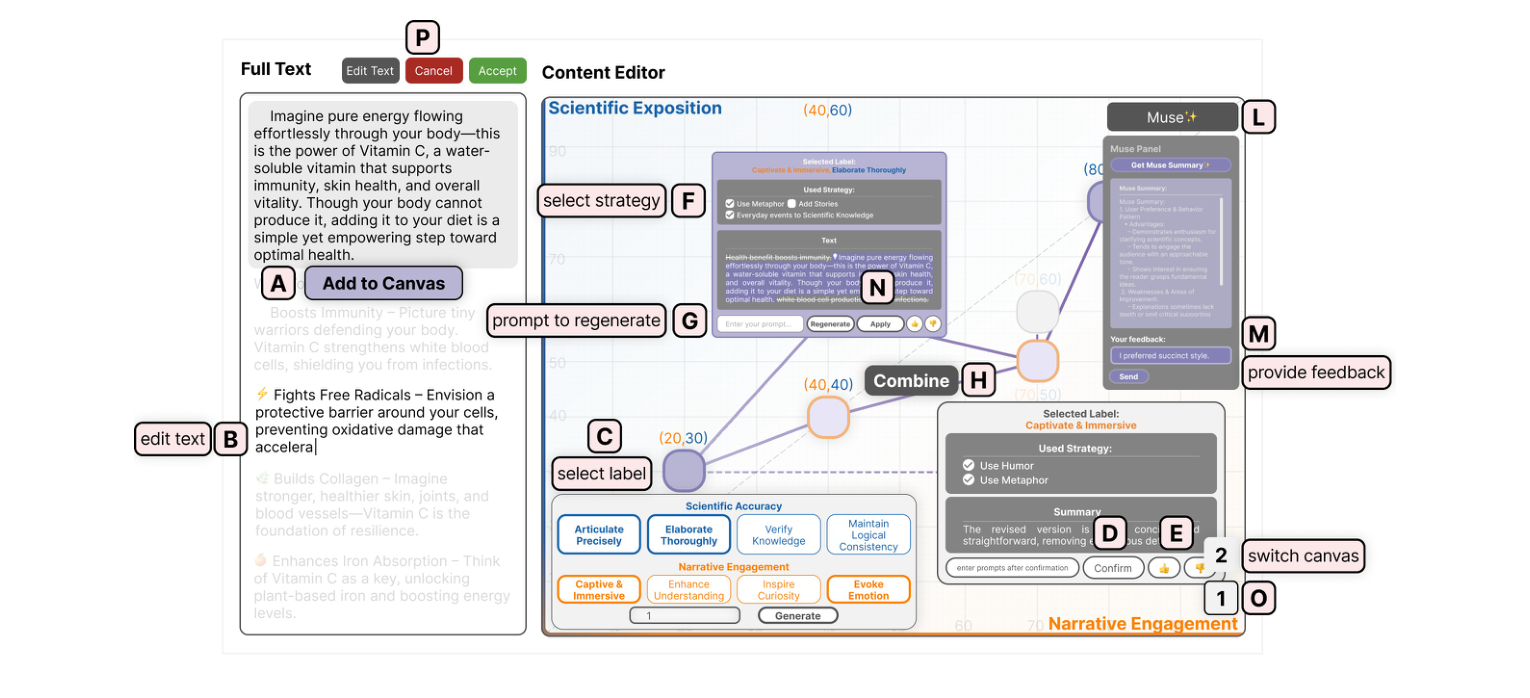
Figure 3 shows the full interface. On the left is a text editor; on the right, the two-dimensional canvas. Authors can drag any text segment onto the canvas as a root node, then choose strategy labels to generate new versions. Confirmed versions are solid nodes; unconfirmed versions are hollow. Edges between nodes represent generation, confirmation, merging, and related actions.
This adds a practical layer of external memory beyond a linear chat box. Authors need not look only at the latest version; they can see how they moved from a more exposition-heavy draft toward a more narrative one — or how they pulled back toward scientific rigor after overshooting on narrative.
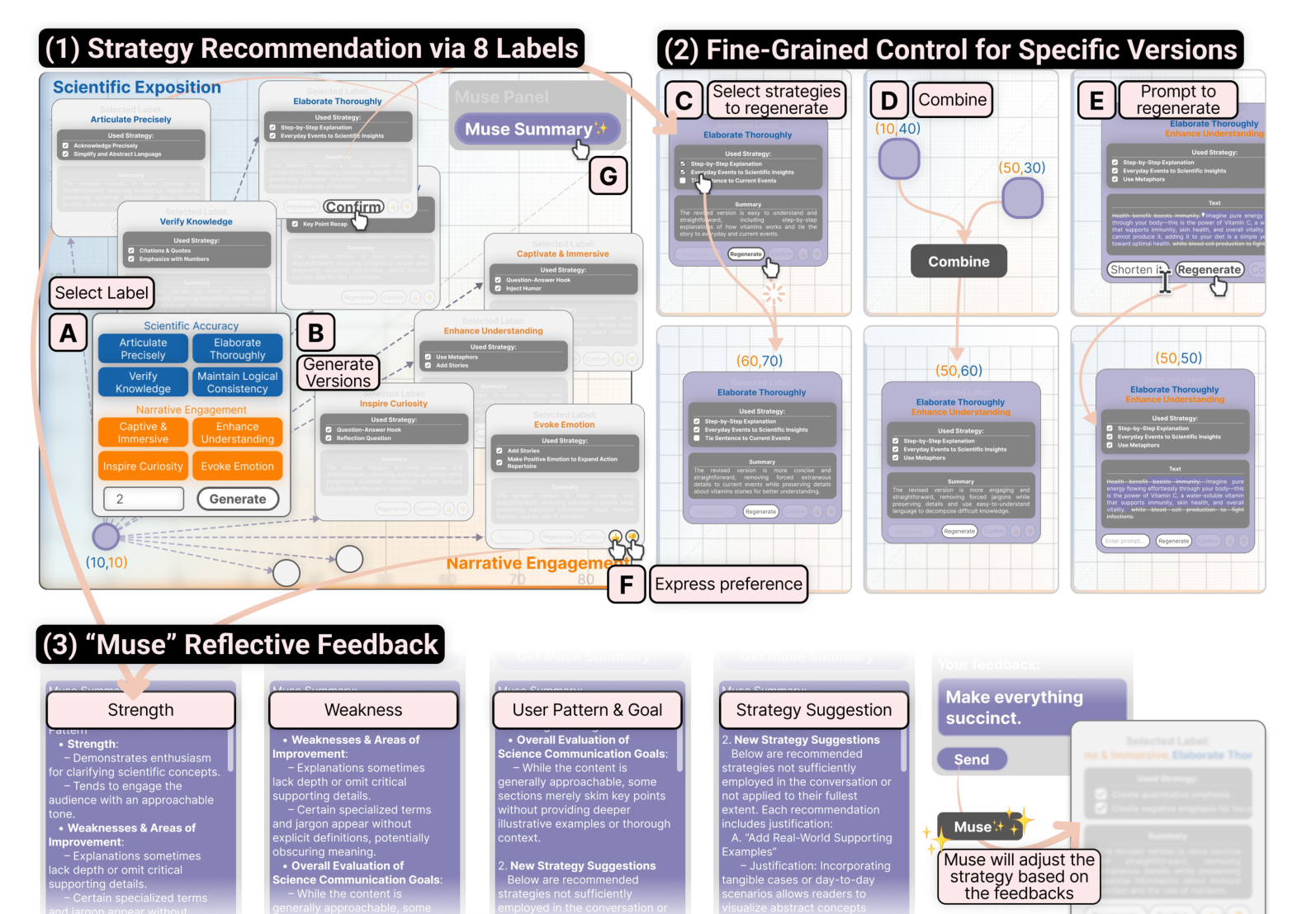
Figure 4 further shows three core forms of support: recommending revision directions through the 8 labels; fine-grained control over a specific version, such as changing strategies, merging nodes, or entering a custom prompt; and reflective feedback from Muse. Together they serve one goal: authors should not be pushed along by AI, but should keep their bearings across rounds of revision.
04 Evaluation asks not whether the final article is better, but whether authors can steer revision
The user study recruited 16 participants — 9 men and 7 women, ages 24–31, mean 26.9. They were not professional science communicators, but creators with research backgrounds and experience producing popular-science content; many were PhD students, postdocs, or early-career researchers.
Each participant completed four text-editing tasks: two with Spatial Balancing and two with a baseline system. The baseline was a familiar linear editor plus a GPT-4o chat interface, together with an Excel strategy sheet containing the same strategy names, definitions, usage notes, and examples as Spatial Balancing.
This comparison should be read carefully. It does not strictly isolate the causal effect of the two-dimensional space alone. It compares two configurations of LLM writing support: one in which strategies, goals, and trajectories are embedded in the interface, and another in which authors must orchestrate those supports manually through a chat box and an external table. The paper itself lists this as a limitation.
05 Results show that spatialization most clearly improves metacognitive regulation
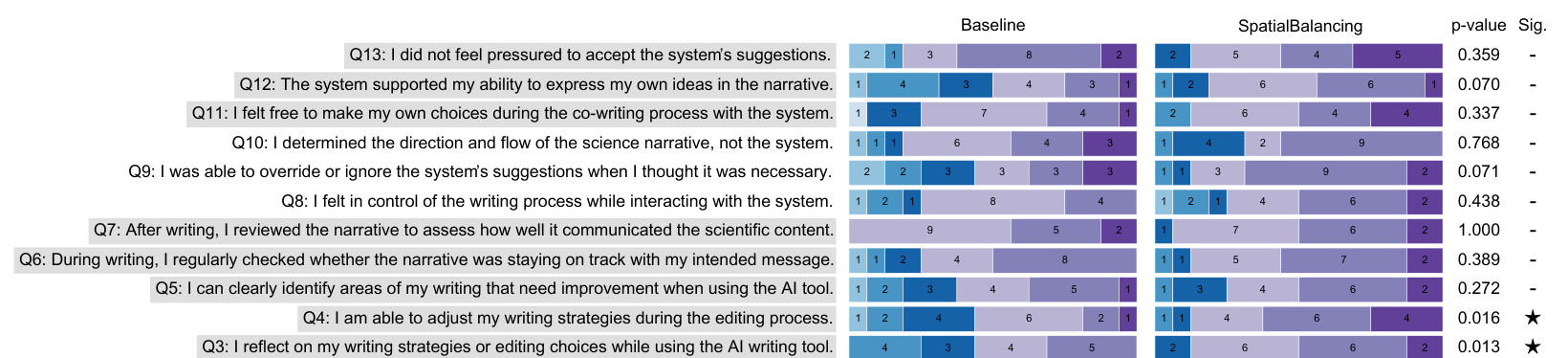
As Figure 5 shows, Spatial Balancing produced two significant differences on metacognition-related questionnaire items. Q3 asked whether participants reflected on their writing strategies or editing choices: Spatial Balancing mean 5.50 vs. baseline 4.63, p = .013. Q4 asked whether they could adjust writing strategies during editing: Spatial Balancing 5.69 vs. baseline 4.56, p = .016.
This suggests the system’s steadiest contribution is not “making the final text better,” but making it easier for authors to notice which strategies they are using, why they are revising that way, and whether the next step should change direction. The paper interprets this as metacognitive control — authors’ monitoring and regulation of their own revision process.
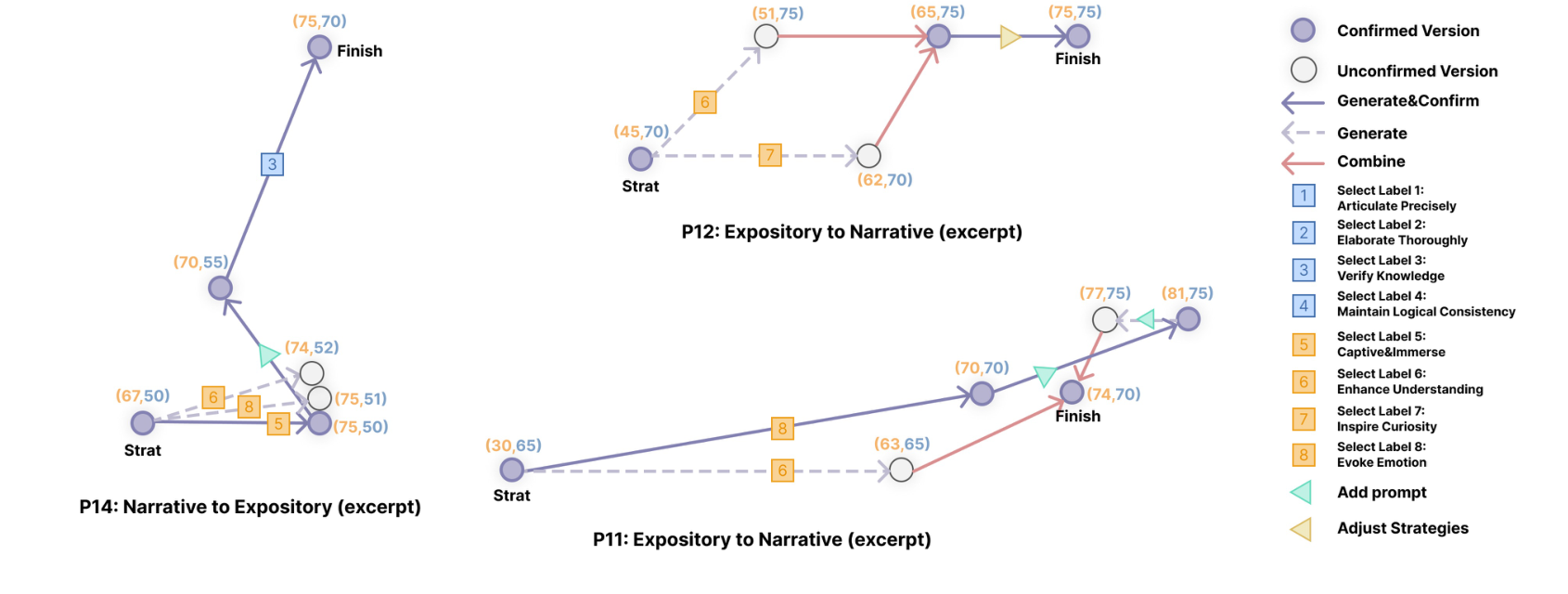
The trajectory examples in Figure 6 help make the result concrete. Participants did not simply jump from one version to another; they left paths of back-and-forth, compensation, and merging on the map. Some paths moved first toward narrative engagement, then pulled scientific exposition back by adding explanation. Revision was no longer a string of isolated outputs, but a route that could be explained.
06 It raised exploration and enjoyment — but did not prove that text quality must improve
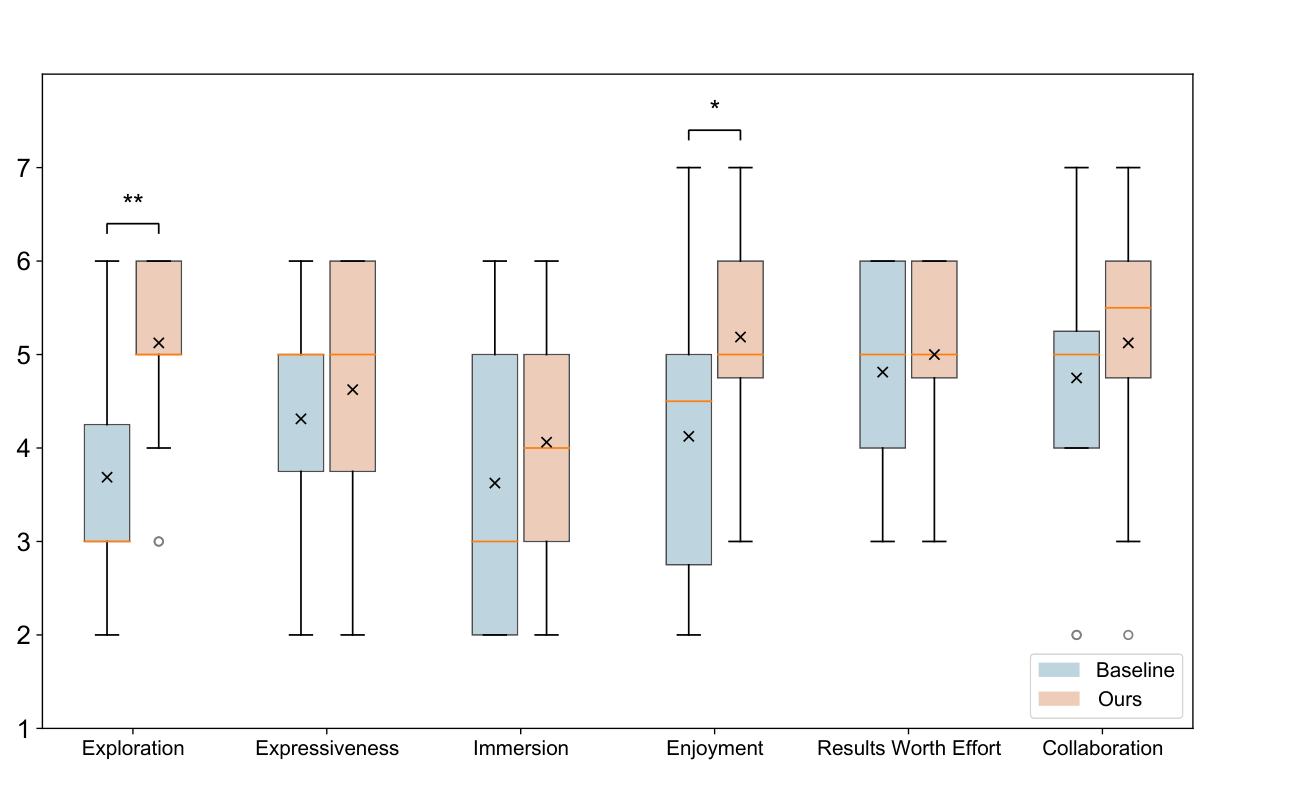
On the CSI questionnaire, Spatial Balancing scored significantly higher than baseline on Exploration and Enjoyment. Exploration mean 5.13 vs. baseline 3.69, p = .004; Enjoyment mean 5.19 vs. baseline 4.13, p = .039. Figure 7 shows these differences.
The results align with the design: the two-dimensional canvas allows parallel exploration of multiple directions, unconfirmed versions can be kept, and nodes can be merged. The “cost of trying” falls for authors, so they are more willing to explore.
The boundary must also be stated clearly. The paper did not independently evaluate whether final texts were truly more accurate or more engaging, nor did it ask target readers to rate understanding and engagement. What it supports more firmly is process experience and self-regulation: authors felt more able to explore, reflect, and see their trajectory. Final communication effects still need expert review and audience studies.
07 The takeaway worth keeping: do not turn externalized feedback into a new authority
Spatial Balancing’s tension is also typical. Externalizing goals and scores can help authors keep direction — but once those signals become too salient, authors may also grow lazy. Some participants said that with the system they outsourced more thinking to AI and trusted the scores more, rather than reading the text as carefully as under the baseline condition.
That is the metacognitive laziness discussed in the paper: the better a tool turns complex judgment into a clear signal, the more users may treat the signal as the answer. The authors therefore stress that scores should be designed as prompts for reflection, not optimization targets; the system should encourage users to explain why they accept, reject, or override a suggestion.
This has implications for every AI writing product. AI should not package “revise better” as a single button, nor disguise a system score as final judgment. A better interface lets authors see goals, paths, and tradeoffs — while preserving the power to reinterpret, question, and rewrite those signals.
The paper’s boundaries are exactly what show what to do next.
The limits are stated clearly. First, the current baseline is a realistic editor-plus-chat workflow, but it differs substantially from Spatial Balancing in support structure, triggers, and presentation, so not every difference can be attributed to “spatial externalization” alone.
Second, the study relies mainly on participants’ subjective process evaluations and does not systematically measure goal attainment, text quality, or communication effects. Third, the two-dimensional coordinates depend on model-generated proxy scores — low-cost signals for comparison and reflection that cannot stand in for the diverse judgments of real audiences.
So the safest conclusion is not that Spatial Balancing has solved AI writing. It clarifies an important design problem: when AI can easily produce many revised versions, what the interface most needs to support is not more generation, but letting authors continually see the tradeoffs they are making.
Paper
Original title: "Spatial Balancing: Designing an LLM-Powered Spatial Externalization Interface for Iterative Science Communication Writing"
Authors: Kexue Fu, Jiaye Leng, Yawen Zhang, Jingfei Huang, Yihang Zuo, Runze Cai, Zijian Ding, RAY LC, Shengdong Zhao, Qinyuan Lei. Primary affiliations include City University of Hong Kong, Clemson University, Harvard University, National University of Singapore, University of Maryland, and others. Published at DIS 2026. DOI: https://doi.org/10.1145/3800645.3812998.
Key terms
Scientific Exposition: Accurate explanation of concepts, mechanisms, evidence, and logic in science-communication writing. It supports credibility, but when overemphasized it can feel burdensome to non-expert readers.
Narrative Engagement: The use of story, metaphor, suspense, emotion, and everyday scenes to keep readers reading. It raises readability, but can also lead to oversimplification.
Spatial Externalization: Placing goals, versions, and revision paths that authors would otherwise track mentally into a visible spatial interface, so they can compare, review, and regulate.
Metacognitive Control: Authors’ monitoring and adjustment of their own writing goals, strategies, and revision process. The paper’s core evidence mainly supports improvement at this level.
References
Fu, K., Leng, J., Zhang, Y., Huang, J., Zuo, Y., Cai, R., Ding, Z., LC, R., Zhao, S., & Lei, Q. 2026. Spatial Balancing: Designing an LLM-Powered Spatial Externalization Interface for Iterative Science Communication Writing. In Designing Interactive Systems Conference (DIS ’26), June 13–17, 2026, Singapore, Singapore. ACM. https://doi.org/10.1145/3800645.3812998