CHB 2026 | Does a Better-Looking AI Teacher Make Students Trust It More?
For GenAI-generated pedagogical agents, appearance shapes learner trust and motivation — but “looking good” does not automatically produce identification.

If future AI teachers can be generated with one click, what would we tune first? Many would say capability, knowledge, feedback speed. But before students actually start learning, another earlier judgment is already running: does this virtual teacher look reliable? Am I willing to learn from it?
That can sound shallow, yet it is not minor. Online education, VR learning, and AI tutors are all remaking "the teacher" as a designable interface. When a teacher's image is no longer decided by a real person, but by prompts, style libraries, and generative models, appearance is no longer mere packaging — it becomes a social cue.
What makes this paper worth reading is not a simple proof that "better-looking AI teachers are more popular." It unpacks "looking good": what are students actually looking at? And which path among trust, similarity, identity, and learning motivation is doing the work?
📌 Paper information
Original title: Perceived algorithmic attraction in GenAI-generated pedagogical agents: Dimensions and effects on learner trust and motivation
Authors: Fu-Song Hsu, Wei-Ting Pai, I-Chia Tsai. Authors are affiliated with the Institute of Communication Studies, National Yang Ming Chiao Tung University (Taiwan), and the Department of Creative Product Design, National Taichung University of Science and Technology.
Publication: Computers in Human Behavior, 184, 109079, 2026. Paper link: https://doi.org/10.1016/j.chb.2026.109079
This paper is not solving an aesthetics problem
Past pedagogical-agent research often asked whether "having an agent is better" or "whether a bit more anthropomorphism helps." In the GenAI era, the question changes: researchers no longer handcraft a few characters for contrast; they can systematically generate pedagogical agents that vary in age, gender, clothing, art style, realism, and character temperament.
That turns appearance design from an "art choice" into a researchable variable. The paper calls attractiveness elicited by generative-AI appearance algorithmic attraction. It is not mere looks; it is a first impression composed of realism, role fit, style, approachability, professionalism, and related cues.
Using the Evaluation Grid Method (EGM), the authors decompose that attraction into three layers: abstract feelings at the top, evaluative dimensions in the middle, and observable design features at the bottom. Figure 1 shows this decomposition: from concrete features upward to "why it feels attractive."
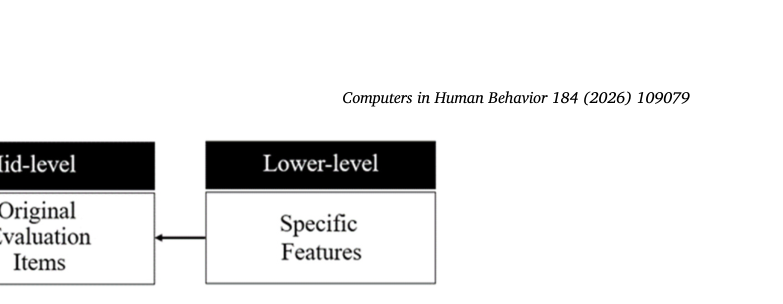
The method's strength is that researchers do not simply declare "what kind of AI teacher is better." Learners first articulate their own judgment criteria. In other words, the paper first builds a perceptual map of "how students see AI teachers," then uses quantitative surveys to validate that map.
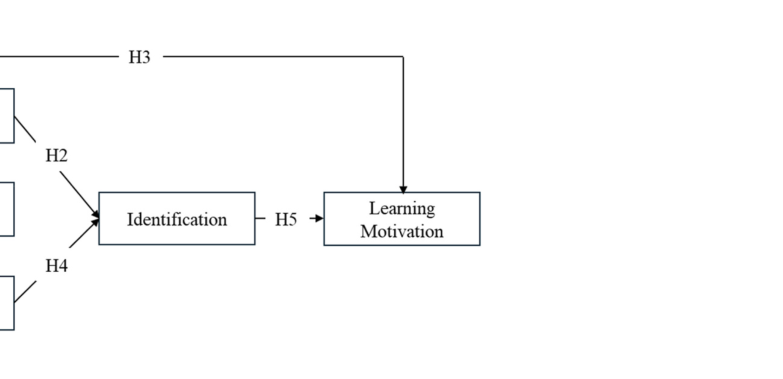
Figure 2 places the variables of interest in one model: appearance attractiveness, similarity, trustworthiness, identity, and learning motivation. The model sets the paper's tone: appearance is not the endpoint; it is a door into learners' psychological judgments.
Why the authors used a four-phase design
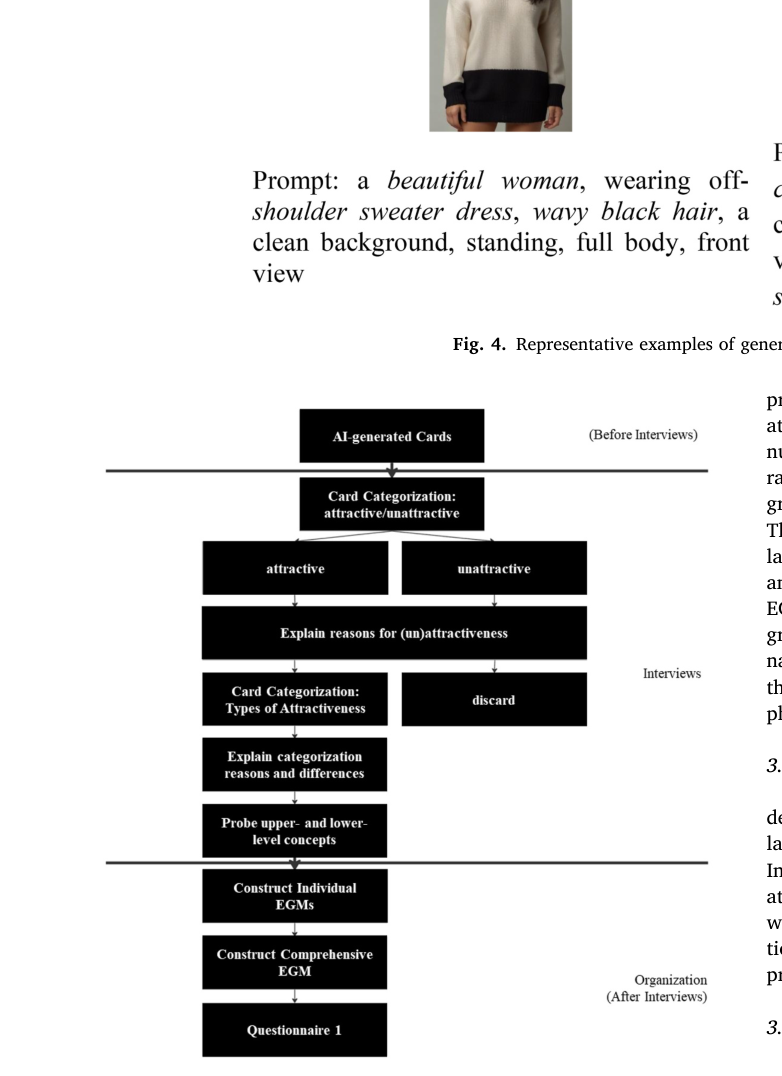
The method has four steps. First, Leonardo AI generated 50 pedagogical-agent stimuli covering realism, Japanese anime style, Pixar style, non-human characters, varied sociodemographic features, and other appearance changes. Second, EGM interviews asked learners to classify, explain, ladder up to abstract values, and ladder down to concrete features.
Third, questionnaires selected representative "high attraction" and "low attraction" agents from the 50 images. Fourth, a larger sample evaluated those two agents on similarity, trustworthiness, identity, and learning motivation.
Figure 3 shows the full research flow. The point is not complexity for its own sake; it chains "generate stimuli," "interview dimensions," "survey-validate dimensions," and "model-test relations" into one evidence path. That reduces a common flaw: testing a few pretty avatars and then reading results as universal design principles.
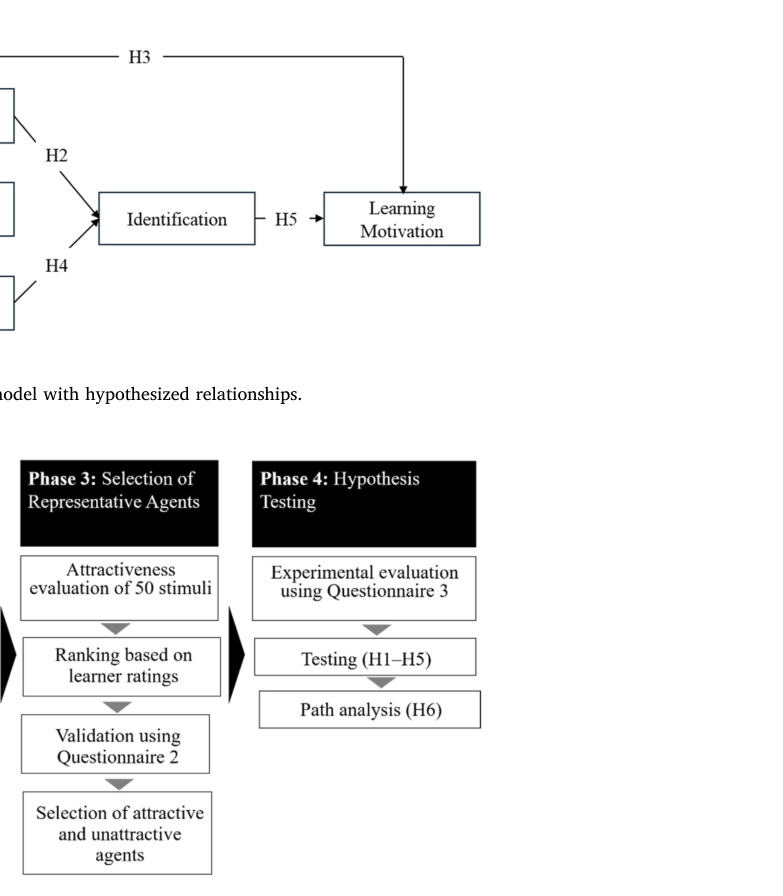
Figure 4 shows part of the generated stimuli. It reminds us that a "pedagogical agent" here is not only a teacher headshot, but a whole design space: real people, anthropomorphic animals, anime characters, and 3D animated characters can all be read by students as different kinds of virtual teachers.
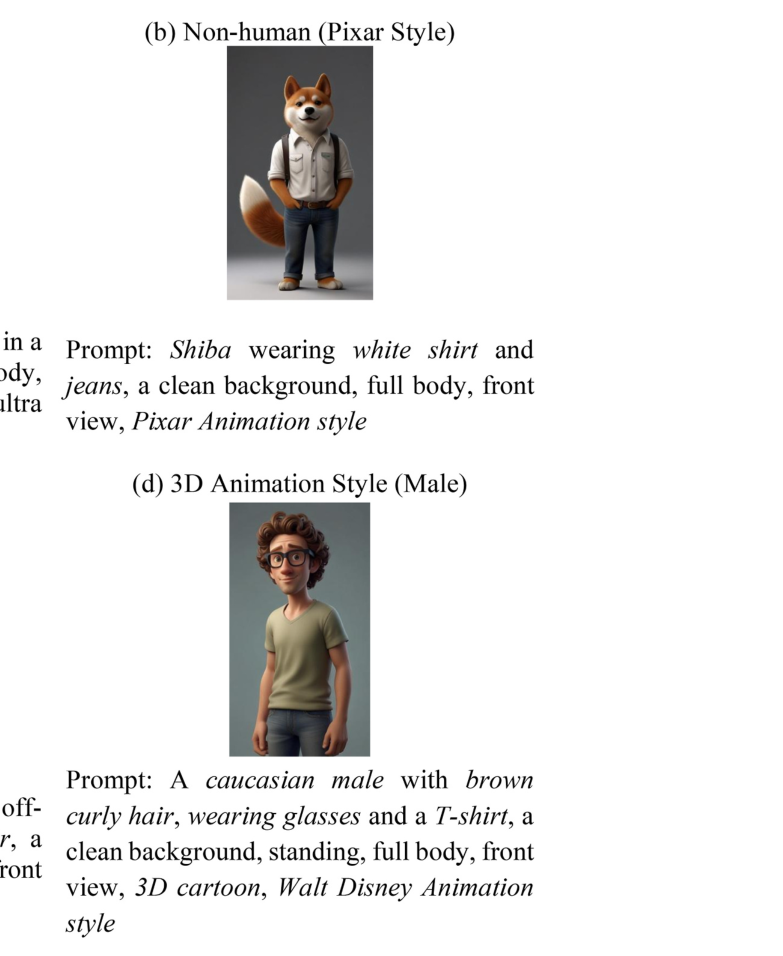
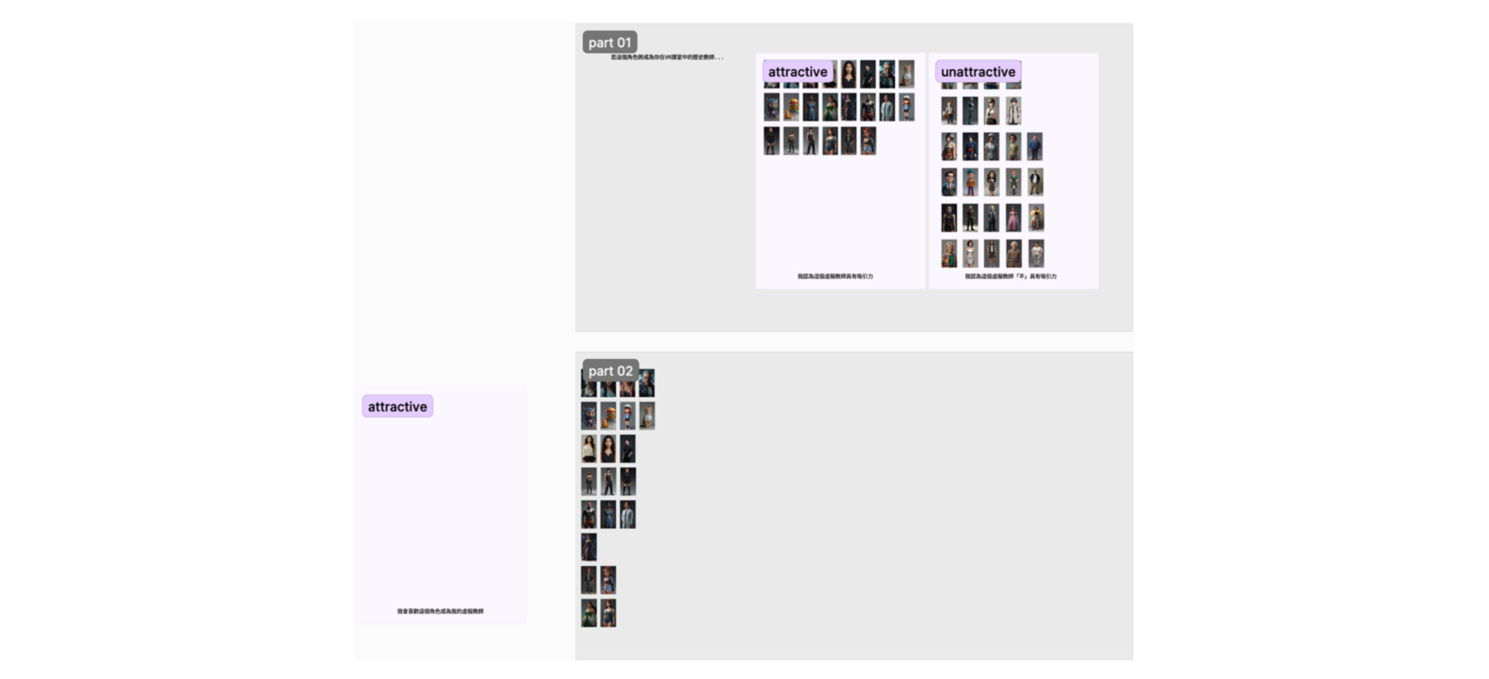
Figure 5 further unpacks Phase 2: learners first sort cards, then explain groupings, and researchers use laddering to probe more abstract feelings and more concrete design features. The paper does not treat "attraction" as a ready-made label; it pursues the structure behind it.
What students mean by "attractive"
The EGM interviews included 8 highly engaged learners, about 60 minutes each. From the interviews, the authors extracted 64 upper-level abstract concepts and, via the KJ method, grouped them into five categories: sense of authority, likability, immersion, vividness, and personalization.
There were four middle-layer dimensions: appearance form, personality and demeanor, style and attire, and design style. At the bottom, 79 concrete features were extracted and further reduced to 29 items. The most mentioned was "realistic features," followed by "match to situation and role," "distant demeanor," "personally styled clothing," "professionally formal attire," and others.
Students were not simply preferring a "pretty face." They were judging at once: does this character look like a teacher? Do clothing and course context fit? Is it professional, approachable, focused? Does its style draw people in, or distract them?
The interactive sorting tool in Figure 6 shows how EGM worked in practice: learners did not fill an abstract scale; they dragged, grouped, and explained image cards. Attraction stopped being a black-box score and could be traced back to concrete design cues.
Key result: looking good raises trust and motivation, but does not automatically create identification
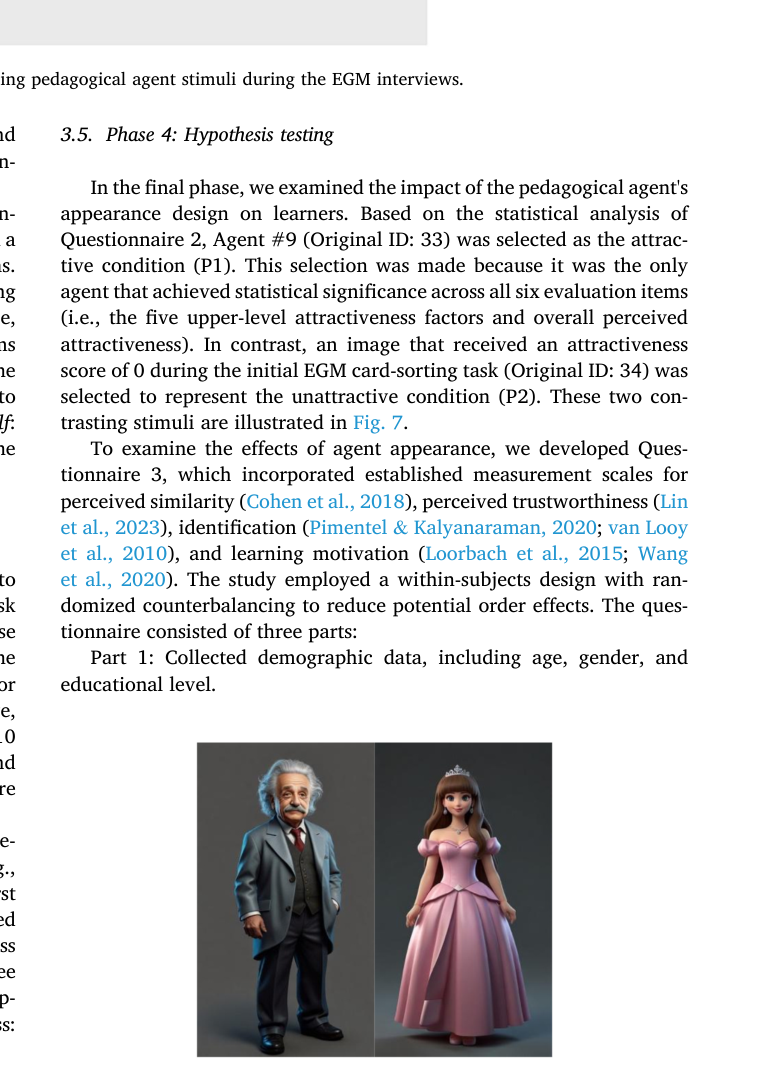
The final survey collected data from 243 participants and retained 229 valid responses after removing invalid ones. Participants evaluated a high-attraction agent P1 and a low-attraction agent P2. Figure 7 shows the two experimental stimuli.
Results are clear: the high-attraction agent scored significantly higher on trustworthiness than the low-attraction agent. Across the full sample, mean trustworthiness was 3.47 for P1 and 3.28 for P2. Learning motivation was similar: 3.44 for P1 and 3.22 for P2, also significantly higher.
But one boundary is crucial: high attraction did not significantly raise identity. Full-sample identity means were 2.83 for P1 and 2.80 for P2 — not significant. Students may find an AI teacher more trustworthy and be more willing to learn from it without projecting themselves into it or forming a deeper psychological bond.
That result is more valuable than "make AI teachers look good." It tells designers: appearance can open a trust doorway, but identification may need interaction, narrative, long-term contact, role relations, and situational feedback. A static avatar at most solves the first-glance problem.
Similarity is the deeper channel
The paper further ran mediation analysis. The tested path was: perceived similarity → trustworthiness → identity → learning motivation. Results show this sequential mediation path held in the full sample. For high-attraction agent P1, the sequential indirect effect was b = .05, 95% CI [.02, .08]; for low-attraction agent P2, b = .07, 95% CI [.03, .11].
In other words, making students feel "this agent is somehow about me" may first raise trust in the agent, then help form identification, and finally relate to higher learning motivation.
Still, this should not be overread. The paper measures perceived learning motivation, not long-term real academic outcomes; materials are static 2D images, not a full AI tutor that speaks, gives feedback, and accompanies learning. The path better describes "what may happen at the first-impression stage" than proves that a given avatar design will raise learning outcomes.
Three reminders for designers
First, AI teacher appearance should serve course context. A repeatedly high-frequency feature in the study is "match to situation and role." History, language, vocational training, and gamified learning may demand very different clothing, age, demeanor, and art style. One unified template rarely fits every scene.
Second, professionalism and approachability need to appear together. Learners preferred confident expression, focused gaze, and formal or appropriate attire — and also gentle expression, humor, and vivid temperament. A good pedagogical agent is neither cold authority nor a cute-only character; it conveys both "I know" and "I am willing to help you."
Third, do not mistake stylization for a universal fix. Anime, cartoon, 3D, and cute styles can all raise attraction, but the paper also shows that overly niche or context-detached styles need not significantly beat neutral levels. Style itself is not the answer; match among style, learning task, cultural experience, and role expectation is.
Evidence strength: solid, with hard boundaries
The paper's strength is mixed methods. It did not stop at one survey: EGM built dimensions, an N = 71 survey validated attraction factors, an N = 70 survey selected representative images, and an N = 229 valid sample tested hypotheses and the mediation model. Scale internal consistency was also high, with Cronbach's α above .70 for each variable.
Boundaries are equally clear. First, the study relies on static 2D images and cannot cover dynamic social cues such as voice, expression change, gaze synchrony, or motion feedback. Second, the sample mainly comes from East Asian learners; aesthetic preference may carry regional features of ACG culture and professional portrait aesthetics. Third, the study looks at pre-interaction evaluation, not long-term learning performance in real classrooms.
So the most cautious conclusion is: appearance of GenAI-generated pedagogical agents can shape learners' judgments of trustworthiness and learning motivation before learning begins; but appearance attraction is not enough to automatically build identity, and cannot be read directly as improved learning outcomes.
What it really changes is how prompts are written
Used in practice, the paper's most direct value is not copying one "most attractive" character image, but changing how prompts are written. When designing AI teachers, a prompt should not only say "beautiful teacher, high quality, friendly"; it should jointly specify role, course context, learners' cultural experience, professionalism, approachability, and similarity.
For example, to raise authority, consider "confident demeanor," "focused gaze," "professional attire"; to raise approachability, "gentle expression," "approachable style"; to raise situational match, make course type and teaching scene explicit. What matters is not generating the prettiest character, but one that "looks like it belongs here" in this learning relationship.
That is also an underestimated part of GenAI design: it does not only lower art cost; it lets researchers and designers systematically explore which visual social cues trigger which learner judgments. As AI teachers enter learning interfaces more often, those questions will matter more than whether an avatar looks good.
Key terms
Algorithmic attraction: Comprehensive attractiveness elicited by GenAI-generated appearance, including realism, role fit, style, approachability, professionalism, and related cues.
CASA paradigm: Computers Are Social Actors — people respond to computers or digital interfaces as social actors, assigning trust, politeness, role expectations, and similar social judgments.
EGM: Evaluation Grid Method, an interview analysis approach that decomposes user preference into abstract values, evaluative impressions, and concrete design features.
References
Hsu, F.-S., Pai, W.-T., & Tsai, I.-C. (2026). Perceived algorithmic attraction in GenAI-generated pedagogical agents: Dimensions and effects on learner trust and motivation. Computers in Human Behavior, 184, 109079. https://doi.org/10.1016/j.chb.2026.109079