CSCW 2025 | AI in VR Feels More Human — Training Gains May Still Not Beat Text
This CSCW Companion 2025 poster compares text-only and VR-embodied AI, testing the value of nonverbal cues in conflict-mediation training.

It is easy to assume that if AI is meant to train interpersonal skills, text alone cannot be enough. In real conflict, the other person's expression, posture, tone, and pauses often cut deeper than the words themselves — and shape how we respond.
So putting conversational AI into VR, giving it a body, expression, and voice, seems naturally better suited to interpersonal skills training.
What makes this CSCW Companion 2025 poster interesting is that it does not stop at that intuition. The authors compare text-only AI and VR-embodied AI in conflict-mediation training, and the result does not fully follow intuition: participants clearly preferred VR-embodied AI, but learning gains did not significantly exceed the text interface.
📌 Paper information
Original title: Comparing Text-Only and Virtual Reality-Embodied Conversational AI Agents for Interpersonal Skills Training
Authors and affiliations: Yejoon Yoo, Yilu Sun, Omar Shaikh, Andrea Stevenson Won. Authors are affiliated with Cornell University and Stanford University.
Venue: CSCW Companion 2025, Bergen, Norway.
Paper link: https://doi.org/10.1145/3715070.3749224
The real question: what, exactly, does AI's body help with?
Over the past year, LLMs have been widely used in education and training. They can simulate students, patients, clients, and negotiation counterparts, and provide immediate feedback. For soft skills such as conflict mediation, AI's largest advantages are safety, repeatability, and low embarrassment: you can practice responding to a dissatisfied person again and again without actually damaging a relationship.
But conflict mediation is not a pure-text task. Crossed arms, a frown, or a colder tone can immediately change strategy. With text alone, trainees practice verbal tactics; in VR, they also face pressure, interpersonal distance, the other's expression, and their own bodily reactions.
So the authors' question is direct: does VR-embodied conversational AI promote cooperative conflict-mediation strategies more than text AI? And which do participants prefer?
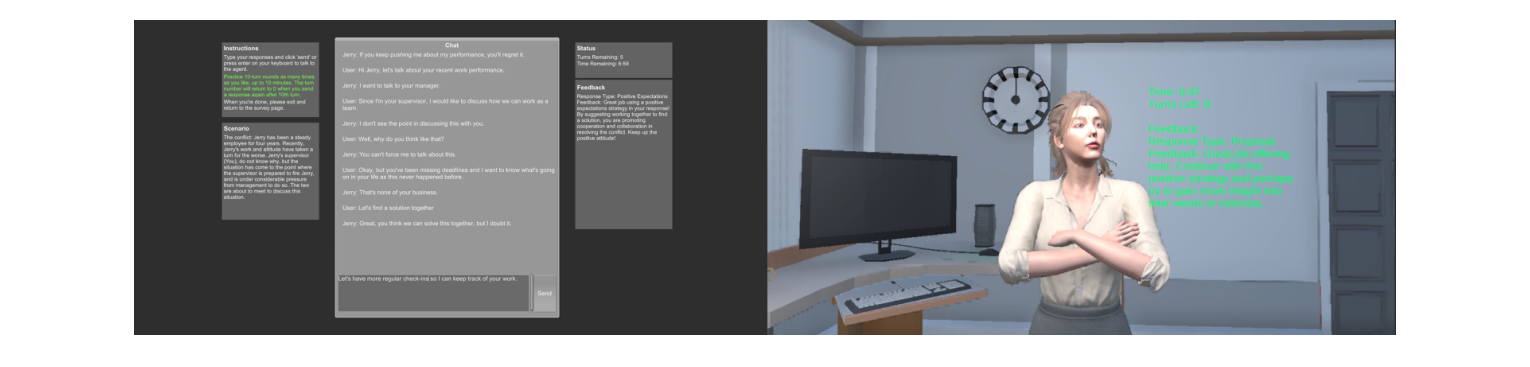
How the experiment worked: the same GPT-4, different dialogue media
The study recruited 29 participants; 5 were excluded for technical issues, leaving a final sample of 24 (8 men, 16 women). It used a between-subjects design with 12 participants per condition.
Both groups used GPT-4 to generate dialogue and assessed participant strategies with the IRP conflict resolution framework. IRP roughly distinguishes cooperative, neutral, and competitive conflict responses. The test score was the number of cooperative conflict resolution strategies used across 10 dialogue turns.
In the VR-embodied condition, participants wore an Oculus Quest 2 and talked with an embodied AI avatar in a Unity 3D environment. The system used OpenAI speech-to-text for participant speech, GPT-4 for replies, and Nova voice for text-to-speech. The avatar also expressed state through smiling, neutral expression, frowning, open arms, crossed arms, and related actions.
The text-only condition ran the same conflict simulation on a laptop through a text interface. Participants typed responses, saw dialogue history, and received tailored feedback in the practice round.
Training flow: pretest, learn, retest, then swap experience
Each participant completed four role-playing simulation rounds. Round one was the first test: up to 10 minutes for 10 dialogue turns, measuring initial conflict-mediation performance.
Participants then watched an IRP framework teaching video and, in a practice round, received AI-generated strategy feedback. A final test again measured cooperative strategy use across 10 turns. An experience round let participants try the other condition, to compare subjective experience of text-only versus VR-embodied.
The design's point is not whether AI can chat, but whether trainees use cooperative strategies more after training, and which interface they prefer for learning.
Result 1: the VR group started higher, but gains were not significant
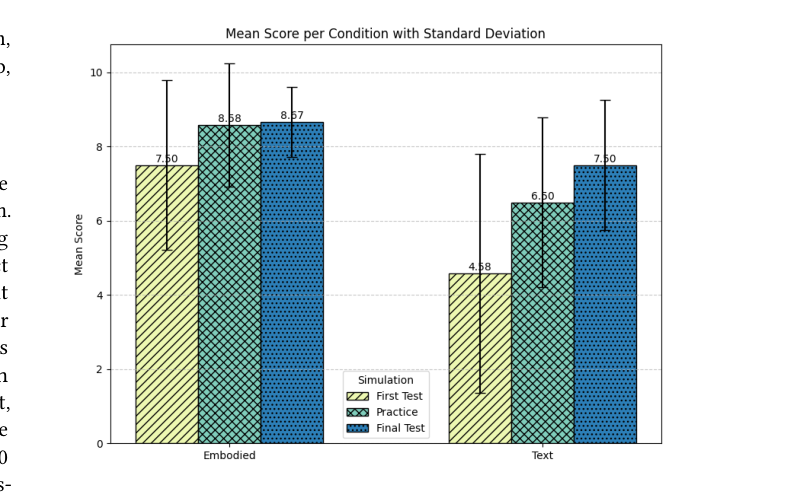
On the first test, the VR-embodied group averaged 7.50 and the text-only group 4.58. In other words, the VR group already used more cooperative strategies at the start.
After practice and feedback, the VR group rose to 8.58 on round two and 8.67 on the final test; the text-only group rose to 6.50 then 7.50. Paired t-tests showed that VR change from first test to final test was not significant, p = 0.1159; text-only improvement was significant, p = 0.0111.
As Figure 2 shows, this is not a simple "VR is better" story. The VR group stayed higher throughout, but had less room to improve; the text group started lower and clearly caught up after training.
Result 2: participants preferred VR, but questionnaire differences were not significant
On subjective preference, 21 of 24 participants preferred the VR-embodied condition; only 3 preferred text-only. That is a strong preference signal.
Reasons for liking VR also match intuition: body language and facial expression made AI feel more like a real person; voice replies affected their own tone and next-step strategy; some felt the dialogue was more engaging.
On standard questionnaires, though, the two groups showed no significant differences on several items — including whether AI was easy to understand, responsive in time, behaved as if responding to them, felt like working with another person, maintained harmony with the AI, and whether the tool was useful.
The tension is clear: users say they prefer an embodied agent, but preference does not automatically become measured learning advantage.
Embodiment is not pure gain — it also adds new friction
Qualitative feedback reveals several kinds of friction in the VR condition.
First, latency. The VR system needs speech-to-text, GPT-4 generation, text-to-speech, audio playback, and lip-sync. The authors added filler sounds such as "umm," "uhh," and "I mean" to ease waiting, but participants still mentioned slow replies, repetition, and the pressure of speaking out loud.
Second, insufficient bodily naturalness. Participants wore a headset, held controllers, and pressed a microphone to interact. They mostly stayed still in space, with only slight arm movement. In behavioral data, only the right-hand controller's y-axis changed significantly between first and final test, p = 0.0428 — possibly more open, relaxed posture — but overall bodily participation remained limited.
Third, uncanny issues. Some participants found avatar expressions limited, delayed, even creepy. Effects of facial expression on participants' own expressions were unstable; some liked them, some found them hard to read, and some showed little reaction because the headset blocked expression.
Judgments most worth taking from this poster
First, embodied AI's advantage may show first in experience, not short-term scores. Participants clearly preferred VR, suggesting embodiment can raise attractiveness, presence, and the feel of real interpersonal interaction. In this small-sample pilot, though, it has not yet proven stronger learning gains.
Second, text-only is not necessarily weak. Though it lacks nonverbal cues, text may reduce cognitive load and let participants focus on strategy itself. For beginners, practicing IRP strategies in text first, then entering VR to handle nonverbal pressure, may be more stable than starting in high immersion.
Third, VR training bottlenecks are not only model capability. Latency, microphone operation, headset burden, avatar expression naturalness, and gesture tracking all affect whether training feels like real conflict. However well an LLM chats, unnatural embodiment can interrupt social presence.
Evidence strength: an illuminating pilot, not a final conclusion
This work is a poster with a sample of only 24 people, 12 per group. Findings are good for direction, not for claiming that "VR-embodied AI already beats text AI."
More importantly, the VR group scored higher on round one, while the text-only group started lower, which affects later headroom. The VR group's final score was still slightly higher, but change was not significant; text-only improved significantly, possibly in part from the low baseline.
The authors also note the need for larger, more diverse samples and more behavioral metrics — time-to-next-turn across conditions, response edits on the text interface, and richer VR behavioral data.
Implications for future AI training products
I find the poster's product reminder practical: do not equate immersion with training effectiveness.
VR fits what text struggles to carry — facing pressure, reading nonverbal cues, managing one's own tone and posture. But if latency is obvious, character expression unnatural, or interaction flow interrupts conversation, it also adds burden.
A more reasonable path may be staged training: use text-only first so users understand strategy and get feedback, then use embodied VR to practice expression, pressure regulation, and nonverbal response closer to real conflict. Text and VR then are not substitutes; they serve different stages.
Key terms
🧍 Embodied AI Agent: An AI agent that does not only speak through text, but participates through avatar, voice, expression, posture, and related channels.
🥽 VR-Embodied Condition: Participants wear a headset and use voice to run conflict simulation with an AI avatar in a virtual environment.
⌨️ Text-Only Condition: Participants type responses and view dialogue and feedback through a text interface.
⚖️ IRP Framework: Interests-Rights-Power framework for analyzing whether conflict responses are cooperative, neutral, or competitive.
References
Yoo, Y., Sun, Y., Shaikh, O., & Won, A. S. 2025. Comparing Text-Only and Virtual Reality-Embodied Conversational AI Agents for Interpersonal Skills Training. In Companion Publication of the 2025 Conference on Computer-Supported Cooperative Work and Social Computing. ACM. https://doi.org/10.1145/3715070.3749224