When AI Answers Too Fast, It Can Seem Careless
A CHI 2026 experiment shows that LLM latency barely changes how users operate the model, yet it changes whether they judge answers as thoughtful.
📌 Original paper title
The Impact of Response Latency and Task Type on Human-LLM Interaction and Perception
👥 Authors and affiliations
Felicia Fang-Yi Tan, Moritz Alexander Messerschmidt, Wen Yin, and Oded Nov. The authors are affiliated with NYU Tandon School of Engineering and the Augmented Human Lab at the National University of Singapore.
🔗 Paper link
https://doi.org/10.1145/3772318.3790716
🧠 What this paper really asks
We usually assume that faster AI is better. Chatbots, writing assistants, and search tools all chase shorter response times. But an LLM is not like traditional software: it is not opening a file or submitting a form; it is generating an unpredictable answer. Waiting time is therefore not only a performance metric. It also becomes a cue users use to judge whether the AI is careful, reliable, and whether it has “thought.”
This CHI 2026 paper systematically studies a counterintuitive question: If an LLM answers a little more slowly, will users think the answer is better? The authors further distinguish task types, because Creation tasks such as writing slogans or brainstorming, and Advice tasks such as giving recommendations or weighing trade-offs, may carry different expectations for speed and quality.
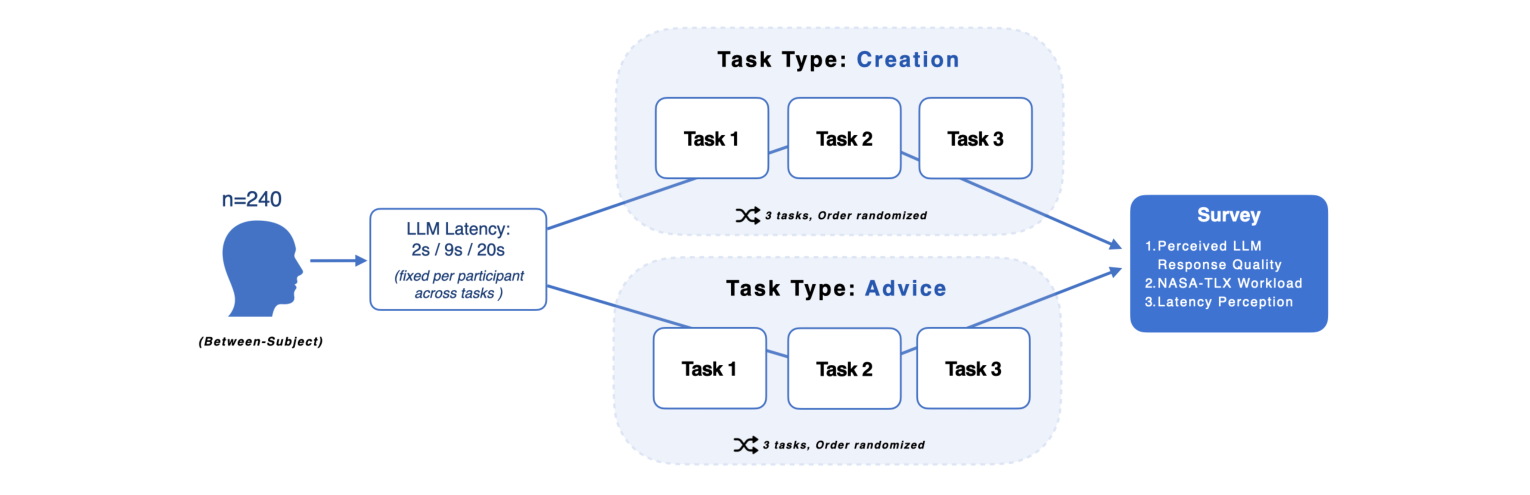
As shown in Figure 1, the study used a 2 × 3 between-subjects design: task type was Creation or Advice; time-to-first-token latency was 2 s, 9 s, or 20 s. Each participant completed three tasks of the same type and stayed in a single latency condition throughout.
🔬 How the experiment was run
The study recruited 240 U.S. Prolific participants who regularly used AI assistants for knowledge work such as writing or decision-making. Creation tasks included generating slogans, designing activities for distracted high-school students, and completing article paragraphs. Advice tasks included advising a remote-work colleague, analyzing the trade-off between a promotion and a job switch, and rewriting an email reply about a friend’s career transition.
What the authors manipulated was time-to-first-token: the wait between submitting a prompt and the first token appearing. Two seconds represented a short wait, nine seconds a medium wait, and twenty seconds a long wait. After the first token, all conditions streamed at the same speed, so first-token latency was not confounded with output rate.
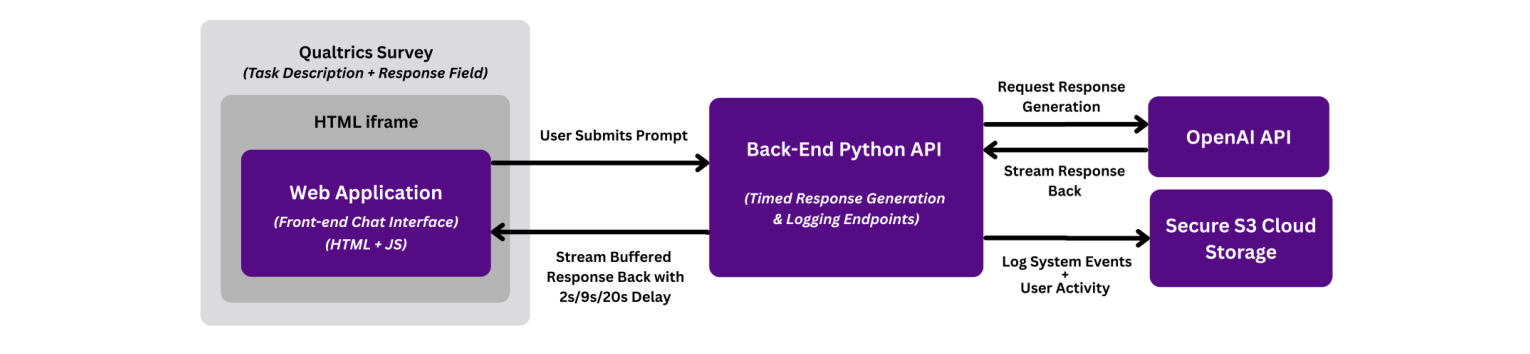
Figure 2 shows the system architecture. A custom web chat app was embedded in a Qualtrics survey. The front end showed a ChatGPT-like interface; a Python back end called the OpenAI API, buffered model output to enforce the assigned latency, and wrote anonymized interaction logs to secure storage.
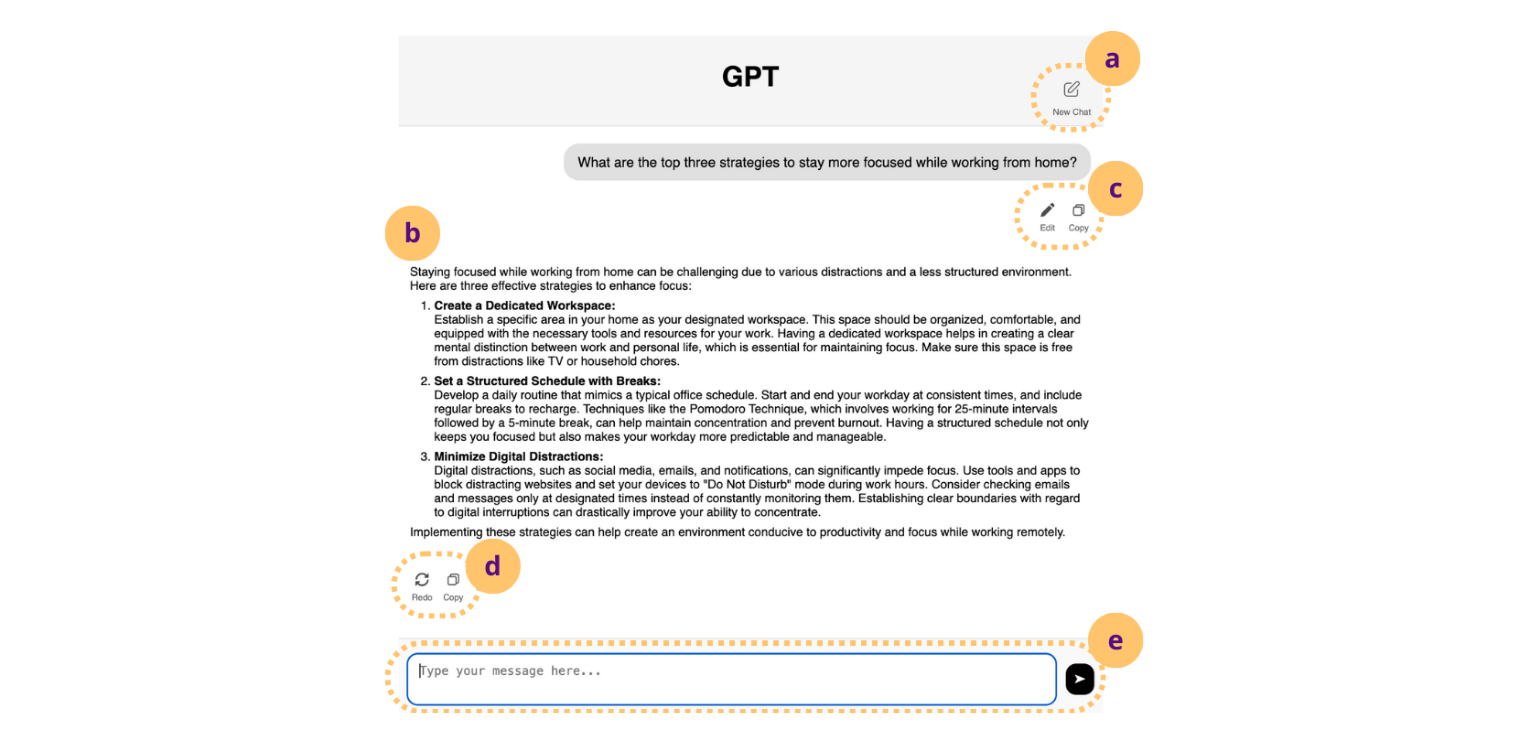
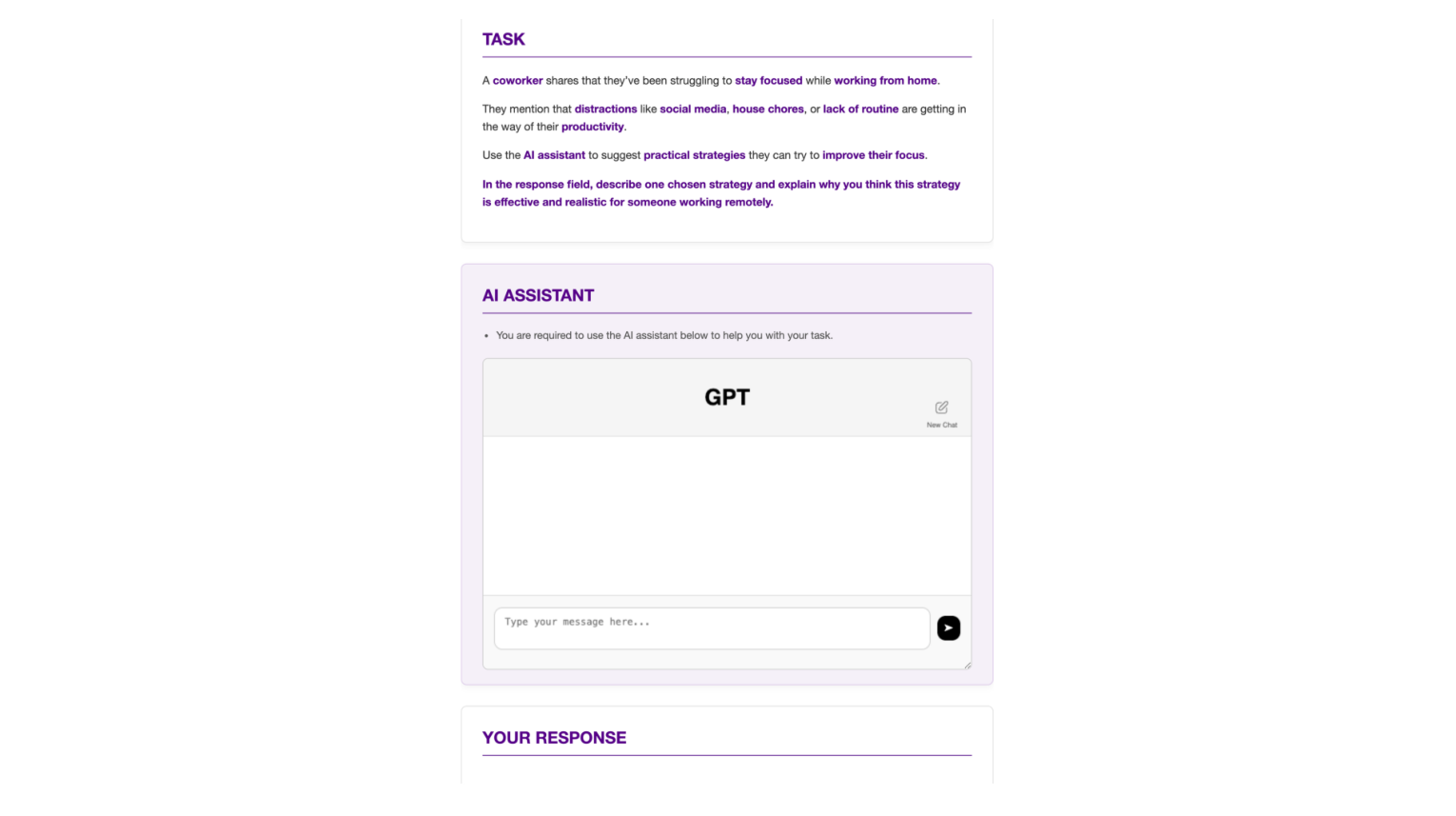
Figures 3 and 4 show the chat and task interfaces participants saw. The interface allowed submitting new prompts, editing the previous prompt, copying replies, regenerating, and starting a new chat. The task description sat at the top, the chat in the middle, and the final-answer field at the bottom. The authors logged prompt submissions, edits, regenerations, copy, paste, and new-chat actions.
📊 Key findings
First, latency did not significantly change how users operated the LLM. Whether they waited 2, 9, or 20 seconds, patterns of submitting prompts, copying, pasting, and opening new chats stayed broadly stable. Editing prompts and regenerating were rare: only about 5.4% of participants ever edited a prompt, and 6.7% regenerated a reply.
In this experimental setting, waiting itself did not clearly change interaction strategy. Even a 20-second wait—already long—still left most people advancing with new prompts rather than cutting queries or leaning heavily on edit features.
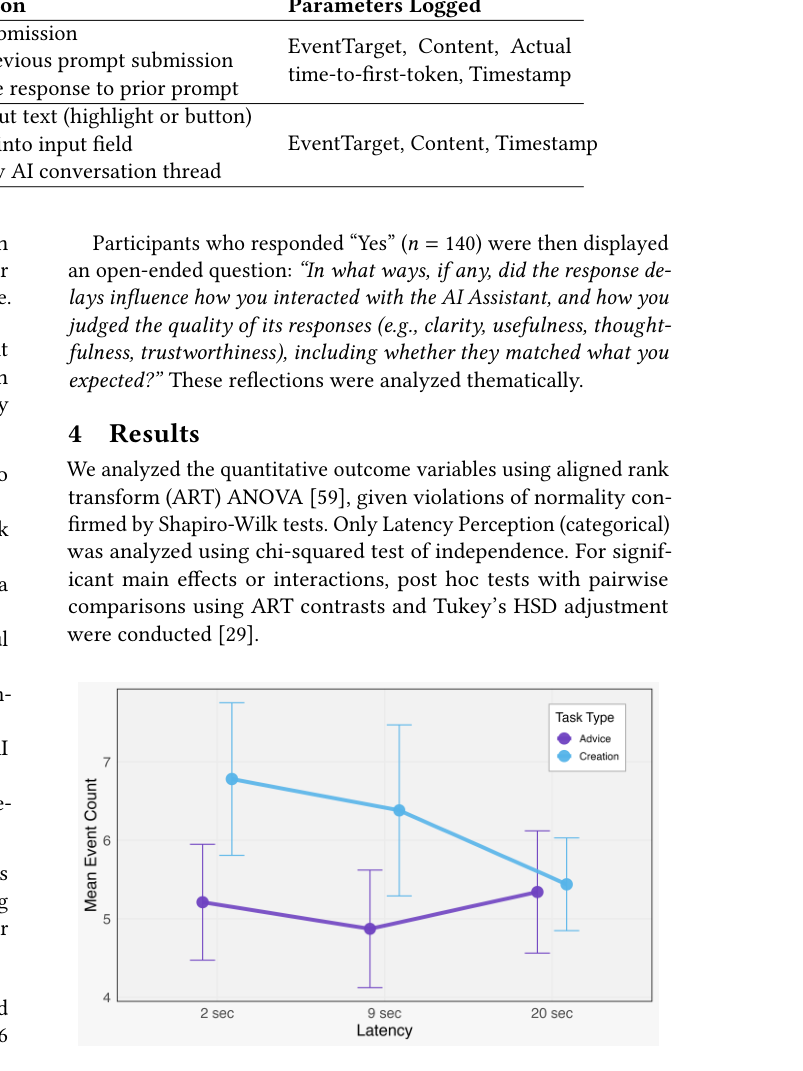
Second, what really changed prompt count was task type. Creation participants submitted 6.20 new prompts on average; Advice participants submitted 5.14—a significant difference. Figure 5 shows the result: creative tasks more readily invite multi-turn exploration, because each round can yield new ideas; advice tasks behave more like convergent judgment, so once an answer is “good enough,” further prompting has diminishing marginal value.
Third, latency changed perceived answer quality. Answers under a 2-second delay were rated less “thoughtful” than those under 9- and 20-second delays. Usefulness was also higher at 9 seconds than at 2. In other words, the same GPT-4o-generated answers were more readily judged as less carefully considered simply because they appeared too quickly.
Fourth, 9 seconds seemed to be a perceptual sweet spot. Nine seconds was more readily read as “serious processing” than 2 seconds, but 20 seconds did not further raise thoughtfulness and began to make some people worry about system reliability. In qualitative feedback, about 31% of participants who noticed the delay interpreted waiting as the AI thinking or processing; under longer waits, others suspected a network drop, a stuck system, or simply felt annoyed.
🧩 Why “a little slower” can seem better
Users assign meaning to LLM waiting time. When traditional software is slow, that means poor performance; when conversational AI is slow, it is sometimes understood as “it is thinking.” The interpretation resembles pauses in human conversation: an immediate answer can sound unconsidered, while a few seconds of pause can sound like deliberation.
The paper links this to the effort heuristic: people infer quality from visible effort. Because users cannot see the model’s internal reasoning, latency becomes a visible cue. The problem is that the cue need not be true. In the experiment, the underlying model was the same across latency conditions; wait times were artificially controlled.
That is also where the paper’s ethical implication is sharpest. Latency can serve as positive friction—slowing users down and inviting reflection—but it can also become performative deliberation: the appearance of careful thought. If a product deliberately slows the AI without explaining why, users may misread “slow” as “more thoughtful.”
✅ How strong is the evidence
Experimental control in this paper is relatively clear. The authors crossed task type and first-token latency into six conditions, with N = 240, used a custom system to control TTFT precisely, and collected interaction logs, subjective quality ratings, NASA-TLX workload, and open responses. Because the data violated normality, they used aligned-rank-transform ANOVA with post-hoc comparisons for significant results.
The results are also measured. Latency affected perceived thoughtfulness and usefulness, not every quality dimension. Clarity, relevance, understanding, and usefulness were more often driven by task type; trust and expectation gap did not change significantly; NASA-TLX dimensions likewise showed no significant differences. Latency mainly shaped how users interpreted answers, rather than directly changing task load.
⚠️ Where the limits are
First, the study manipulated only first-token latency, not overall generation time, token rate, latency jitter, or output length. In real products, these factors jointly shape waiting experience.
Second, the tasks were low-stakes knowledge tasks in a controlled experiment. Participants had no real work deadlines and did not bear consequences for outcomes. In medical, financial, safety, or team-collaboration settings, a 20-second wait may be unacceptable.
Third, the interface used silent waiting with no “analyzing” or reasoning-process display. Real products often show progress cues, thinking labels, or reasoning-mode traces, all of which change how users interpret delay.
Fourth, participants were U.S. adults who used AI assistants at least monthly. People with different cultures, digital experience, or AI familiarity may tolerate and interpret waiting differently.
🚦 Implications for LLM product design
This paper is not a brief for making every product deliberately slower. What it actually reminds us is that speed is not neutral. Response time helps shape users’ mental models of AI.
For creative tasks, a moderate pause may have value. It can create a little expectation, and can be paired with a light prompt asking users to consider what they want the answer to include. For advice or high-stakes tasks, long waits more easily become reliability concerns—especially when users expect clear, quick judgment.
A better approach is not fixed delay but task-aware response rhythm. Systems can adjust tempo by task type, risk level, whether users need reflection, and whether they are collaborating synchronously. More importantly, if a product deliberately designs waiting, it should explain transparently—whether the wait is for reflection, queuing, model computation, or something else.
⚖️ Ethical note
Latency design can cross a line. Users cannot see inside the model, so products can use time to imply capability. A little slowness may make novices trust answers more—even over-trust them—while experts may be less swayed by that signal. That yields uneven trust calibration.
If delay comes from real computation, little explanation may be needed. If delay is engineered to shape perception, users should get control or an explanation. Otherwise response speed risks turning from interaction design into a form of covert persuasion.
📚 Key terms
⏱️ TTFT: time-to-first-token—the interval from prompt submission to the first token. This paper manipulates that delay.
🧠 Positive friction: small, intentional resistance that slows users down, invites reflection, or reduces over-automation.
💬 Creation tasks: open generative work such as writing, brainstorming, or slogan generation, usually encouraging multi-turn exploration.
🧭 Advice tasks: recommendation and evaluation work such as revision feedback, trade-off analysis, or decision support, with stronger emphasis on accuracy and reliability.
🎭 Performative deliberation: using delay or cues to manufacture a sense of careful thinking that may not correspond to real reasoning depth.
📖 Reference
Tan, F. F.-Y., Messerschmidt, M. A., Yin, W., & Nov, O. (2026). The impact of response latency and task type on human-LLM interaction and perception. In Proceedings of the 2026 CHI Conference on Human Factors in Computing Systems. ACM. https://doi.org/10.1145/3772318.3790716